wsp
Health Warn
- License — License: AGPL-3.0
- Description — Repository has a description
- Active repo — Last push 0 days ago
- Low visibility — Only 5 GitHub stars
Code Pass
- Code scan — Scanned 12 files during light audit, no dangerous patterns found
Permissions Pass
- Permissions — No dangerous permissions requested
No AI report is available for this listing yet.
Your setup, on cloud machines, for coding agents. Fork your own dev machine in seconds and let Claude Code and Codex work on it.
wsp
Your setup, on cloud machines, for coding agents.
The site is wspx.vercel.app. The docs are wsp.apidocumentation.com.
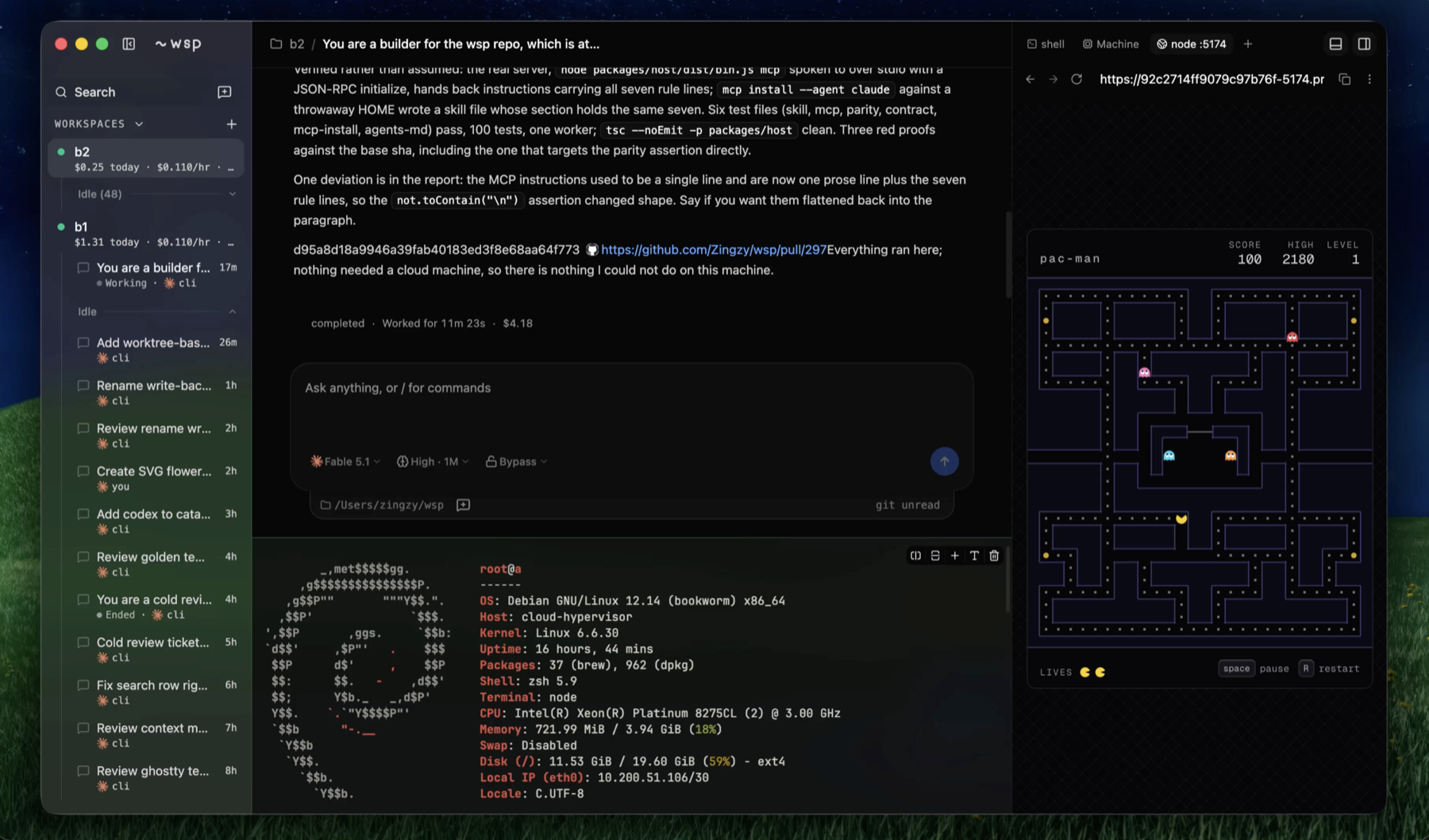
wsp reads your computer once, builds a machine that has what it has (your agents, your tools, your sign-ins), and forks workspaces from it in about twenty seconds. Coding agents work inside those workspaces as threads. You read and answer them from the app, the command line, or another agent over MCP.
What it does
- One image of your machine. The agents you use, the tools they run, your logins, sealed once into a golden image on the machine provider. Rebuild it when your setup changes.
- Forks in seconds. Every workspace is a fork of that image, with your setup already there. Forks are live clones: what was running on the source is running on the fork.
- Agents as threads. Claude Code and Codex run headless on the machine. Start a thread with a task, read its reply, send the next message, stop it. Threads get real titles and you can rename them, in wsp and in the agent's own session list.
- Agents starting agents. An agent on your computer drives wsp over MCP: it forks a workspace, opens a Claude Code thread there, starts a Codex thread beside it, reads both back. Everything it does shows in your sidebar.
- The machine, in the app. A terminal that uses your Ghostty config, the ports it listens on as browser tabs, its processes, its files, its cost and state.
- Naps and wakes. An idle workspace naps with its RAM intact and wakes on the next message. A machine the provider loses is rebuilt from the image with your files back.
- Your keys never leave a machine you own. wsp runs on your own computer, or on a box you own, and talks to the provider with your key. There is no hosted service in between.
Before you start
- Node 22 or newer, on macOS or Linux.
- A Solari account and API key. Solari provides the machines; they cost money while they run and nap on their own when idle.
- A way for Claude Code to sign in: an Anthropic API key, or a Claude subscription you log in with on the machine during the first run. Codex signs in the same way.
Install
npm i -g @zingzy/wsp
Let your agent set it up
Give your agent the wsp tools, then ask it to set you up:
wsp mcp install --agent claude # or codex, gemini, opencode
Then, in that agent: "set up wsp for me". It reads what you use on this computer, writes the recipe, asks you about the heavy rows, builds the image, and hands you each sign-in link as the build reaches it. Sign-ins finish in your browser.
Or do it yourself
wsp init
One screen at a time: the agents on this computer, their tools, what else to bring from this computer, sign-ins, wsp for your own agents, then the build; a screen with nothing to pick is skipped. Everything is ticked from what you actually use; Enter through every screen takes the defaults. Nothing leaves your disk before the confirm.
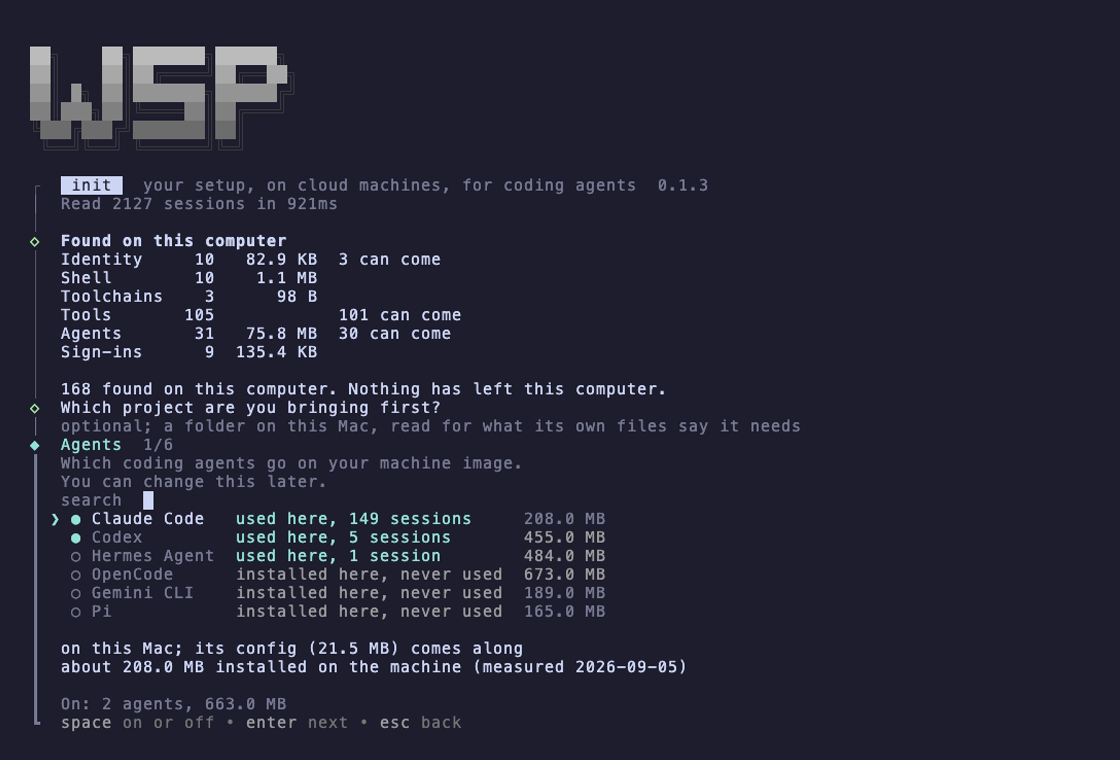
Useful flags: --yes takes every default and asks nothing. --recipe <path> builds from a recipe an agent wrote. --non-interactive --json prints one JSON line per sign-in and build stage, for an agent driving the setup. --state <path> and --port <n> keep a second setup apart from the first.
Every day
wsp new api                  # a workspace from your image
wsp import api ~/code/api    # put a folder in it
wsp run api "fix the flaky terminal test"
The first line that needs a host starts one and says so; wsp down stops it. wsp up is for a host you want to watch in a terminal, and wsp up --service keeps one up across logins. The desktop app is the same host and app in one window; bundles for macOS and Linux are on the releases page.
wsp --help is sixteen words on five nouns: image, place, workspace, thread, project. Every command is wsp <verb> <workspace> ..., the workspace first. wsp --help agent has the verbs your agents use and wsp host --help the roads to a host on another computer. The command line and the MCP tools are the same verbs; the app's palette runs them too.
Renamed in 0.3.0
The front page of wsp --help is sixteen words on five nouns: image, place, workspace, thread, project. Every command is wsp <verb> <workspace> ..., the workspace first. Nothing answers to the old words, so here they are, once.
| was | is |
|---|---|
wsp thread new --in <workspace> "<task>" |
wsp run <workspace> "<task>" |
the MCP tool thread_new |
the MCP tool run |
wsp import <folder> --to <workspace> |
wsp import <workspace> <folder> |
wsp threads --in <workspace> |
wsp threads <workspace> |
wsp new --local [name] |
wsp new <name> --on <place>, naming the computer you are at |
wsp new --ssh <user@host> |
wsp add user@host (or an alias from your ssh config), then wsp new <name> --on <that place> |
wsp init --provider <id> |
wsp add <id> |
wsp pair, wsp devices |
wsp host pair, wsp host devices |
wsp connect <url> |
wsp host connect <url> |
wsp hosts default, wsp disconnect |
wsp host default, wsp host forget |
wsp relay link, wsp relay unlink |
wsp host link, wsp host unlink |
wsp relay hosts, wsp host linked, wsp host list |
wsp hosts, one listing of both roads |
wsp relay clients, wsp host clients |
wsp login, and wsp logout <id> to sign one out |
wsp up to get going |
nothing: the first command that needs a host starts one, and wsp down stops it |
plain wsp serving |
plain wsp prints the help |
This computer and every computer or provider you add are places, and wsp places lists them; --on <place> on wsp new is the one flag you meet, and only once you have more than one. wsp add is the one way a place joins: wsp add user@host for a computer over ssh (an alias from your ~/.ssh/config works as well), wsp add <provider> for a provider, wsp add alone for the line another computer types. wsp up is still there for a host you want to watch in a terminal or one that serves beyond this computer.
Agents on this computer get the new skill the first time the new host starts; a project folder whose AGENTS.md carries the old section gets the new one at the next wsp mcp install there.
Opening a downloaded bundle
Open the macOS disk image and drag wsp onto the Applications folder it shows. One image holds both Apple silicon and Intel.
The bundles are not signed yet, so macOS refuses the first open of wsp.app. Open it once, dismiss the refusal, then in System Settings under Privacy & Security find the line saying wsp was blocked and pick Open Anyway. Or from a terminal: xattr -dr com.apple.quarantine /Applications/wsp.app. Every open after that is a double click.
The Linux AppImage needs the run bit before it starts: chmod +x wsp-*.AppImage.
What is next
Spaces: one workspace at a time in the sidebar, with its own tint. Images in threads. Pi and Gemini threads.
Building from source
git clone https://github.com/Zingzy/wsp.git && cd wsp
pnpm install && pnpm build
pnpm wsp init
pnpm test runs without any key. The laws the code follows are in CONTRIBUTING.md; how a browser reaches a workspace is in docs/reach.md; cutting a release is docs/release.md.
Issues
github.com/Zingzy/wsp/issues. Say what you ran, what you saw, and the output of wsp --version. Never paste a key.
License
AGPL-3.0-only. See LICENSE and THIRD_PARTY_NOTICES.
Reviews (0)
Sign in to leave a review.
Leave a reviewNo results found