presentation-skill
Health Pass
- License — License: MIT
- Description — Repository has a description
- Active repo — Last push 0 days ago
- Community trust — 21 GitHub stars
Code Pass
- Code scan — Scanned 12 files during light audit, no dangerous patterns found
Permissions Pass
- Permissions — No dangerous permissions requested
No AI report is available for this listing yet.
Source-first PowerPoint/PPTX skill for Codex and ChatGPT agents: editable decks, style routing, data artifacts, and QA.
presentation-skill
A skill for coding agents that produces editable PowerPoint decks from structured source files. The idea is to treat a deck like code: outline.json is the source, scripts build the .pptx, and a validation loop checks layout, density, and design-taste issues before delivery.



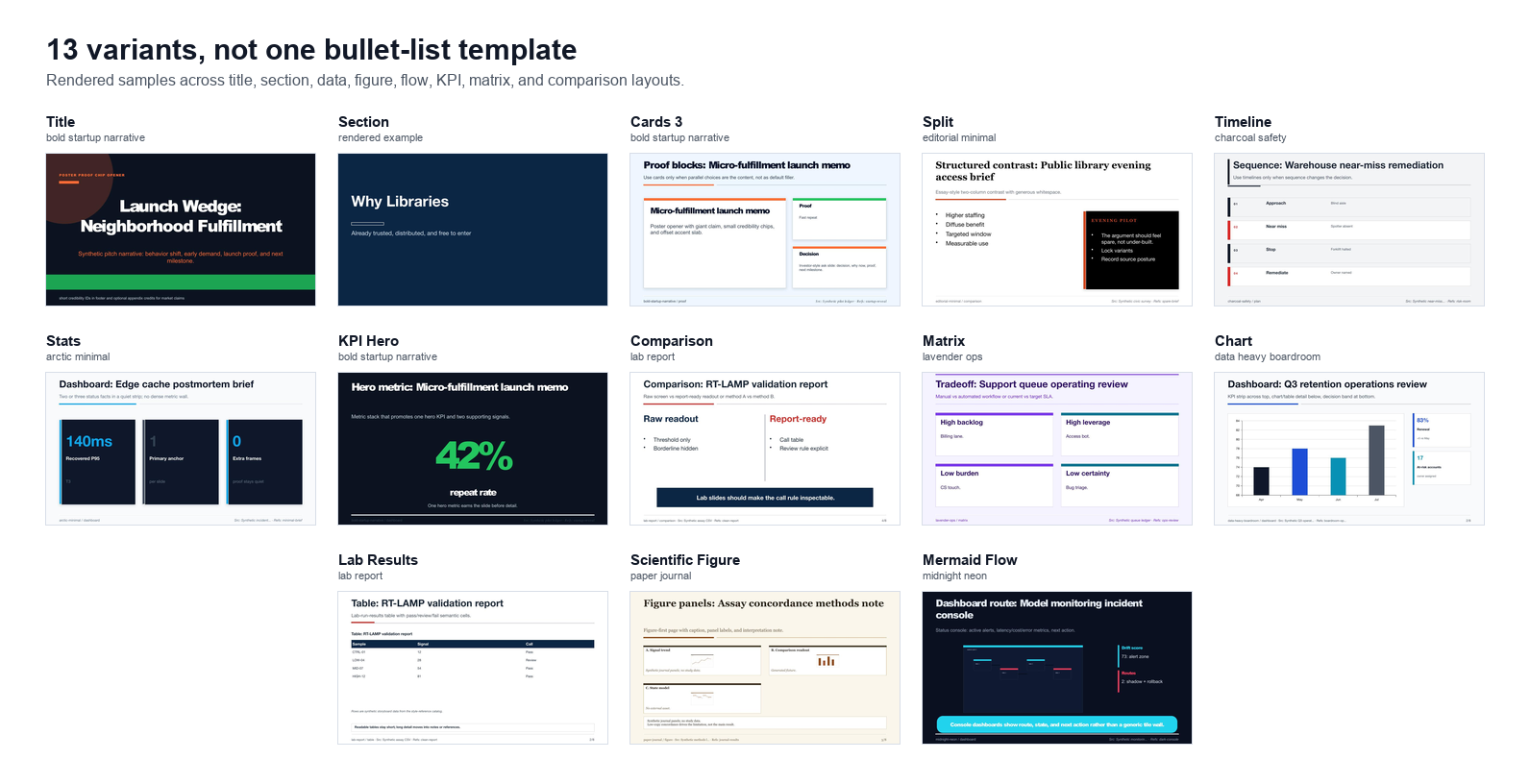
Rendered samples across the renderer variants, from title and section slides to lab tables, figures, KPI, matrix, chart, comparison, and flow layouts.
Ask an agent for a lab report, board memo, investor update, clinical dashboard, policy brief, or scientific figure deck. The skill writes source JSON, routes style and content structure, builds an editable .pptx, and runs QA instead of shipping a screenshot or a stack of centered bullets.
Why
Most agent-built slide decks pass automated checks and still look bad. Dead whitespace, centered body text, the same three-card layout used five times in a row, generic stock-icon clusters. They feel like AI output even when the words are right.
This skill encodes deck design as constraints instead of vibes. A variant grammar restricts what a slide can be. A preset system fixes palette, typography, and density per style family. A descriptor-only corpus of public deck-like records gives the agent style context to pick from instead of inventing from scratch. A QA loop catches layout regressions before the deck ships.
When to use this skill
Reach for it when an agent needs to:
- build a one-off PowerPoint
.pptx, slide deck, or presentation from a single prompt (quick-deck mode, no workspace needed) - generate a
.pptxfrom a structuredoutline.json - redesign, rebuild, or extend an existing slide deck
- run layout and design QA on a generated deck
- assemble a lab, clinical, board, investor, or editorial deck with consistent style
- maintain a reusable presentation workspace that can be re-rendered later
Quick-deck mode is the right path for one-shot 5-10 slide decks. Workspace mode is for decks that will be iterated, audited, or rebuilt later.
Skip it for text-only brainstorming where no deck artifact is needed, or for direct edits to a generated .pptx when its workspace source files are available (fix the source instead).
Skill name: presentation-skill. Aliases for fuzzy skill matching and search: powerpoint-deck-builder, pptx-skill, PowerPoint skill, PPTX skill, slide-deck generator, slides generator, deck builder, presentation generator, presentation maker, PowerPoint generator, agent presentation skill, Codex presentation skill, ChatGPT presentation skill.
What's actually in the box
- A pptxgenjs renderer with 13 slide variants.
title,section,cards-3,split,timeline,stats,kpi-hero,comparison-2col,matrix,chart,lab-run-results,scientific-figure,flow(Mermaid). Each variant has its own layout discipline so a deck doesn't collapse into bullet-list-after-bullet-list. - A preset system across 13 style families. Lab report, executive clinical, board risk memo, investor reveal, editorial report, civic science policy, and so on. Each ships with palette, font pair, density profile, and treatment options.
- A descriptor-only style corpus (~2,200 records) atomized into a LEGO token atlas. The corpus carries described palettes, layouts, density patterns, and structural motifs from public deck-like sources (no copied assets). It's processed into 311 composable atoms across 12 atom types (palette, typography, layout_motif, chart_treatment, table_treatment, header_treatment, footer_treatment, decorative_motif, density, arc_beat, rhythm_signature, content_treatment). A composition router queries the atlas to mix and match atoms across families per topic, so decks pull grammar — not just colors — from the corpus.
- A three-step QA loop. Geometric checks (overflow, overlap, density), rendered-image visual inspection on JPGs, and a placeholder-text grep that catches leftover
TODO/lorem/xxxstrings. The visual-inspection prompt is biased toward finding problems, not confirming the deck looks fine. - Workspace mode for decks you'll rebuild later.
design_brief.json,content_plan.json,evidence_plan.json,asset_plan.json,outline.json, andnotes.mdlive in a folder. Readiness diagnostics tell the agent what to fix next instead of re-running blind.
See it
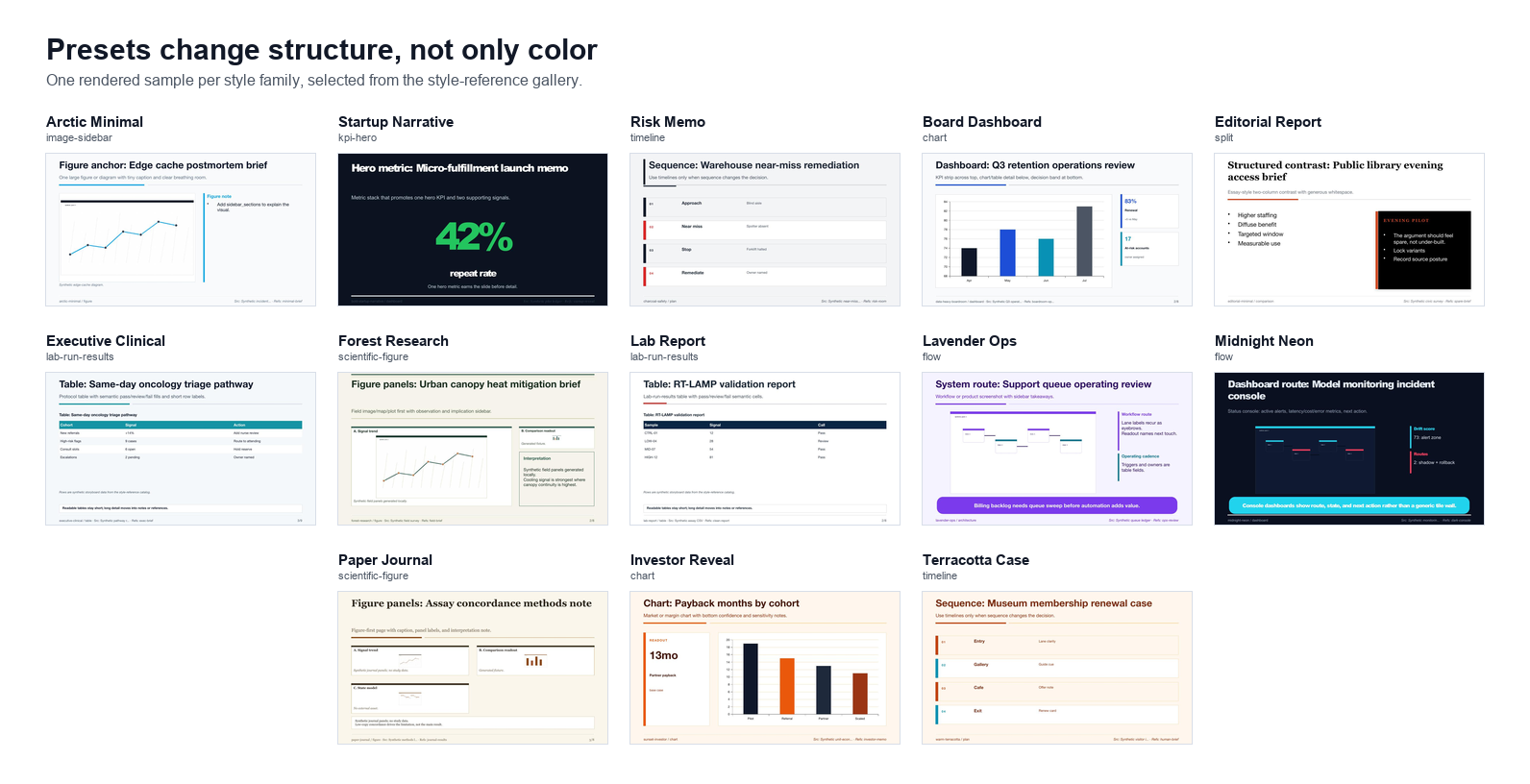
The style board samples one rendered slide per preset family so the differences are visible as structure, not only palette.
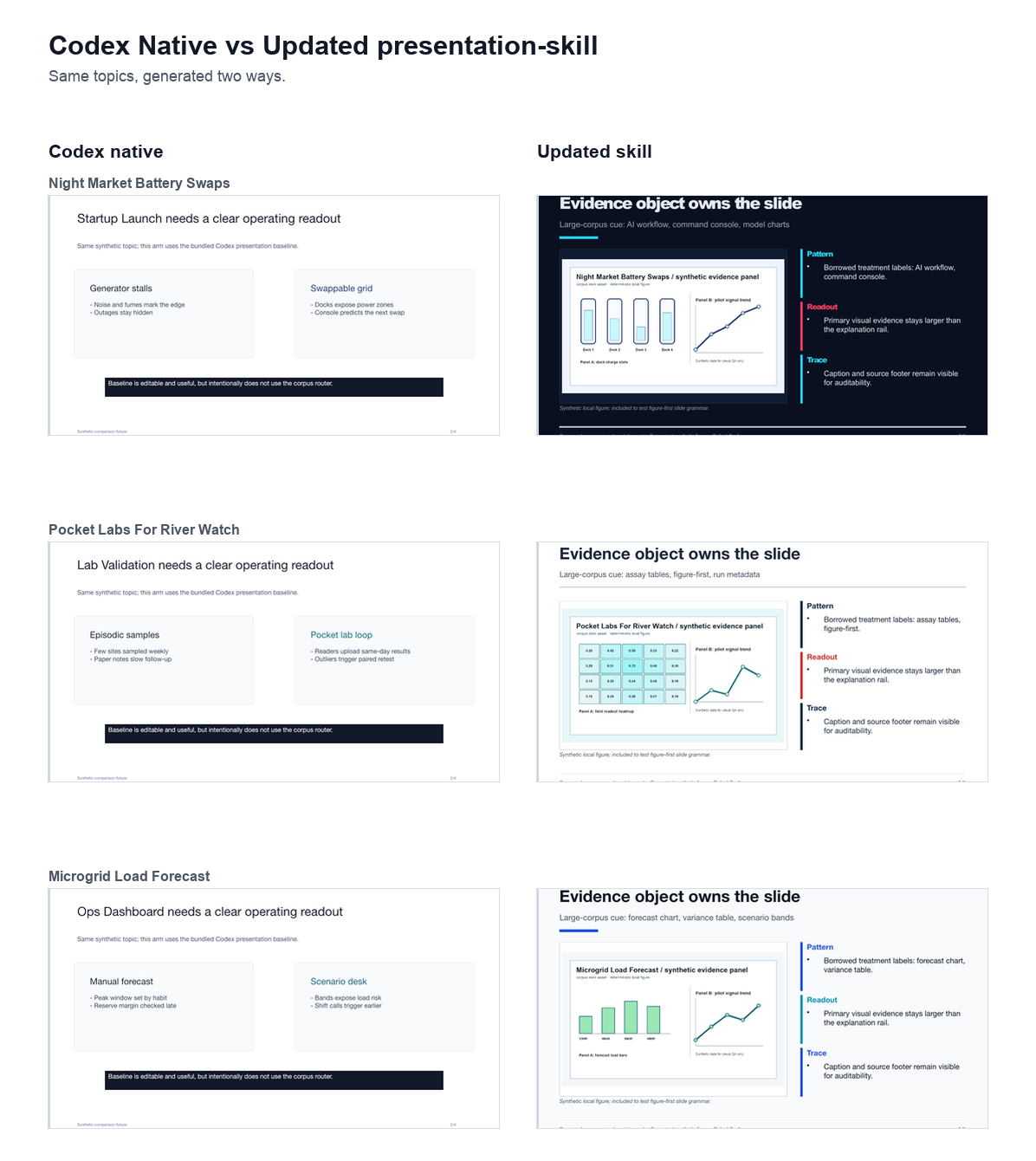
Full release notes and comparison images are in the v0.7.0 release.
Install
Clone or copy this repo into your Codex skills directory:
git clone https://github.com/sirilsengolraj-source/presentation-skill \
  $CODEX_HOME/skills/presentation-skill
cd $CODEX_HOME/skills/presentation-skill
pip install python-pptx "markitdown[pptx]"
npm install
Core generation does not require LibreOffice. Render-based verification uses LibreOffice soffice and Poppler pdftoppm when available.
Try It
Build and verify the bundled example:
node scripts/build_deck_pptxgenjs.js \
  --outline examples/outline.json \
  --output out.pptx \
  --style-preset executive-clinical
Then verify:
python3 scripts/qa_gate.py \
  --input out.pptx \
  --outdir /tmp/pptx-qa \
  --style-preset executive-clinical \
  --skip-render
For production builds, add --strict-geometry --fail-on-design-warnings --fail-on-whitespace-warnings and complete one manual visual review (which writes a manual_review_passed.flag into the outdir) before re-running.
For agents, the shortest useful prompt is:
Use
presentation-skillto build a 7-slide editable PowerPoint deck. Treatoutline.jsonas source, choose a preset that fits the topic, use charts/tables/figures where they help, and run the QA gate before delivery.
What people actually build with this
A few concrete use cases this skill is set up for, drawn from the variants and presets it ships with:
- Lab and clinical data reports. CSV in, scientific-figure slides with subfigure labels out.
lab-run-resultsslides use semantic table coloring (red/green/yellow for pass/fail/status).image-sidebarfor microscopy panels and workflow diagrams. - Investor and board decks.
kpi-hero,stats, andcomparison-2colvariants with thebold-startup-narrativeordata-heavy-boardroompresets. Generated charts cropped, slide-sized, and readable before assembly. - Editorial and policy briefs.
editorial-reportandcivic-science-policypresets withcards-3,matrix, andtimelinevariants. Built for proof-burden + audience-posture decks rather than 10-bullet recap slides. - Design gallery testing. Build the same outline across all 13 presets with multiple header variants to see how a content shape lands in different design families. Useful when you don't know which preset fits a topic.
Feedback
The most useful feedback is a concrete deck-quality miss: repeated layout, crowded text, weak chart/table/figure use, unreadable type, awkward whitespace, or a style that did not match the topic. Use the deck quality feedback template and include the prompt, preset, contact sheet, or outline.json when possible.
Workspaces
For decks you'll rebuild or extend later, use workspace mode:
python3 scripts/init_deck_workspace.py \
  --workspace decks/my-deck \
  --title "My Deck Title" \
  --style-preset executive-clinical

# edit outline.json + brief, then:
python3 scripts/build_workspace.py \
  --workspace decks/my-deck \
  --qa \
  --overwrite
Two scripts make workspaces self-driving:
report_workspace_readiness.py— diagnoses what's wrong with the source files before you rebuild. Surfaces unbound artifacts, stale outlines, missing source recommendations, and ranks the next action.advance_workspace.py --execute— runs the next deterministic action (bind artifacts, scaffold data figures, apply contracts) or hands back an agent-facing source-edit prompt when the next move needs an outline change.
Full workspace docs in references/deck_workspace_mode.md.
Verification
qa_gate.py runs three classes of check:
- Geometric — text overflow, element overlap, low-contrast text, narrow text boxes that force excessive wrapping, decorative lines positioned for single-line titles that wrapped to two, footer collisions, insufficient slide margins.
- Visual (optional, requires render) — slides are exported to JPGs and inspected with a prompt biased toward finding problems. Catches things geometric checks miss (white-band issues on dark backgrounds, mermaid pile-ups, decorative elements bleeding into content).
- Content — placeholder grep on the markitdown extract. Catches leftover
TODO,[insert ...],xxx,lorem, and template-stub strings.
A deck isn't declared ready until the geometric gate passes, the visual pass returns zero findings, and at least one fix-and-verify cycle has been run.
Run with --skip-render for fast iteration without LibreOffice; drop --skip-render for the full render-and-inspect pass.
Project layout
presentation-skill/
├── SKILL.md                  # full skill spec for agents
├── agents/openai.yaml        # OpenAI-style agent prompt
├── scripts/                  # builders, QA, workspace tools
├── templates/pptxgenjs/      # variants + presets (JS renderer)
├── templates/python/         # python-pptx renderer (legacy + niche)
├── references/               # outline schema, planning schemas,
│                             # style corpus, design guidance
├── examples/outline.json     # minimum-viable outline example
└── decks/                    # release showcases and gallery decks
Agent integration
Codex and other OpenAI-style agents trigger this skill for PowerPoint, .pptx, slide deck, presentation, deck editing, and layout-QA requests. The full agent contract lives in SKILL.md. Key rules:
- Source-first: write
outline.jsonfirst, not inlinepptxgenjsorpython-pptxcode. - Fix the source files, never the
.pptxartifact. - Run QA before delivery. If QA fails, rebuild from source.
Discovery metadata for agents and shareable summaries for humans live in DISCOVERY.md and agents/discovery.json.
Releases
v0.7.0— optional first-class atom composition in the normal deck-start/design-contract/style-router workflow, plus README proof boards for renderer variants, style families, and Codex-native vs updated-skill comparison.v0.6.0— topic-aware atom router, stricter reproducible composition prompts, readable stats rendering, refreshed random-topic evidence gallery.v0.5.0— descriptor-only style corpus (~2,000 records), random-topic comparison gallery, design-catalog selector.v0.2.0— per-preset contact sheets, style-reference routing.v0.1.0— initial release with variant renderer + workspace mode.
Further reading
SKILL.md— full agent contract and verification loopDISCOVERY.md— share kit, trigger phrases, proof links, and adoption checklistDESIGN.md— design philosophy and decisionsROADMAP.md— open work and directionDEVELOPMENT.md— maintainer workflow
License
MIT. See LICENSE. Third-party dependencies keep their own licenses; no proprietary slide assets are bundled.
Topics: powerpoint, pptx, presentation, slide-deck, slides, deck-generator, presentation-generator, agent-skill, codex-skill, chatgpt-skill, openai-agents, pptxgenjs, python-pptx, deck-design, slide-qa, layout-validation, presentation-workspace, lab-report-deck, investor-deck, board-deck, scientific-figure-slides
Reviews (0)
Sign in to leave a review.
Leave a reviewNo results found