RoadRaven
Health Warn
- License — License: NOASSERTION
- Description — Repository has a description
- Active repo — Last push 0 days ago
- Low visibility — Only 5 GitHub stars
Code Fail
- rm -rf — Recursive force deletion command in install.sh
Permissions Pass
- Permissions — No dangerous permissions requested
No AI report is available for this listing yet.
Your plan, watching itself. Local desktop roadmap tree that Claude Code and any MCP host keep up to date live. Plain JSON, no cloud.
RoadRaven
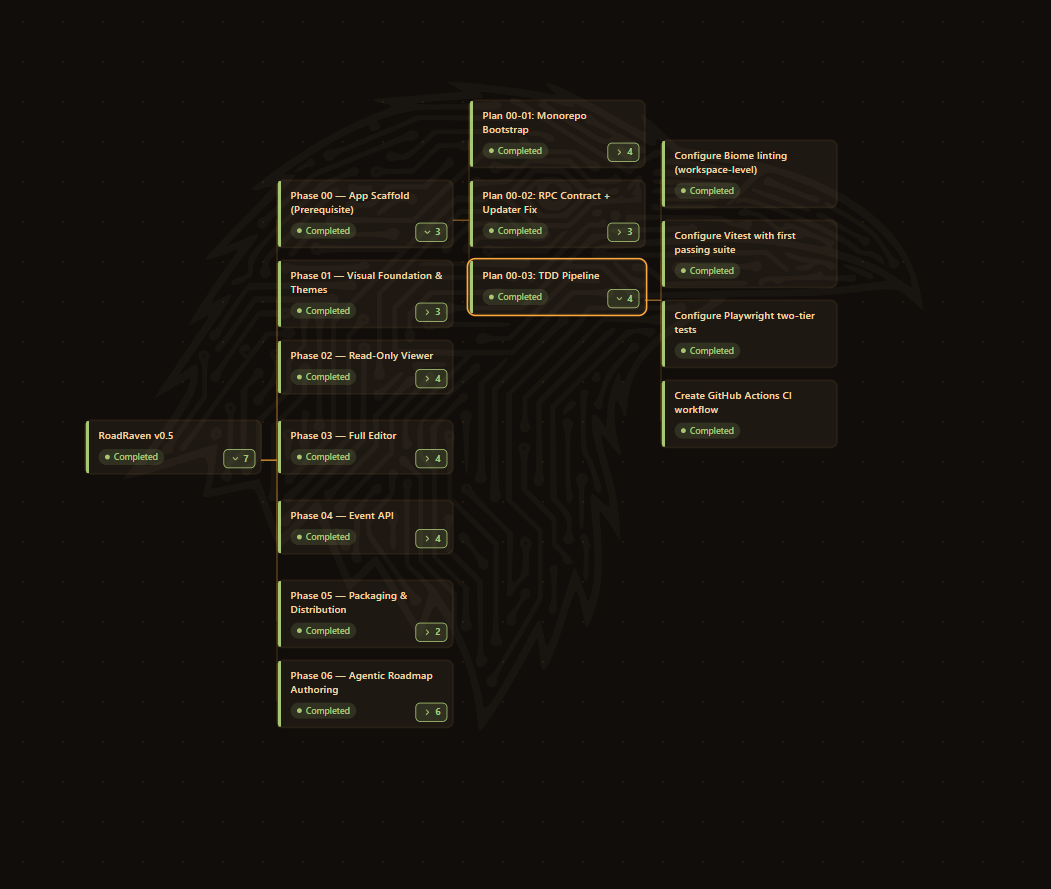
The plan that watches itself. A local desktop tree of your project's plan
where every node can be wired to something real (a Claude Code task, a CI job,
a script) and flips status by itself as the work happens.




You plan in a doc. The work happens in terminals, CI, and AI agents. Within a
day the doc is fiction. RoadRaven keeps the plan and the work in one place: a
plain roadmap.json in your repo, rendered as a tree, updated live over a
local WebSocket by whatever is actually doing the work. No cloud, no accounts,
no sprints, no story points. Just a file you own.
The headline use case: give Claude Code (or any MCP host) the roadmap, and
watch it plan, work, and tick nodes green while you supervise.
Alpha (v0.8.5). Core editing and the live Event API work today. The data
format, APIs, and packaging may still change before v1.0. Bug reports and
feature requests are very welcome via Issues.
60-second start
1. Install (Windows and Linux today; macOS is next).
Windows x64, PowerShell. Downloads the latest release, verifies it against the
release's SHA256SUMS, runs the installer:
irm https://raw.githubusercontent.com/Shuffzord/RoadRaven/master/install.ps1 | iex
Linux x86_64:
curl -fsSL https://raw.githubusercontent.com/Shuffzord/RoadRaven/master/install.sh | sh
Windows SmartScreen will say "Windows protected your PC" because the alpha
ships unsigned. Click More info, then Run anyway. Manual downloads,
version pinning, and checksum steps: Install details.
2. Connect Claude Code. Launch RoadRaven. The first-run Setup Wizard
detects Claude Code and OpenCode and registers the bundled MCP server with one
click. No commands, works offline. Restart your MCP host and the tools are live.
3. Try it. Open a sample from the Welcome screen, then tell Claude Code:
Read the open RoadRaven roadmap, pick the first todo node, do the work, and set its status as you go.
Nodes change colour on the canvas as the agent works. That is the whole idea.
Demo
https://user-images.githubusercontent.com/4171628/607591096-bc94a8c8-36c9-44dc-8cdb-6417437949b9.mp4

Why RoadRaven
- Plan-as-file. The roadmap is plain JSON in your repo. Diffable, reviewable, yours. No database, no proprietary format.
- Live status from anything. Any process that can open a WebSocket updates a node. A GitHub Action finishes, the node turns green. Claude Code completes a task, the node updates.
- Built for agent supervision. The MCP server exposes 21 tools so an agent can create, edit, move, delete nodes and push status as it works. You watch; it keeps the plan current.
- Local-first. Binds to
127.0.0.1, works air-gapped. Nothing leaves your machine. - Keyboard-first. Navigate and edit the whole tree without the mouse.
- Zero-opinion schema. You define the statuses, types, and hierarchy. The app stays dumb; your tools do the talking.
Connect an MCP host
Three ways, easiest first. Every path needs the desktop app running: tools talk
to it over the local Event API and return app_not_running otherwise.
Setup Wizard (recommended). Described in 60-second start.
Re-open it any time from the ⚙ button in the top bar. It writes to~/.claude.json (Claude Code) and ~/.config/opencode/opencode.json
(OpenCode) without touching other servers you have configured. If the Claude
Code plugin below is already installed, the wizard defers to it.
Claude Code plugin. Requires Node.js >= 24. From inside Claude Code:
/plugin marketplace add Shuffzord/RoadRaven
/plugin install roadraven@roadraven
Any other MCP host. Requires Node.js >= 24. Pin the version that
matches your installed app (the app warns on a major.minor mismatch):
claude mcp add -s user roadraven -- npx -y @roadraven/[email protected]
Tell Claude to use it. Tools alone give Claude no reason to plan in the
roadmap. This adds a short RoadRaven section to a CLAUDE.md, asking first
whether to put it in the current project or in ~/.claude/CLAUDE.md for every
project. Safe to re-run; it updates its own block and touches nothing else:
npx -y @roadraven/[email protected] init
Cursor, Codex, Copilot, Gemini, OpenCode, version-mismatch handling, and a
build-from-source path: MCP install guide.
Writing your own producer (a CI job, a script, a bot)? The Event API contract
is in the plugin authoring guide.@roadraven/core (Zod schemas and types) is not on npm yet; build it from source.
Install
Download from GitHub Releases.
Every release since v0.8.0 ships a SHA256SUMS file.
Windows x64. The one-liner above, or by hand:
- Download
win-x64-RoadRaven-Setup.zipandSHA256SUMS. Check the download (printsTruewhen it matches):(Get-FileHash win-x64-RoadRaven-Setup.zip).Hash -eq (Select-String -SimpleMatch ' win-x64-RoadRaven-Setup.zip' SHA256SUMS).Line.Split(' ')[0] - Extract the zip and run
RoadRaven-Setup.exe. - SmartScreen: More info, then Run anyway. RoadRaven is unsigned in the alpha.
RoadRaven renders through the system WebView2 runtime on Windows, so the
download carries no bundled browser engine. Pin a version with$env:ROADRAVEN_VERSION = 'v0.8.5' before the one-liner.
Linux x86_64. The one-liner above, or by hand:
sha256sum -c SHA256SUMS --ignore-missing
tar -xzf linux-x64-RoadRaven-Setup.tar.gz
chmod +x ./installer
./installer
The installer puts the app under ~/.local/share/ and creates a desktop
shortcut. Chromium (CEF) ships bundled, so no system browser dependency. Pin
a version with ROADRAVEN_VERSION=v0.8.5 in front of sh.
Once installed, RoadRaven checks GitHub Releases for updates and asks before
downloading one.
Status
| Shipped as of v0.8.5 | Next |
|---|---|
| Tree canvas, keyboard editor, side-panel markdown notes and metadata | macOS installer |
Atomic autosave, $ref split files, File menu, Outline navigator |
Code signing |
| Event API over WebSocket, agent-safe writes (optimistic locking, batch updates) | Drag-and-drop reparenting |
| MCP server on npm, Setup Wizard, Claude Code marketplace plugin | @roadraven/core and @roadraven/react on npm |
| 8 themes with WCAG contrast gates, user theme files, in-app theme editor | |
| In-app updates: checks on launch, asks before downloading, restart to install | |
| Windows and Linux installers with verified checksums | .deb packaging |
| Undo / redo, status ribbons, per-file layout knobs, draggable custom layout, persistent collapse |
Full feature list and keyboard reference: docs/features.md.
Release history: CHANGELOG.md.
Documentation
- Features and keyboard reference
- MCP install guide
- Plugin authoring guide (write your own Event Producer)
- Architecture overview
- Development guide
- Design system
- Logging
Contributing
RoadRaven is built on Electrobun (not
Electron) with Bun as the runtime. Local setup, test commands, code style,
and project conventions are in CONTRIBUTING.md.
bun install
bun run dev:hmr       # Vite HMR + Electrobun
bun run verify        # tests + typecheck + build + lint
A note from the creator
I built RoadRaven to scratch my own itch. When you're working on something with a
lot of moving parts, your plan and your actual work drift apart fast. The plan
lives in a doc or in your head, while the real state is scattered across terminals,
CI, and AI agents. The doc is out of date the moment you write it, and slowly turns
into fiction.
It started as a personal study- and project-tracker. The moment it clicked was
watching nodes flip status on their own as Claude Code worked through tasks. I
hadn't touched anything, I just opened the app and the current state was right
there. That's the whole idea: your plan, watching itself.
If you have ideas, hit rough edges, or want a node to watch something I haven't
thought of yet, please open an issue
or a PR.
License
Functional Source License 1.1, MIT future license (FSL-1.1-MIT),
the same license Sentry uses. In plain words:
- You can use it for anything, at home or at work, free, including
inside a company. Modify it, fork it, ship it with your own tools. - The one thing you can't do is sell or host RoadRaven itself (or a thin
fork of it) as a competing product. - Every release turns into plain MIT two years after it ships, automatically.
Nothing is locked away forever.
Not OSI "open source", but close: source-available, free to use, MIT in time.
Reviews (0)
Sign in to leave a review.
Leave a reviewNo results found