dive-browser
Health Gecti
- License — License: MIT
- Description — Repository has a description
- Active repo — Last push 0 days ago
- Community trust — 10 GitHub stars
Code Gecti
- Code scan — Scanned 12 files during light audit, no dangerous patterns found
Permissions Gecti
- Permissions — No dangerous permissions requested
Bu listing icin henuz AI raporu yok.
The browser built for developers: Chromium, a workspace per project, a developer toolkit beside the page, and an agent that can work in your tabs.
Dive
The browser built for developers.
Chromium, a workspace per project, a developer toolkit that lives next to the page, and an agent that can work in your tabs.










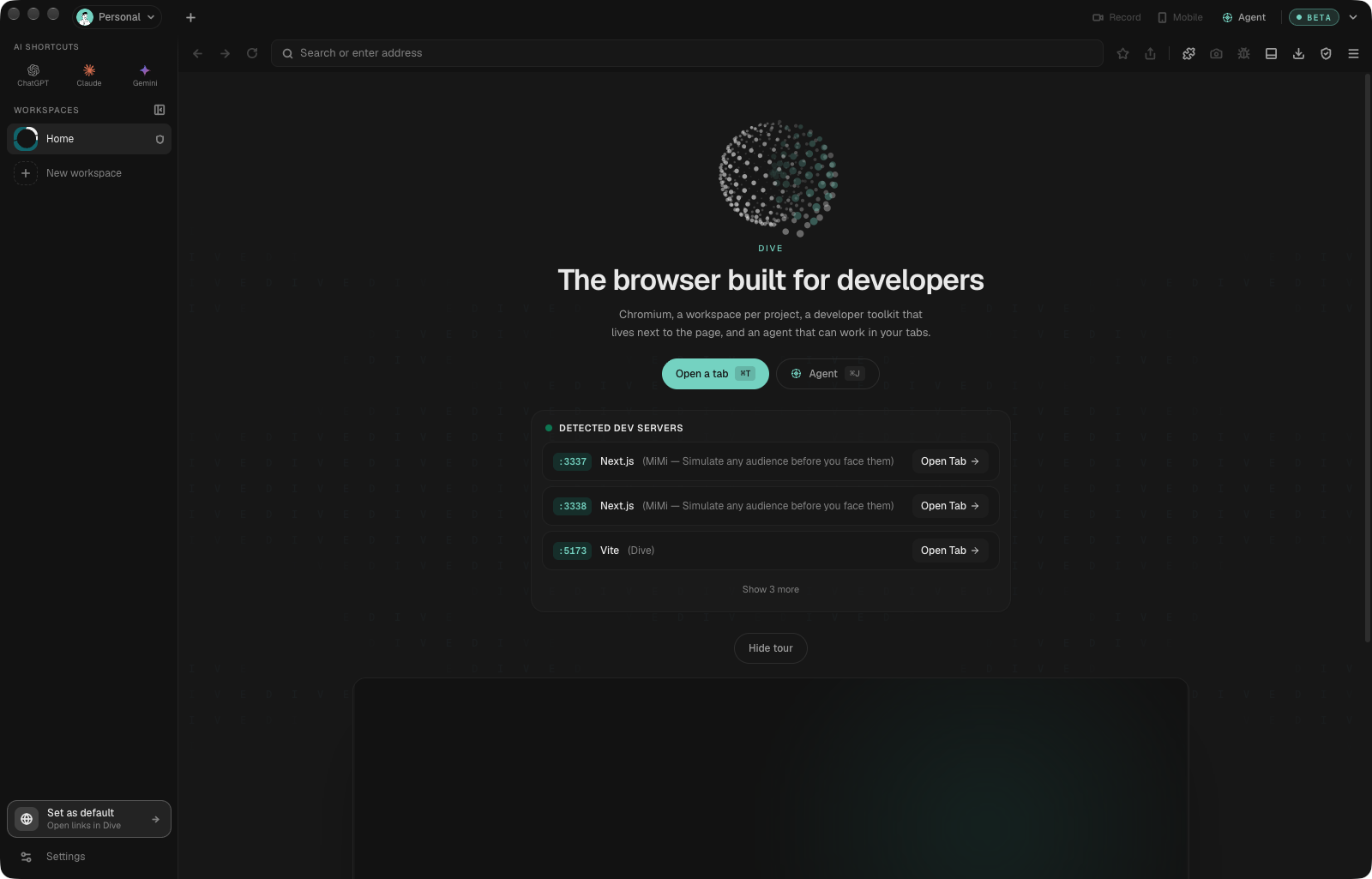
Dive is a native browser for macOS and Windows, built on the Chromium Embedded Framework, with a Rust core and a React chrome. It is keyboard-first. The difference is what sits beside the page: network, console, storage and accessibility panels, a device simulator, a screen studio, and an AI agent that can read and operate the tab. Open tabs in the workspace in front are reachable by Claude Code, Cursor or any MCP client; sleeping tabs are omitted.
What you get
- An agent in the side panel. It reads the page, clicks, types, inspects requests and reports back. Bring your own key for Anthropic, OpenAI, Google, OpenRouter, Groq, Mistral, DeepSeek or xAI, or run fully local with Ollama or LM Studio.
- MCP built in. Claude Code, Cursor and other Model Context Protocol clients can open tabs, read pages, click, type, take screenshots and tail the console and network over localhost, behind a bearer token.
- A developer dock, not a bolt-on. Network with request bodies, SSE and WebSocket frames and HAR export. Console, storage, request mocking and rewriting, axe-core accessibility audits, Core Web Vitals, and an OpenAPI spec inferred from the traffic you just watched. Full Chrome DevTools one shortcut away.
- Device simulator. Real phone and tablet frames, user agents, pixel ratios, touch, and Offline, Slow 3G and Fast 3G throttling.
- DivePrivacy. First-party ads and tracker lists can run in the request pipeline, with per-site controls. Off until you turn it on. No extension needed.
- DiveScreen. Record any tab as video or GIF, then crop, zoom and add cursor effects to make a clip that looks like a product demo.
- Workspaces and profiles. Separate cookies, tabs and mock rules per project, switchable with a keystroke. Profiles keep whole identities apart. Private windows run in their own process.
- Idle Today tabs unload. After an hour away they drop their page and keep their place; click one and it comes back. Same-site tabs can still share a renderer.
- Sites as apps. When a page's manifest passes Chrome's install rules, an install button appears beside the address. The tab becomes the app's own window — no tabs, no address bar, the app's icon in the title bar — and a launcher lands in
~/Applications/Dive Appson macOS, or in the Start Menu under Dive Apps on Windows. Leave the app's scope and a thin bar offers the site back in Dive.
Screenshots
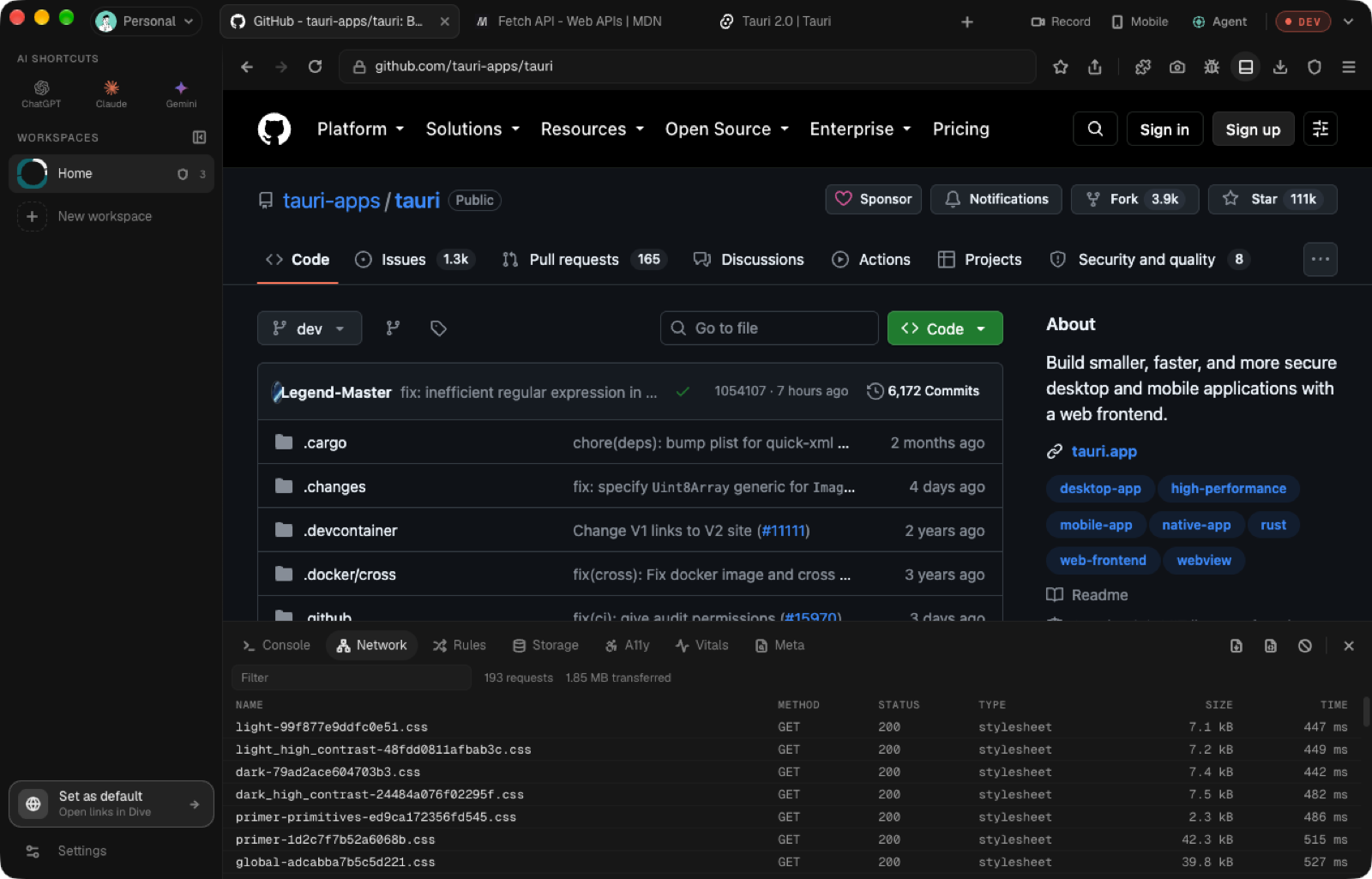 Developer dock with the Network panel open beside the page. |
|
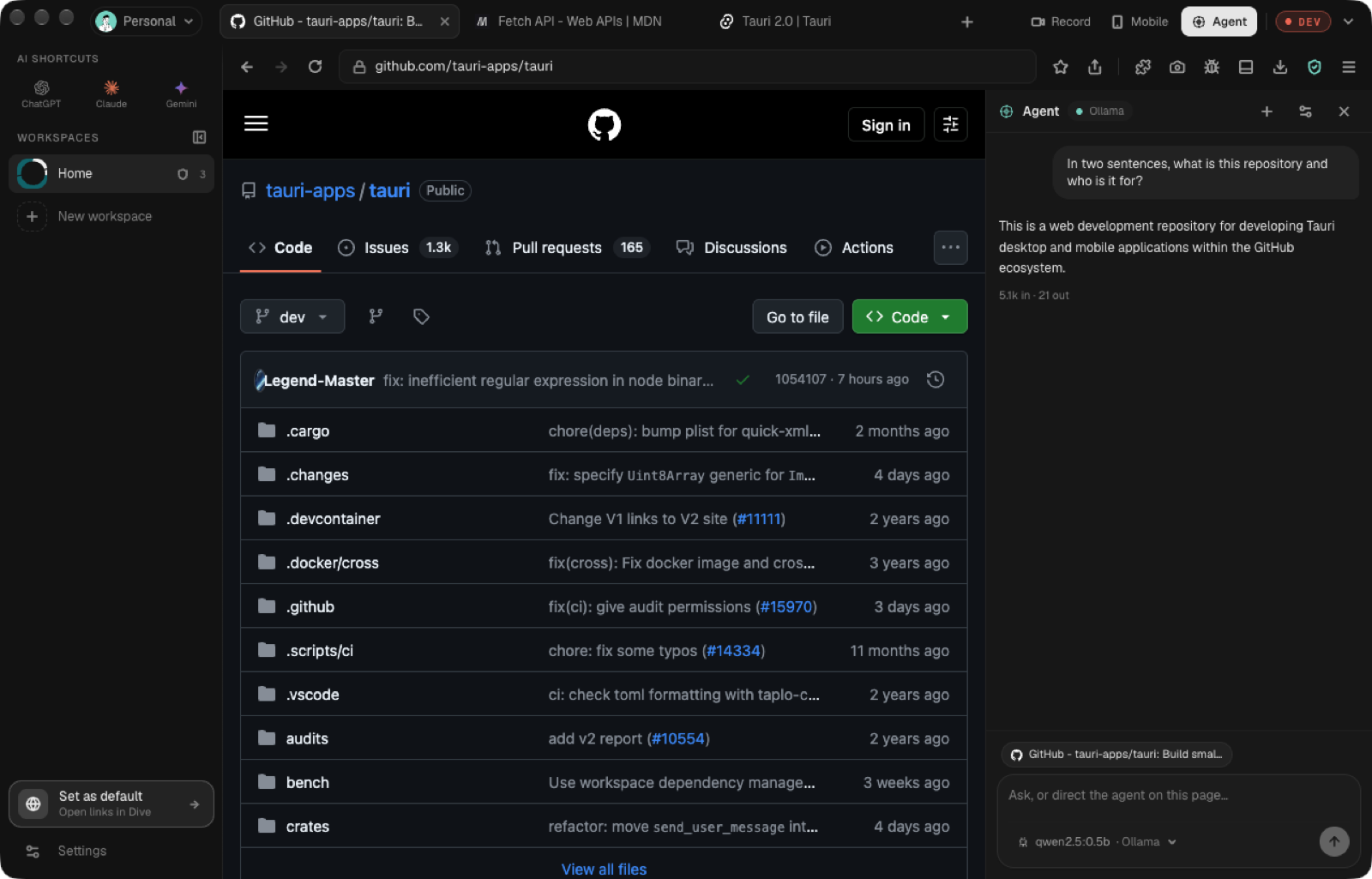 Agent reading the page, here through a local Ollama model. |
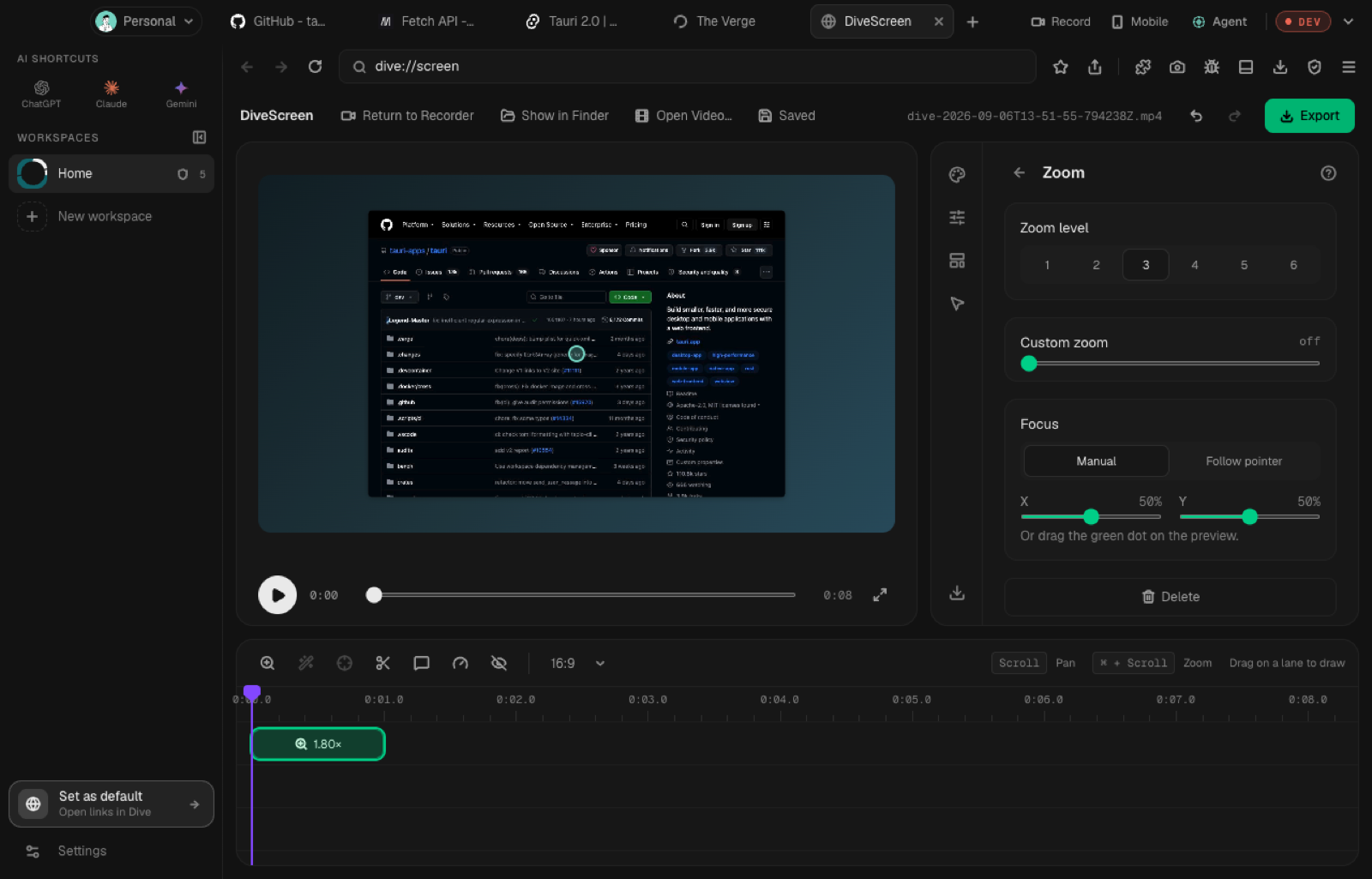 DiveScreen turning a tab recording into a demo. |
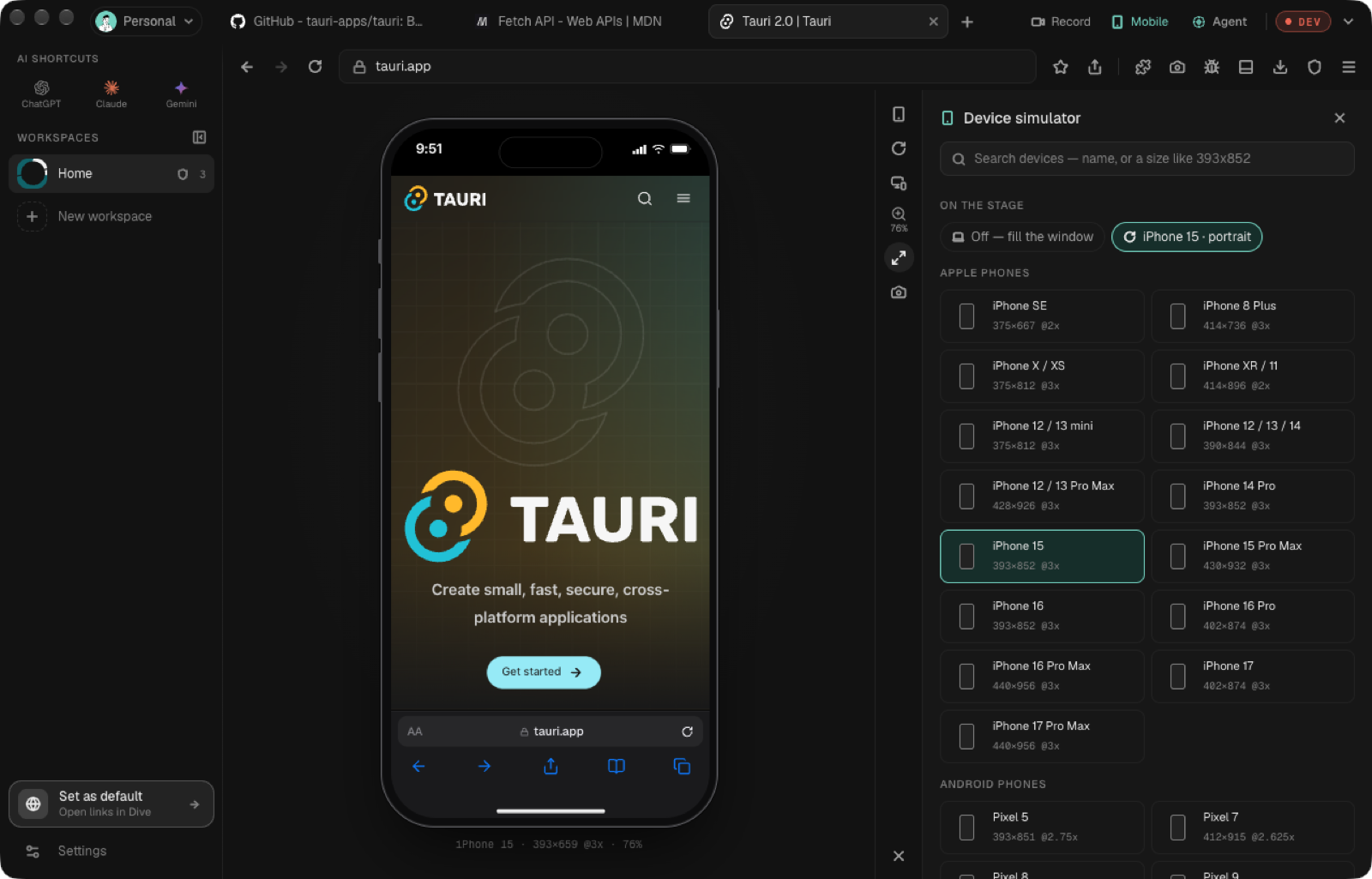 Device simulator with real frames and throttling. |
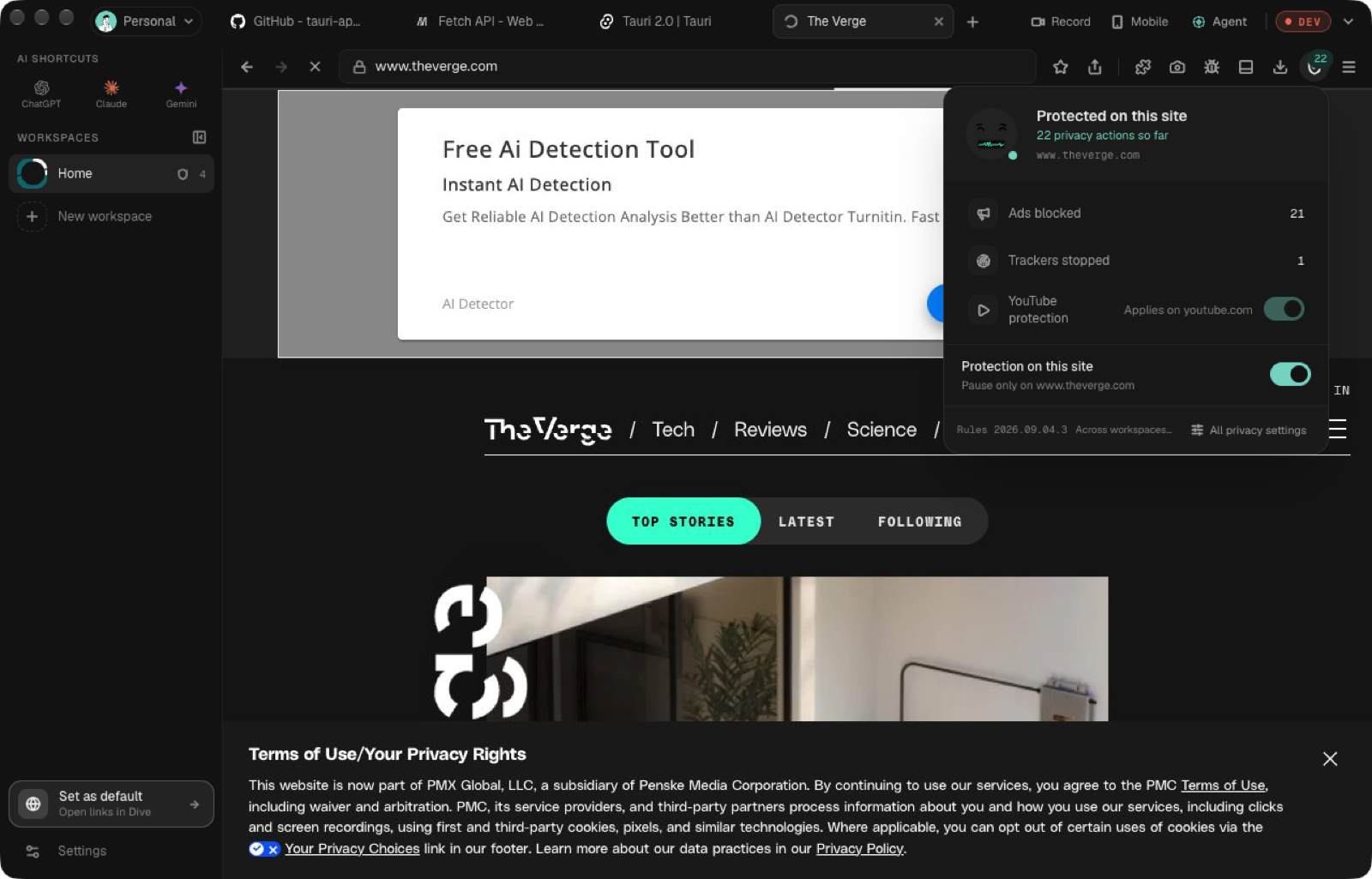 DivePrivacy per-site controls. Off until you turn it on. |
Install
| Platform | |
|---|---|
| macOS 13 or newer, Apple Silicon | Download the DMG |
| Windows 10 or newer, x64 | Download the installer |
Release builds check for updates shortly after launch. Installing one restarts Dive.
macOS builds are signed with an Apple Developer ID certificate and notarized.
Windows builds are being set up for code signing through the
SignPath Foundation's free program for open-source
projects; see docs/CODE_SIGNING.md for the policy.
Until that certificate is issued the Windows installer is unsigned, so
SmartScreen warns the first time you run it: choose More info, then Run
anyway.
Connect an agent
Dive serves MCP on 127.0.0.1:7391 and requires the token it writes to its data directory. Private windows do not serve MCP.
On macOS the token is under ~/Library/Application Support/app.dive.browser/mcp-token:
claude mcp add --transport http dive http://127.0.0.1:7391/mcp \
  --header "Authorization: Bearer $(cat ~/Library/Application\ Support/app.dive.browser/mcp-token)"
On Windows the token is under %APPDATA%\dive\mcp-token:
claude mcp add --transport http dive http://127.0.0.1:7391/mcp `
  --header "Authorization: Bearer $(Get-Content $env:APPDATA\dive\mcp-token)"
Cursor and other clients take the same URL and header. Settings › Developer shows the token path and the current port. page_evaluate stays off unless you start Dive with DIVE_MCP_ALLOW_EVAL=1.
Build from source
Needs Node 20+, pnpm 10, Rust 1.98+, CMake and Ninja.
brew install cmake ninja pnpm
git clone https://github.com/ronaldxdale09/dive-browser.git && cd dive-browser
pnpm install
export CEF_PATH="$HOME/.local/share/cef"   # CEF is downloaded here once (~500 MB)
pnpm dev
Windows needs the MSVC toolchain and one extra environment variable so
whisper.cpp and CEF agree on a C++ runtime; docs/WINDOWS.md
has the setup and the reasoning.
pnpm check runs the full gate. Layout, environment knobs and conventions are in CONTRIBUTING.md; design notes and measurements are under docs/.
License
Dive is MIT licensed and redistributes the Chromium Embedded Framework under its BSD-3-Clause license. To report a vulnerability, see SECURITY.md.
Yorumlar (0)
Yorum birakmak icin giris yap.
Yorum birakSonuc bulunamadi