rolling-memory
Health Uyari
- License — License: NOASSERTION
- Description — Repository has a description
- Active repo — Last push 0 days ago
- Low visibility — Only 7 GitHub stars
Code Gecti
- Code scan — Scanned 12 files during light audit, no dangerous patterns found
Permissions Gecti
- Permissions — No dangerous permissions requested
Bu listing icin henuz AI raporu yok.
Source-available, local-first long-term memory for AI coding agents: one MCP tool (recall) over a private local SQLite vault — zero cloud, zero vectors, zero background LLM calls, ~30 ms lookups. Free for noncommercial use (PolyForm-Noncommercial-1.0.0).
Rolling-Memory
English · 简体中文 · Official Website · AML Leaderboard · Documentation Hub · Token Math & Falsification · FAQ · Benchmarks · Contributors · Declaration & Disclaimer
Rolling Memory is a source-available, local-first memory tool for AI coding agents — Claude Code, Codex, OpenCode, Cursor, Windsurf, Cline, ZCode, and more — built on the Rolling Autonoetic Memory Engine. It indexes supported conversation sources and mounted files locally so connected agents can query them through one MCP tool: recall. See the integration guide for collection limits and manual import. No cloud required, no vectors, no background LLM calls; free for every noncommercial use.
Independent benchmark result: on the Agent Memory Leaderboard (AML) Cycle 2 — closed-source methods board, code track — Rolling Memory ranks No. 1 on the “Noisy new features” code sub-capability with an 80.39% resolution rate, the highest of any entrant for that sub-capability. The submission used the same local engine as this repository, with no track-specific tuning. Results were published on 2026-11-19. See the official AML leaderboard.
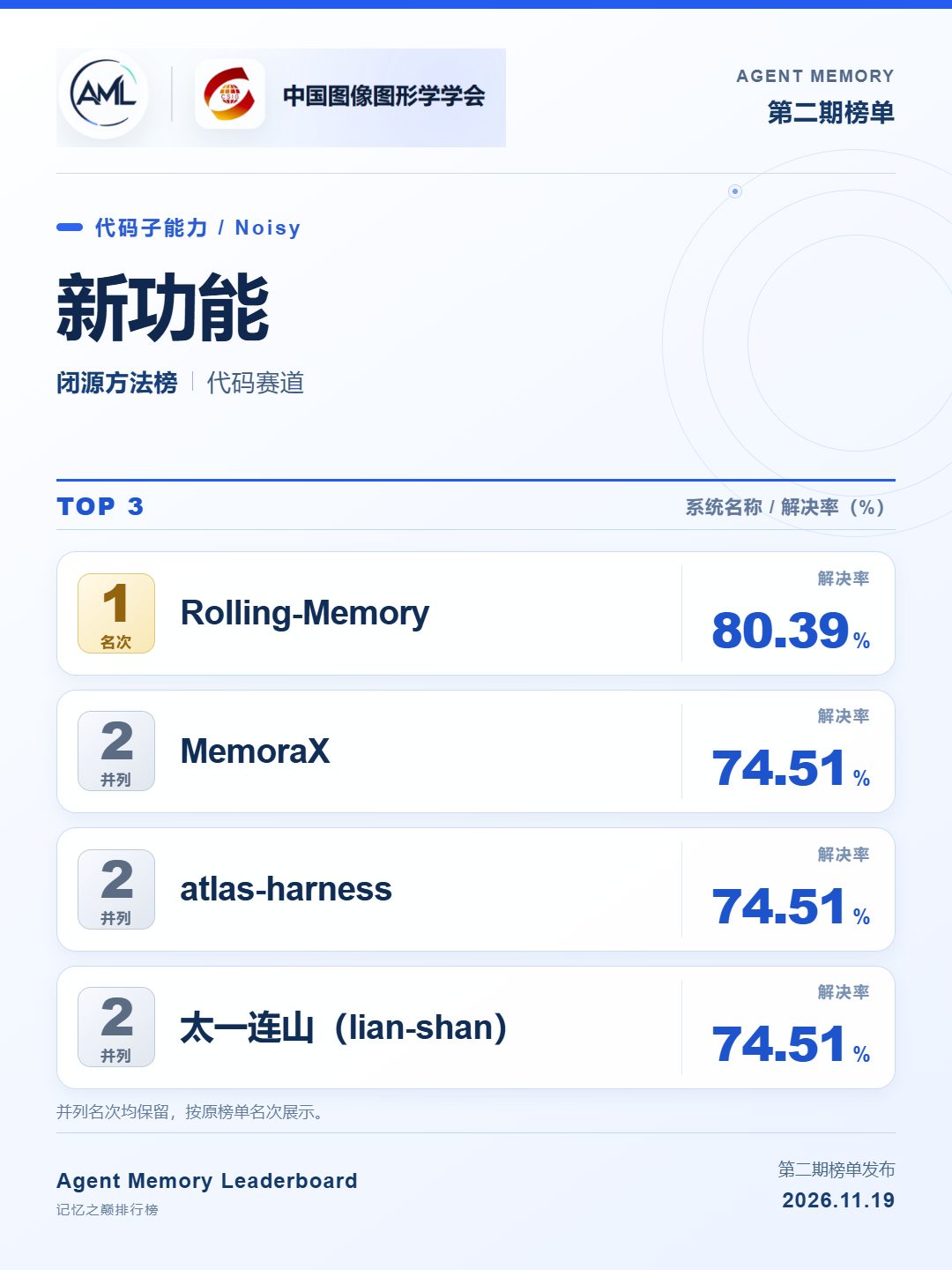
AML Cycle 2 (published 2026-11-19) · closed-source methods board · code track · code sub-capability “Noisy new features”: No. 1 — 80.39% resolution rate. Official leaderboard →
Get started: Run
curl -fsSL https://github.com/rocareer/rolling-memory/raw/main/install.sh | bash(orbash install.shfrom a local checkout) to wire your coding assistants, then just chat normally. Whenever you need to trace back history, ask something like "Where did we fix that bug last time?" See the Quick Start Guide for details.
The payoff in daily work: your agent asks once and gets the original record back — the decision, the reasoning, the exact file coordinate — instead of re-running blind keyword searches. A summary keeps the gist; recall keeps what actually happened.
Our goal is simple: making AI memory accessible and affordable for everyone. Long-term memory for coding agents should work like local files — a basic utility that any individual developer, student, or small team can run out of the box, without needing a credit card, cloud subscriptions, or a background pipeline that quietly burns LLM tokens on every turn.
In everyday use, that comes down to four practical things: genuinely free, real-time with no waiting, private with no third party in the middle, and portable enough to carry on a USB drive —
- Genuinely free (zero hidden bills): No background LLM extraction fees, no online vector embedding API bills, and no cloud hosting or account subscription costs — no sign-up and no credit card;
- Local retrieval: No background LLM extraction or embedding service is required; indexed conversations and mounted files can be queried on demand;
- Safe and private (no third party in the middle): Everything compiles to a single zero-dependency Go binary (
CGO_ENABLED=0) and lives in one SQLite file on your machine, with zero network requests in the memory layer — other than you and the agent actively working for you, no third-party memory service, embedding provider, or external server ever sees your code, file paths, or conversations. One precise boundary: if your coding agent uses a remote LLM API, the passagesrecallreturns travel to that model provider as part of your prompt (see docs/privacy.md §1); - Evaluation hooks, evaluation cards, and a rough ROI module enabled by default (easy to disable anytime): In local mode, experience-evaluation hooks and evaluation cards are enabled by default so you get an immediate feel for whether a memory hit actually helped, alongside a built-in (admittedly rough) ROI estimation panel in the web console. If you find hooks distracting, you can disable or remove them at any time:
# Option 1: Wire only the pure MCP recall tool without any hooks or instruction blocks rolling-memory install --mcp-only # Option 2: Keep the install, but turn off hook ledger recording rolling-memory config set hooks.ledger false - Built-in USB portable mode: Because both the binary and the SQLite vault are self-contained files, we also included a USB portable mode (see
docs/usb-portable.md) so you can put the tool and your memory vault onto a thumb drive and carry them around. It is still experimental and not thoroughly tested yet, and it comes with a real prerequisite: for project-specific memories to be useful on another machine, you have to be working on the same project there. If you are curious and like tinkering, feel free to try it out and tell us what works and what does not.
All of that runs behind one local binary and one local SQLite vault. The built-in Live Console puts the moving parts on one screen:
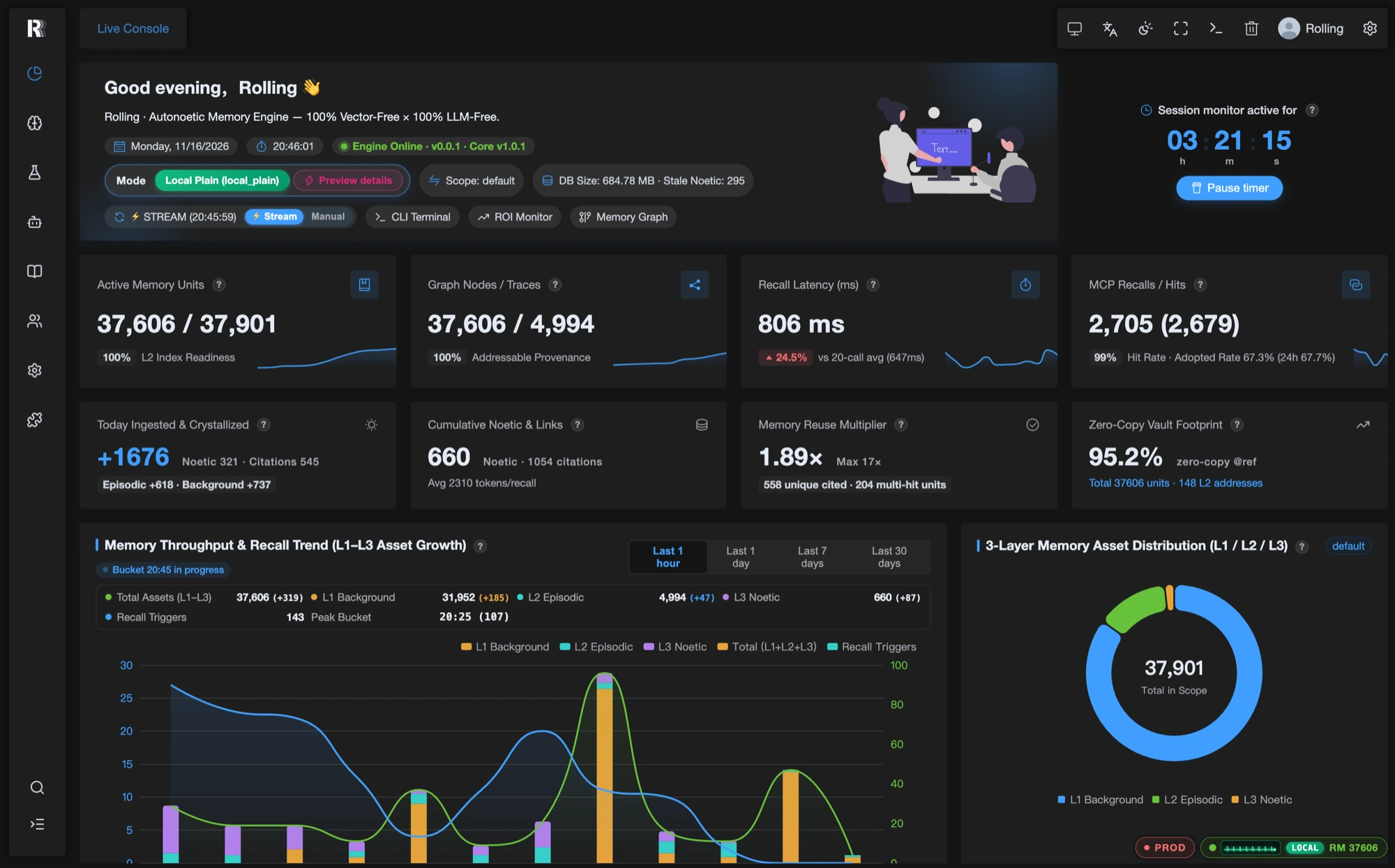
The built-in Live Console (rolling-memory panel) at a glance — vault telemetry, the MCP recall ledger, and 3-layer memory growth, all running on your machine with zero external network requests.
About this release: This repository ships pure local mode (
local_plain): recall, storage, and consolidation all run in the local vault, with no memory-plane network requests. The only outbound calls are the evaluation LLM endpoint you configure, the optional upstream benchmark-corpus download, and the optional update check. A separate cloud memory service — ciphertext-only by design and aimed at advanced and enterprise users — is offered by application and is not part of this repository; see DECLARATION.md for the release and license boundary and SUPPORT.md for how to get help.
1. What it does for you in daily work (every saved turn counts)
It indexes supported conversation sources and mounted local documents using local lexical and statistical signals, and gives your agent one MCP tool — recall — to look up available records and their source coordinates.
What is the practical benefit? Helping your harness agent cut down on blind search round-trips.
In daily long-horizon coding sessions (where active context sizes typically sit between 100k and 400k tokens), every extra tool-use turn forces the client to re-send that entire 100k–400k context to the LLM as billed input tokens, while you wait for another round of model inference and tool execution. When you ask something like "Where did we fix that status-bar flicker last time?" or "Why did we drop Approach A?":
- Without memory, the agent often has to guess keywords and spend 3–5 turns running
grep,find, andReadby trial and error; - If
recallhits a past record that points straight to the target file or decision, eliminating even a single unnecessary round-trip saves one full re-read of your current context's total tokens (100k–400ktokens) — and shaves a bit of wall-clock time off the task. Every bit saved helps.
Of course, if recall misses and returns nothing useful, that extra turn costs you tokens instead of saving them. Rather than making vague claims, we wrote a dedicated note laying out the exact arithmetic — when it saves tokens, when it loses tokens, how you can falsify our claim, and our own real-world dogfooding log from the past week (and past 24 hours):
👉 How Local Memory Saves (or Costs) Tokens and Time: The Turn-Elimination Math (with Our 7-Day Real Usage Report)
A quick look at our own 24-hour audited numbers & 7-day cost projection:
On our primary development machine (where110,340LLM requests over the past 7 days averaged272.0kinput tokens per call — and the last 24 hours averaged320.1k), the last 24 hours produced33deduplicated turn-review cards:6(18.2%) honestly reported0saved turns (two recall calls timed out under heavy load; four turns needed no lookup at all), while27(81.8%) pinpointed exact file coordinates or past fixes and saved116blind search turns in total (≈4.3per hit). A model-free cross-check agrees: of the46recall outcomes settled by our deterministic post-hoc adoption audit in the last 24 hours,41(89.1%) were actually adopted in the agents' subsequent tool calls or replies (38direct file/symbol coordinates +3context facts) — versus61.1%across the longer retained ledger.
Extrapolating that 24-hour audited pace across a full week (× 7 days) projects to812avoided blind turns per week — or162.4Mgross tokens saved per week (158.2Mpractical net;154.0Mstrictest net, assuming every zero-turn card cost a full standalone200kturn) at a conservative200ktokens per turn. At the latest official API pricing for GPT-6 Astra, Claude Fable 5.2, and Gemini 4 Argon, even after factoring in an 85% prompt-cache read ratio, that translates to roughly$74.7–$885/weekin real blended savings on a single heavy developer machine ($325–$3,248/weekat standard uncached input rates). Full breakdown and pricing table indocs/token-economics.md§6.
To be completely upfront: we do not promise it will always help. Lexical retrieval has real limits, and we are actively working to make it better — especially stripping out more log noise and improving recall accuracy. Suggestions, bug reports, and code or algorithmic contributions are warmly welcome so we can improve it together.
2. Why keep verbatim records + local lexical-statistical search?
Many memory systems ask an LLM to summarize conversations at ingestion time, or chunk and embed everything into dense vectors. Those approaches have clear strengths (summaries are compact; vectors bridge synonyms), but we chose to build a solid local verbatim baseline first for four practical reasons:
- Original records hold all the facts; ingestion-time rewriting doesn't just lose detail — it compounds error: There is a common myth that LLM-based summarization is a form of "distillation." But if your agent can misinterpret context, so can the LLM tasked with summarizing it. Using a potentially hallucinating model to rewrite an already potentially misinterpreted conversation is "error compounding." Worse, once the original transcript is "summarized" and discarded, the truth is lost forever. Some systems propose "costly explicit iterative memory correction," but that leads to a paradox: How do you detect the error? And how do you ensure the incorrect memory doesn't poison subsequent reasoning before you catch it?
Our rule is simple: history happened as it happened. We do not rewrite, compress, or "polish" records, because every rewrite is a new opportunity to bake hallucination and factual error into your long-term memory. A passage retrieved today is the same as the one retrieved next year, ensuring an unshakeable chain of evidence. - Your agent already reads well — why pay a large upfront LLM extraction tax just to save a few dozen tokens at read time?: The one obvious benefit of LLM summarization is that the extracted note may be a few dozen or a few hundred tokens shorter when retrieved later. Compared against a
100k–400kper-turn context, however, saving a few hundred tokens at consumption time is tiny — yet to get that summary, you have to pay the LLM comprehension cost at write time, whether your active agent spends an extra100k–400kround-trip calling a "save memory" tool mid-task, or a separate sidecar LLM reads the context to extract facts. Since your coding agent already has strong reading comprehension and knows your current question, it is much more economical to run zero-cost deterministic format cleanup (stripping protocol wrappers,<thinking>blocks, and duplicate log lines) and hand the verbatim passage to the agent on demand. - Code identifiers, errors, and file paths live in the literal words — while dense vectors blur exact symbols and AI coding sessions use consistent terminology: A large share of engineering lookups (project codenames, function names, config keys, error strings, ports, version tags, dates, file paths) are exact lexical anchors. Dense embedding vectors work by smoothing text into a continuous semantic space — which bridges loose synonyms, but makes near-identical symbols like
err_code_4012vs.err_code_4013, port8008vs.1828,v0.0.1vs.v0.0.2, or2026-05-12vs.2026-05-19look almost indistinguishable (>0.98cosine similarity), while static embedding vocabularies struggle with newly coined identifiers and require heavy model downloads or minutes of CPU fan spin to backfill tens of thousands of historical turns. Just as importantly, in a coding harness you are typically working with the same model on the same codebase: unlike casual human conversation, an AI assistant writes structured prose without ungrammatical phrasing, dropped subjects, or ambiguous pronouns, and its vocabulary stays consistent across turns. - Clear division of labor — skipping heavy stacks is a deliberate engineering choice, not a lack of familiarity: When you work in Claude Code, Cursor, or ZCode, a frontier LLM is already sitting in front of you. A local memory tool does not need to run a second small model in the background to guess semantics; its job is to surface verbatim, high-information evidence in tens of milliseconds and leave 100% of semantic reasoning to your host agent. Our team knows the heavy LLM-extraction + vector + knowledge-graph route firsthand — across earlier heavyweight memory prototypes, we achieved a 92.79 score on the LoCoMo benchmark. Building and running those heavy pipelines is precisely what made their hidden token bills and ingestion latency obvious to us, and motivated us to see how far a genuinely free, lightweight local system can go for everyday coding work.
3. How it works
The system divides the work into three simple steps. The first two run locally via deterministic code; the third is left to your agent:
| Step | Where it runs | What it does |
|---|---|---|
| 1. Store records | Local SQLite file (default ~/.local/share/rolling-memory/memory.db, directory 0700, file 0600) |
Stores conversation turns, chunk offsets for mounted local files, timestamps, source identifiers, and content hashes. When mounting local code or doc folders, it records only file paths and byte offsets and reads files in place on demand, without duplicating your repository into the database. |
| 2. Index & retrieve | Local index derived from the vault (rebuildable at any time) | Runs a deterministic, vector-free information-theoretic kernel over the local plaintext vault: a pure-substring tokenizer feeds a cluster-based ranker that combines three mechanisms: (a) adaptive self-information & burst-clone folding (rarity weights adapt directly to your live vault's distribution without relying on frozen external vocabularies, while near-duplicate logs pasted repeatedly on the same day are folded logarithmically so they never dilute rare terms); (b) deterministic cross-form alignment (bridging natural-language dates like "May 12, 2025" with ISO "2025-05-12", morphological variants, compound identifiers, and inline number-unit pairs like "500ms" or "16GiB"); and (c) dimensionless multi-cue coherence resonance (amplifying candidate passages where multiple rare cues from the query co-occur within a tight temporal window). No external model, frozen vocabulary, or network call is involved. |
| 3. Read & judge | Your host agent or you | The agent calls the single MCP tool recall, receives the matching source passages and provenance pointers, and reads them in the context of your current question. |
In daily use, the agent does not need to call a manual "write memory" tool: a background watcher can import completed turns from supported sources, while other sources may require manual import. When recall hits useful passages, the system records the link between the query and cited units locally.
4. Independent evaluation and public benchmark results
4.1 AML Cycle 2 — official third-party result
The Agent Memory Leaderboard (AML) is a public comparison organized by Datawhale with nearly 30 universities and research institutions. Every entrant is scored on the same tasks with the platform's generation and scoring models, so the differences mainly reflect the memory system itself. Rolling Memory entered the closed-source methods board of the code track with the same local engine as this repository and no track-specific tuning.
| Code-track reading (AML Cycle 2, published 2026-11-19) | Result | Standing |
|---|---|---|
| Noisy new-feature resolution rate | 80.39% | No. 1 — highest of any entrant |
| Noisy overall resolution rate | 62.00% | tied 3rd on the closed-source board |
| Official combined code-track ranking (Overall) | 61.00 | 5th |
| Noisy bug-fix resolution rate | 52.53% | mid-pack |
The card at the top of this page is the official leaderboard graphic for the new-feature sub-capability. Read it at that granularity: 80.39% is a sub-capability result, not a claim that Rolling Memory leads every code-memory dimension. The same track's bug-fix sub-capability (52.53%) shows the other half: reusing a repository's own history for new feature work is where verbatim, high-information recall transfers best; pinning down an exact fix that is still valid for the current code version is a different and harder retrieval problem we are still improving. The official combined code-track ranking is 5th, and the three AML tracks use different tasks and metrics and are not comparable with each other.
Official leaderboard: https://agentmemories.ai/leaderboard/
4.2 ATM-Bench and LoCoMo — reproducible local readings
We also evaluated this local retrieval pipeline on two public long-term memory benchmarks: the University of Cambridge ATM-Bench (11,034 personal multimodal text records) and LoCoMo (5,882 dialogue turns across 1,540 questions). All figures below can be recomputed directly from the archived per-question retrieval outputs (JSONL).
Metric note: ATM-Bench
Recall@10below strictly follows the official evaluator (comprehensive_eval.py), which computes the mean per-question gold-set coverage. Binary reachability (Any-Hit@10, whether at least one gold item appears in the top 10) and full coverage (All-Hit@10, whether every gold item appears in the top 10) are listed separately as auxiliary diagnostics and are never mixed with officialRecall@10when comparing against public baselines. Daily plugin usage (rmem recall/ MCPrecall) and thermem evalrunner share the exact same local engine, sentence-harmonic encoder, and ranker.
| Metric | ATM-Bench Main (1,013 questions) | ATM-Bench Hard (31 questions) | LoCoMo Full Set (1,540 questions) |
|---|---|---|---|
Official Recall@10 (per-question gold coverage mean) |
82.77% | 52.43% | — |
Official Recall@25 / Recall@50 |
86.44% / 90.16% | 59.91% / 70.62% | — |
Auxiliary Any-Hit@10 (at least one gold item in Top-10) |
85.29% (864/1,013) | 80.65% (25/31) | — |
Auxiliary All-Hit@10 (every gold item in Top-10) |
80.06% (811/1,013) | 29.03% (9/31) | — |
| Answer Token Recall / Answer-in-Context (2026-11-08 reference run) | — | — | 72.93% / 53.96% (831/1,540) |
| End-to-end judge accuracy (deepseek-v4.1-flash answerer + judge, 2026-11-16) | — | — | 85.26% (1313/1540 · cat1 70.57 / cat2 87.23 / cat3 71.88 / cat4 90.96) |
| Per-query retrieval latency (recorded run; mean / P95) | 68.6 ms / 108.3 ms | 107.9 ms / 651 ms | 371 ms mean (P95 not recorded) |
- Current product arm: the ATM rows above are the current
local_plainproduct-arm readings (corpusc9c4cc55…, question sets3c4cbf84…/f6f63ff1…), re-verified 2026-11-20. Composite score (0.70 × Main R@10 + 0.30 × Hard R@10) = 73.67. The frozen v0.0.1 readings (77.21% / 46.12%) are kept in the changelog as historical values; do not mix them with the current rows. - Latency is recorded per run and depends on cache state, CPU, and concurrency; treat the values above as a single-run reference, not a cross-run benchmark.
4.3 How to read these numbers
These results show both what local lexical-statistical search can do and where its limits lie:
- About one in seven Main questions still misses the Top-10 (and why that matters less in coding harnesses): On ATM Main-1013, 148 questions (14.61%) have no gold evidence in the top 10, and 86 questions have none in the top 50. On Hard-31, 6 questions miss the top 10 (and 4 miss the top 50). Inspecting those misses shows they are mainly cases with zero lexical overlap between the question and the record. That happens often in human-to-human casual conversation — for example, nicknames vs. formal names (calling someone "Old Zhang" in one place and "Zhang San" in another), dropped subjects, or vague references ("that project… that person… got it done"). In coding harness workflows, however, you typically use the same model to develop a specific project: its output is consistent and well-formed, free of ungrammatical phrasing or ambiguous references, and anchored on the same module names, symbols, and file paths. That environment fits this system's lexical-statistical architecture naturally, and dense vectors or graphs add less value here than people often assume (we are experienced in that area too — our team previously achieved a 92.79 score on LoCoMo with heavyweight vector/graph/LLM architectures; leaving them out of the default local path here is a practical engineering choice).
- How much a local dense vector adds (controlled test): On the same 11,034 ATM records, running a local
all-MiniLM-L6-v2vector retriever alone gives an officialRecall@10of 67.35% on Main and 29.58% on Hard. In that controlled run (pre-fusion reference baselines: Main 76.72% / Hard 41.93%), fusing the vector model with our lexical-statistical backbone at a small weight ($w_{\mathrm{vec}} = 0.15$) via RRF raised MainRecall@10to 78.42% (+1.70 percentage points, +17 net hit questions) and Hard to 42.96%–43.20%; however, fusing them at equal weight ($w_{\mathrm{vec}} = 1.00$) pulled HardRecall@10down to 38.68% (-3.25 percentage points). - Same-protocol ATM-Bench reference points: Under the same standard fixed 2B SGM text protocol, publicly reported ATM-Bench official
Recall@10baselines include MemPalace (76.40%), ATM-RAG (68.70%), HippoRAG2 (66.40%), and Mem0 (61.90%) on Main; and MemoryOS (32.70%), HippoRAG2 (31.90%), ATM-RAG (30.40%), and Mem0 (23.70%) on Hard. The Rolling-Memory rows are on the official ATM-Bench boards: the maintainers accepted and merged the submission on 2026-11-24 (atmbench/atmbench.github.io, merge commit42b8418), with DeepSeek V4.1 Flash at QS 73.55 / 39.46 and Qwen3-VL-8B at 58.29 / 16.63 (Main / Hard),Recall@1082.77 / 52.43. The board footnote records that these are in-sample readings, and gives the earlier complete run over the same retrieval (72.78 / 35.52 and 57.29 / 16.63). The AML Cycle 2 result in §4.1 is the other official third-party result.
5. Known limitations and scope boundaries
- Preserving a record does not make its content true: The memory system only tells you that a statement was recorded at a given time. That statement may have been mistaken, may now be outdated, or may contain untrusted text. Verifying whether a past record is still accurate remains the job of the human user and downstream agent.
- "No LLM" and "offline" apply only to the memory plane: Ingesting, indexing, and retrieving memories make no model calls and no network requests. However, if your coding agent is connected to a remote LLM API (such as Claude, GPT, or DeepSeek), the passages returned by
recallwill be sent to that model provider when the agent answers your prompt. - Scores reflect iterative development on these benchmarks: The weighting rules and heuristics were refined through multiple rounds of error analysis on ATM-Bench and LoCoMo; they should not be read as blind zero-shot generalization to unseen datasets. The AML result is a single Cycle 2 run on one code-track board, not a guarantee of repeatability across future cycles.
- Language and scale coverage need broader testing: Current evaluations focus on English personal archives and long dialogues (~$10^4$ records). Other languages, heavy code-switching, and million-record streaming workloads need further testing and community feedback.
- Provided "AS IS": This software is provided without warranty of any kind. See DECLARATION.md for the full disclaimer.
6. Quick start
Option A: One-line installer or Desktop Client (macOS / Linux / Windows — no Git, Go, Node.js, or Python required)
Desktop Client (macOS .dmg / Windows .zip — zero terminal required):
- macOS (
Rolling-Memory-<version>-darwin-arm64.dmg/darwin-amd64.dmg): DragRolling-Memory.appto/Applicationsand launch it. On first launch it deploys the bundled engine and console assets, initializes your local memory vault, wires detected AI hosts, places a menu-bar tray icon (for one-click session sync, host re-wiring, and online updates), and opens the console in a native desktop window. - Windows (
Rolling-Memory-<version>-windows-amd64-desktop.zip/windows-arm64-desktop.zip): Extract and double-clickRolling-Memory-Desktop.exe. It silently initializes your local vault, wires detected AI hosts, creates a Desktop shortcut, starts the local console services (:9006/:8008), and opens a dedicated app window.
Command-line one-liner (zero pre-installed dev tools required):
# macOS / Linux: downloads SHA-256 verified prebuilt binary (via curl or wget, with automatic mirror fallback),
# adds ~/.local/bin to your shell profile, initializes the local vault, wires detected harnesses, and runs check
curl -fsSL https://github.com/rocareer/rolling-memory/raw/main/install.sh | bash
# Optional: add a desktop shortcut icon to launch the Web Console with a double-click
rolling-memory install --with-hooks --desktop-shortcut

# Windows PowerShell (supports both x64 and ARM64; automatically adds the install directory to your User PATH):
irm https://github.com/rocareer/rolling-memory/raw/main/install.ps1 | iex
If rolling-memory is not found right after installing: the installer writes the PATH entry into your shell profile, but a terminal that was already open keeps the environment it started with. Open a new terminal, or copy the matching line below, then confirm with rolling-memory --version:
# bash / zsh — current terminal only; a new terminal picks the entry up automatically
export PATH="$HOME/.local/bin:$PATH"
rolling-memory --version
# fish
fish_add_path ~/.local/bin
rolling-memory --version
# Windows — an already-open PowerShell window keeps its old PATH; reopen it or run:
$env:Path = "$env:LOCALAPPDATA\rolling-memory\bin;$env:Path"
rolling-memory --version
Option B: Build from source (requires Go 1.26+)
git clone https://github.com/rocareer/rolling-memory.git
cd rolling-memory
CGO_ENABLED=0 go build -trimpath -o bin/rolling-memory ./cmd/rolling-memory
ln -sf rolling-memory bin/rmem
export PATH="$PWD/bin:$PATH"

rolling-memory init --write-config
rolling-memory install --with-hooks
rolling-memory install --check
Option C: Online self-update (CLI & Web Console — SHA-256 verified, Git-free)
rolling-memory update --check          # compare local SHA-256 digests against the release channel without modifying files
rolling-memory update                  # update CLI binary, installed console, and host wiring
rolling-memory update --with-console   # also install or update the local web console (backend :9006 + web frontend :8008)
rolling-memory panel --update          # check and update console assets before opening http://localhost:8008/#/admin
rolling-memory update --release-base https://your-mirror.example.com/releases/latest/download
You can also click Version & Update in the top bar of the Web Console (Memory Overview or Memory Console) to inspect local SHA-256 digests, check for updates, and upgrade in place from the browser. Updating only swaps binaries, static web assets, and host wiring — it never modifies or overwrites your local SQLite memory vault (memory.db).
Upgrade defaults: published installs follow the
stablechannel and install verified updates in the background; source installs followdevand notify. Switch channels or theupdate.autopolicy anytime in the console's update dialog or withrolling-memory config set update.channel. See the full Installation & Upgrade Guide for channels, breaking changes, backups and rollback.
7. MCP and multi-harness setup
Running rolling-memory install --with-hooks automatically configures detected installations of ZCode, Claude Code, Codex, OpenCode, Cursor, Windsurf, Cline, dsh, CodeBuddy, WorkBuddy, and Doubao with your machine's real paths. If you are wiring another MCP client by hand, replace <YOUR_HOME> below with your home directory path (e.g., /Users/alice on macOS or /home/alice on Linux):
{
  "mcpServers": {
    "rolling-memory": {
      "command": "<YOUR_HOME>/.local/bin/rolling-memory",
      "args": ["mcp"],
      "env": {
        "ROLLING_MEMORY_DB": "<YOUR_HOME>/.local/share/rolling-memory/memory.db"
      }
    }
  }
}
For tool parameters and response formats, see MCP Contract and the Multi-Harness Guide.
8. Reproduce and verify benchmarks
The rmem eval runner verifies your corpus against the pinned SHA-256 digests published in docs/benchmarks.md. The benchmark corpora are not redistributed with this repository — obtain them from the upstream projects, point the runner at your copy with --eval-data <dir>, then run retrieval evaluations completely offline and recompute metrics directly from the generated JSONL files. Both benchmarks support one-command acquisition (download from the pinned upstream revision, rebuild locally, verify the digests):
# Fetch + rebuild the ATM-Bench corpus from upstream (pin-verified, ~35 MB)
rmem eval --fetch-only --fetch atm --accept-upstream-license

# Fetch + rebuild the upstream-official LoCoMo question set (1,540, ~2.8 MB)
rmem eval --fetch-only --fetch locomo --accept-upstream-license

# Run ATM-Bench (Main-1013 or Hard-31) local retrieval evaluation (no answerer/judge LLM calls)
rmem eval --suite atm --tier 1013 --answerer none --judge off --top-k 50
rmem eval --suite atm --tier hard --answerer none --judge off --top-k 50

# Run LoCoMo local retrieval evaluation over the official Cat 1-4 question set
rmem eval --tier 1540 --answerer none --judge off --top-k 20
Each run uses an isolated evaluation scope so it never touches your personal memory database. Full instructions and verification steps are in docs/benchmarks.md.
9. Documentation
| Document | Contents | Simplified Chinese |
|---|---|---|
Token Math & Falsification (docs/token-economics.md) |
How eliminating a blind search turn saves (or costs) tokens in long-context sessions, with break-even math and counterexamples | docs/zh-CN/token-economics.md |
recall & Background vs. grep (docs/background-vs-grep.md) |
Why use recall and Background mounts when your harness already has grep — boundaries, 4 things grep cannot do, and 3 reproducible proofs |
docs/zh-CN/background-vs-grep.md |
FAQ (docs/faq.md) |
How this relates to grep / ripgrep, vector RAG, LLM extraction services, and static AGENTS.md files |
docs/zh-CN/faq.md |
Benchmarks (docs/benchmarks.md) |
LoCoMo and Cambridge ATM-Bench reproduction commands, protocol pins, and raw JSONL recomputation | docs/zh-CN/benchmarks.md |
MCP Contract (docs/mcp.md) |
recall input parameters, output format, and background capture |
docs/zh-CN/mcp.md |
Configuration Reference (docs/configuration.md) |
Config file location and precedence, common settings (delivery window, engine memory cap), environment variables, and the equivalent System → Memory Service console controls | docs/zh-CN/configuration.md |
Multi-Harness Guide (docs/harness.md) |
One-command setup across supported coding agents and install --check |
docs/zh-CN/harness.md |
USB Portable Mode (docs/usb-portable.md) |
Running and safely ejecting a portable memory vault on removable drives | docs/zh-CN/usb-portable.md |
Web Console (docs/plugin-console.md) |
Built-in local web console for browsing memories, status monitoring, and running evaluations, plus a preview 3D Memory Graph (built-in LoCoMo sample) | docs/zh-CN/plugin-console.md |
Privacy & Local Data (docs/privacy.md) |
Local storage, file permissions, historical audience limitations, backup, and deletion | docs/zh-CN/privacy.md |
10. Common question: Every harness vendor already has its own memory feature — why use this too?
Instruction files and host memory features can complement Rolling Memory: concise notes provide guidance, while imported sources provide material for local retrieval.
- Built-in auto-notes cost turns to write and only capture a tiny fraction of what happened:
Host auto-memory can depend on an agent writing a note, so details left out of that note may not be retained. Rolling Memory can index supported conversation sources locally forrecallto retrieve; automatic collection does not cover all history, and other sources may require manual import. - Always-on instruction files bloat the prompt if you dump everything into them:
AGENTS.mdandMEMORY.mdcan hold concise project rules. Hosts differ in when and how they load these files, and large files may consume more context. Imported history can instead be queried on demand withrecall. - One shared local memory across all your harnesses (no tool lock-in):
Connected tools can query the same local SQLite vault, including records imported from supported sources. Connecting a tool does not itself import that tool's conversation history. - Unedited verbatim transcripts as a ground-truth fallback when summaries go wrong:
Model-written summaries can contain mistakes. For imported records,recallcan return source passages and provenance for you and your agent to check.
11. License, contributing, and acknowledgments
- Contributing: Issues, suggestions, and pull requests are very welcome — see CONTRIBUTING.md and SUPPORT.md. This project uses a "human-defined invariants & acceptance criteria + AI-assisted implementation" workflow; the full disclaimer is in DECLARATION.md.
- Contributors: External contributions are credited in CONTRIBUTORS.md. Thanks to @Buyou27 for the Windows PowerShell 5.1 compatibility fix in
install.ps1(#2). - License: Released under the PolyForm Noncommercial License 1.0.0 (SPDX:
PolyForm-Noncommercial-1.0.0). Full source code — including the client SDK undersdk/(license copy) — is free to use, modify, and share for any noncommercial purpose; commercial use and commercial distribution (including SaaS hosting and commercial embedding) require a separate written commercial license. Third-party attributions are in NOTICE. - Acknowledgments: The web administration console is a derivative of AI GO ADMIN (Apache-2.0; Go + Gin + Vue 3 admin framework — mirrors: Gitee · AtomGit), whose UI lineage traces back to BuildAdmin (Apache-2.0, © 妙码生花). The plugin catalog page is ported from BuildAdmin
v2.3.9. Per-file attribution and modification notes are registered in NOTICE §2.
Copyright © 2026 Rocareer & Rolling-Memory Organization (Albert <[email protected]>). All rights reserved.
Yorumlar (0)
Yorum birakmak icin giris yap.
Yorum birakSonuc bulunamadi