openinterpreter
Health Gecti
- License — License: Apache-2.0
- Description — Repository has a description
- Active repo — Last push 0 days ago
- Community trust — 68439 GitHub stars
Code Gecti
- Code scan — Scanned 12 files during light audit, no dangerous patterns found
Permissions Gecti
- Permissions — No dangerous permissions requested
This tool provides a natural language interface for your computer, allowing large language models to run code locally. It lets you perform general computer tasks—like editing files, controlling a web browser, and analyzing datasets—directly through a terminal chat interface.
Security Assessment
The overall security risk is High. By design, the system executes code (Python, JavaScript, Shell) directly on your local machine based on AI-generated outputs. While the README explicitly states that users are asked to approve code before it runs, the inherent risk of local code execution remains substantial. The rule-based scan flagged an `exec()` shell command execution inside the Mac installer script. There are no hardcoded secrets detected, and it does not request dangerous base permissions. However, the core functionality relies heavily on executing shell commands and requires network requests to communicate with AI providers (such as OpenAI's API).
Quality Assessment
The project is highly trustworthy from a community and maintenance perspective. It boasts an impressive 63,410 GitHub stars and is actively maintained, with the most recent code push occurring just two days ago. Furthermore, it is fully compliant with open-source standards, using the AGPL-3.0 license, and includes clear documentation and setup instructions.
Verdict
Use with caution: The project is highly reputable and actively maintained, but its core design of executing AI-generated code locally requires strict human oversight on every prompt.
A coding agent for open models like Kimi K3 and GLM 5.3
Open Interpreter
A coding agent optimized for low-cost models. Blog post ↗
English • Español • 简体中文 • 日本語



[!NOTE]
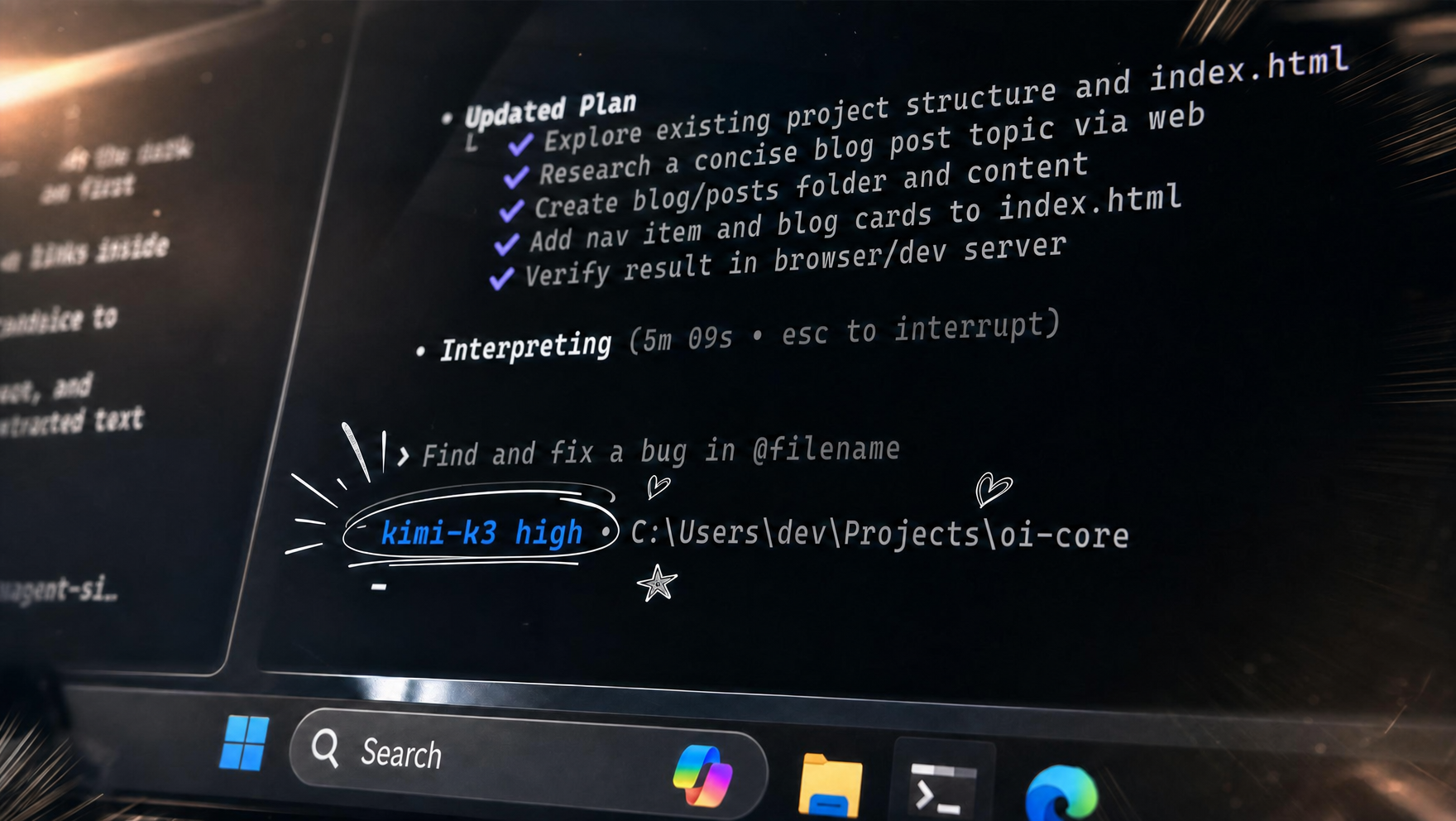
Today: Kimi K3 is here. We have reimplemented the provider-recommended
Kimi Code harness in Rust, giving you
maximum K3 performance with a Codex-like interface.
Kimi Docs →
Installation
macOS and Linux:
curl -fsSL https://www.openinterpreter.com/install | sh
Windows:
irm https://www.openinterpreter.com/install.ps1 | iex
Then type i or interpreter in your terminal to start a session.
Harness Emulation
Open Interpreter is a fork of OpenAI's Codex, with a focus on emulating the agent harness that gets the best performance out of low-cost models.
Use /harness to switch the active harness:
> /harness

native
claude-code
claude-code-bare
zcode
kimi-code
kimi-cli
qwen-code
deepseek-tui
swe-agent
minimal
Read more in the harness docs and provider setup guides.
ACP compatible, Codex compatible
Open Interpreter works in ACP-compatible editors and clients. Configure the client to launch interpreter acp; see the ACP guide for examples.
Already building with OpenAI's Codex SDK? Keep the SDK and make a one-line
binary override:
-const codex = new Codex();
+const codex = new Codex({ codexPathOverride: "interpreter" });
Open Interpreter speaks the same Codex exec protocol. See the SDK guide and run scripts/test-codex-sdk-compat.sh for a local, provider-free compatibility check.
Portable by default
Open Interpreter should fit into your existing agent setup instead of trapping
it in an Open Interpreter-only format. The product goal is to prefer shared,
tool-neutral standards and directories, keep user-authored data in readable
files, and make moving to or from another compatible agent straightforward.
Today that includes repository AGENTS.md, shared .agents/skills directories,
MCP, ACP, and the Codex exec protocol. Product-specific storage under~/.openinterpreter is reserved for configuration and runtime state that does
not yet have a practical shared standard. Legacy product-specific skill
directories remain readable for compatibility, but new skills belong in.agents/skills or ~/.agents/skills.
See the portability guide for the current boundary and
the rules for evolving it.
Computer Use
Open Interpreter ships with a QA skill that lets any model operate and test interfaces. It can drive web apps in a real browser with agent-browser, or operate and test native apps with trycua.
Features
- Runs commands inside native sandboxing on macOS, Linux, and Windows.
- Switches providers and models from the TUI with
/model. - Runs any selected OpenAI-compatible provider through Chat Completions with
interpreter --chat-completionsorinterpreter exec --chat-completions. - Inspects or switches Rust-native model harnesses with
/harness. - Tests web and native apps through the built-in QA skill.
- Runs as an Agent Client Protocol agent for editors with
interpreter acp. - Reuses shared
AGENTS.mdinstructions and.agents/skillsdirectories. - Keeps product-only config and session state local under
~/.openinterpreter. - Supports
exec, MCP, skills, hooks, permissions, andAGENTS.md.
Documentation
- Terminal docs
- Quickstart
- Install guide
- Configuration
- CLI reference
- Harnesses
- Model provider guides
- Agent Client Protocol
- Codex SDK
- Portability
- Sandbox & approvals
- Branding a distribution fork
Provider and model membership is generated, not maintained as Rust lists. Fromcodex-rs, refresh all hosted providers withpython3 scripts/write_provider_catalog.py, or repeat--provider <provider-id> to update only selected provider entries. Live model
sources require the provider credentials documented in the
provider docs.
[!NOTE]
This is the new Rust version of Open Interpreter, based on Codex. Looking for the original Python project? It lives on as a community-maintained fork at endolith/open-interpreter.
License
Apache-2.0
Yorumlar (0)
Yorum birakmak icin giris yap.
Yorum birakSonuc bulunamadi