nobrainer-tech-flow
Health Uyari
- License — License: MIT
- Description — Repository has a description
- Active repo — Last push 0 days ago
- Low visibility — Only 5 GitHub stars
Code Gecti
- Code scan — Scanned 12 files during light audit, no dangerous patterns found
Permissions Gecti
- Permissions — No dangerous permissions requested
Bu listing icin henuz AI raporu yok.
From task to done. A portable workflow for AI agents: clarify the goal, do the work, check the result.

NoBrainer Tech Flow
From task to done.


NoBrainer.tech · Flow overview · Production-ready agentic workflows
Tell it what you need. Flow clarifies the goal, does the work, and checks the result.
Say “Use nb-ultra” (or invoke $nobrainer-ultra in Codex) to fix code, prepare
an everyday document, or investigate a problem. Clear tasks go straight to execution;
meaningful ambiguity gets one focused question round. Done means the agreed
criteria are met and the result is checked. A real blocker is reported with the
next unblock action.
A quick answer stays a quick answer. The model-neutral workflow uses one plan,
bounded corrective attempts and a Markdown checkpoint for longer work. Native
goals, telemetry, subagents and client-specific tools are optional.
Existing installations keep the nobrainer-tech-skills package/plugin ID and all
skill commands. See the Flow migration guide.
Source-backed comparison decisions
cover the current collected Trending snapshot and explain what we adopted or retained.
Try one real task
Install safely, start a fresh session, then give the agent a
small task with a checkable result:
Use nb-ultra. Fix one bug in this project. Reproduce it first, make the
smallest correction and run the relevant check. Tell me what changed and
what remains unverified. Ask only if a missing decision changes the result.
Prefer a non-coding trial? Try an invitation, a small code fix or a bounded
command. The guide gives explicit acceptance criteria so you
can judge your own result. These are trials, not promised benchmark scores.
Install safely
Clone a reviewed ref, validate it, preview exact targets, then apply:
(
  set -u
  : "${NB_REVIEWED_COMMIT:?set a reviewed full 40-character commit SHA}"
  test "${#NB_REVIEWED_COMMIT}" -eq 40 || exit 2
  case "$NB_REVIEWED_COMMIT" in *[!0-9a-f]*) exit 2 ;; esac
  git clone --no-checkout https://github.com/nobrainer-tech/nobrainer-tech-flow.git || exit 3
  cd nobrainer-tech-flow || exit 3
  git checkout --detach "$NB_REVIEWED_COMMIT" || exit 3
  test "$(git rev-parse HEAD)" = "$NB_REVIEWED_COMMIT" || exit 3
  python3 scripts/validate_skills.py --suite || exit 4
  python3 scripts/install_skills.py --client codex || exit 4
  python3 scripts/install_skills.py --client codex --apply || exit 4
)
Set NB_REVIEWED_COMMIT to the exact full commit SHA you reviewed. Tags and
branches are rejected because they can move; every failed gate stops before the
next command.
The installer defaults to all fifteen canonical skills, supports an exact
subset, refuses foreign targets and can use links or copies. Restart the client
and perform clean-session discovery before claiming runtime installation. Full
client-specific steps and rollback are in Installation.
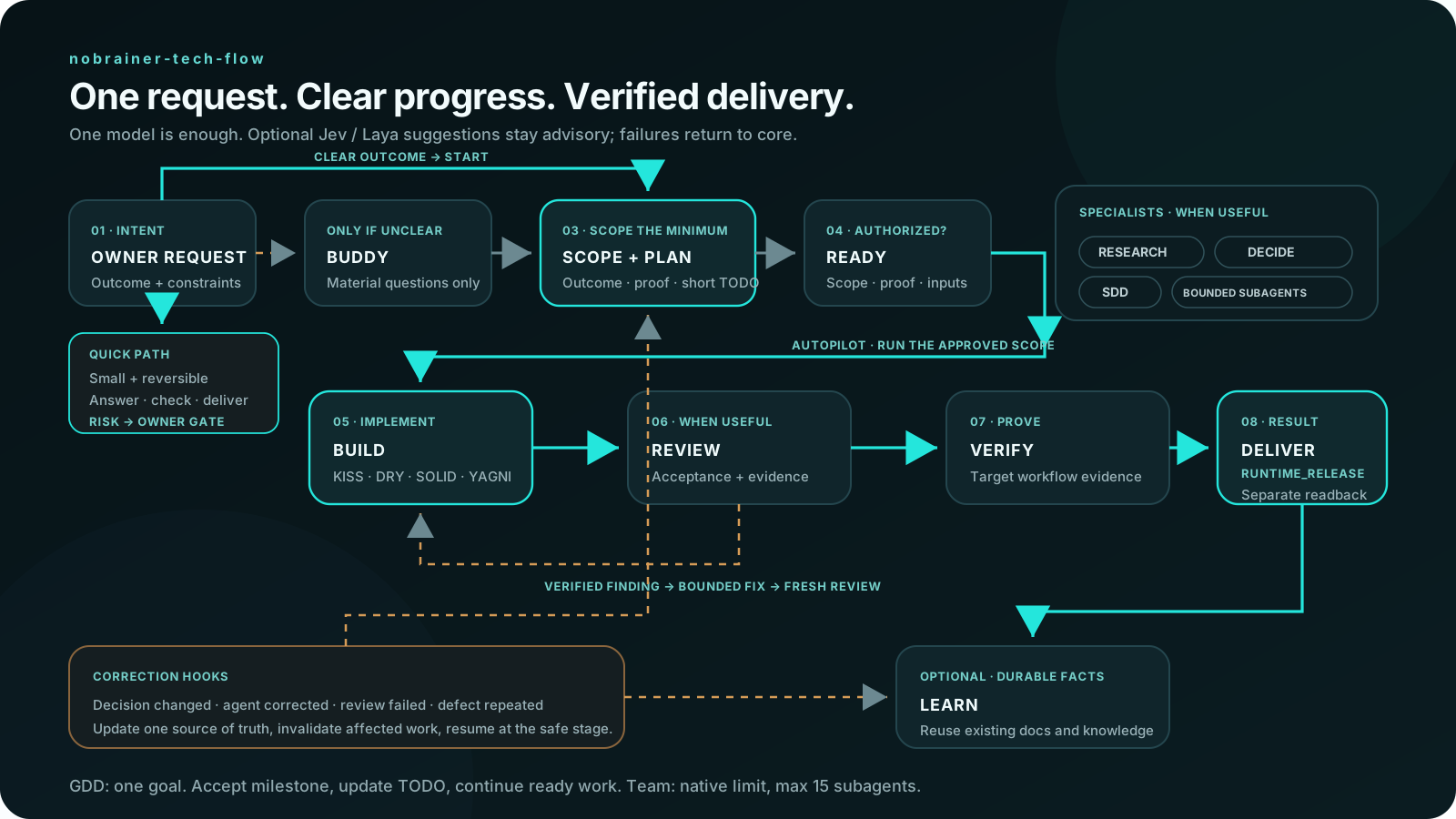
GitHub flow chart
flowchart TD
    A[One outcome] --> B{Material ambiguity?}
    B -->|yes| C[BUDDY: one focused question round]
    B -->|no| D{Small and clear?}
    C --> D
    D -->|yes| E[Direct answer or edit; check the result]
    D -->|no| F[SCOPE + PLAN: outcome, authority, proof; concise TODO]
    F --> G[AUTOPILOT: execute the authorized scope]
    G --> H[Verify; independent REVIEW when useful]
    H -->|verified defect; attempt budget remains| G
    H -->|acceptance met| I[Audit delegated artifacts and stop owned workers]
    H -->|blocked| J[Checkpoint; report one unblock action]
    E --> K[Deliver evidence and stop]
    I --> K
    F -. optional .-> L[Markdown goal for resume]
    G -. independent work .-> M[Bounded native subagents]
    M --> H
    L -. unavailable native goals or telemetry .-> G
Astra Ready Flow, portable by design
Version 1.6 removes client-specific prerequisites from ordinary work.
OpenAI introduced GPT-6 Astra on
September 3, 2026. The suite keeps the host-selected model and uses the same
plain-text instructions with other models; it does not pin a provider or choose
an expensive tier automatically.
Compatibility separates available models, tested
behavior, client loading and source distribution. Local smoke evidence covers
only its recorded source and scenarios. It is not a universal compatibility,
quality or token-savings benchmark.
The 1.6.1 instruction review
clarifies user authority, skill-caused pauses and when verification is sufficient.
The same rules apply across models; historical runtime proof stays tied to the
tested release bytes.
Small task       -> direct result + relevant check
Larger task      -> clarify if needed + short TODO + execute + verify
Resumable task   -> same workflow + one Markdown goal/checkpoint
Independent work -> optional bounded subagents, audited before integration
Load specialists only when needed. Reuse the project's instructions, tests,
specs and wiki. Choose SDD for durable contracts and TDD when a failing test
would expose the behavior; neither requires installing a framework.
See the v1.6 review and research decisions.
Start with one skill
Use nobrainer-ultra for setup or any non-trivial
outcome. A small reversible edit without a public contract, routing, workflow or
portfolio change can use its quick path; other changes use the full path and its
coherence gate.
In Codex, explicit invocation is $nobrainer-ultra; nb-ultra is a
natural-language trigger phrase and therefore depends on a client's implicit
description matching.
DRIFT_CHECK -> BUDDY -> SCOPE -> AUTOPILOT -> VERIFY -> RECEIVE_AUDIT -> LEARN
BUDDYis the first and only ordinary clarification stage.SCOPEfreezes outcome, non-goals, expected files, proof, untouched work,
minimum solution, test decision and clean completion before a non-trivial write.- One canonical plan owns TODO state; the owner sees only a compact Progress
checklist and one next action. - A durable ledger adds exact identity, dependencies, checkpoints, retries and
rollback only for cross-session, dependency-rich or consequential work. AUTOPILOTcontinues through routine approved work without repeated check-ins.nobrainer-teamselects the minimum useful capabilities;nobrainer-dispatcherschedules only approved ready work in bounded batches;nobrainer-sessionscreates or reuses exact visible sessions only when
parallelism, isolation, handoff or independent evidence earns the cost.- Failed review returns to
nobrainer-build; changed code invalidates old proof. - Merge, deploy, publishing, spending, credentials, destructive operations and
production mutation remain owner gates unless exact authority is already
recorded.
The two execution axes stay independent:
CONTROL_MODE: BUDDY -> AUTOPILOT
SESSION_MODE: MAIN | MULTI_SESSION
For resumable or delegated work, SESSION_HEALTH_GATE uses available,
configured limits. Missing optional telemetry lowers the health claim and still
allows bounded safe work. An explicitly required hard budget must be enforceable.RUNTIME_RELEASE concerns actual task-owned workers; a completed result does not
prove they stopped. GOAL_FILE is optional Markdown recovery state. A native goal
is used only when available and authorized; the file alone suffices.
Autopilot works in one MAIN session. Native subagents need a scoped assignment,
observable completion and reviewed output. Use persistent sessions and a
Dispatcher only when a real handoff or dependent queue needs them.
Fifteen skills, distinct ownership
Aliases are trigger phrases, not duplicate directories. Each skill owns one
recurring boundary:
| Skill | Alias | Responsibility |
|---|---|---|
nobrainer-ultra |
nb-ultra |
End-to-end setup and delivery: one requirements gate, concise progress, bounded execution, recovery, audit and learning |
nobrainer-team |
nb-team |
Minimal capability roster, installed-skill inventory and safe temporary specialist discovery |
nobrainer-dispatcher |
nb-dispatcher |
Dependency-aware ready-set scheduling, bounded dispatch, backpressure and audited result routing |
nobrainer-research |
nb-research |
Bounded current research from primary sources with facts separated from inference |
nobrainer-writing |
nb-write, nb-brief |
High-signal drafting, compression and short human-sounding comments, issues and stories that preserve meaning, evidence, voice and action |
nobrainer-build |
nb-build |
Smallest verified implementation using calibrated KISS, DRY, SOLID, YAGNI and anti-slop gates |
nobrainer-security |
nb-security |
Threat models, security review, supply-chain audit and high-risk release evidence |
nobrainer-sessions |
nb-sessions |
Named visible sessions, exact identity, isolated writers, audited handoff, lease and recovery |
nobrainer-spec-driven-development |
nb-sdd |
Durable specification and acceptance ledger when contracts, risk or resumability justify it |
nobrainer-wiki |
nb-wiki |
Targeted retrieval and sourced durable knowledge without hidden memory or live task state |
nobrainer-browser |
nb-browser |
Playwright-first rendered inspection, bounded CDP profile restart, approved session attach, browser tests and trace evidence |
nobrainer-autoimprove |
nb-autoimprove |
Measured baseline/variant/eval/holdout improvement with keep-or-revert |
nobrainer-decide |
nb-decide |
Consequential decisions with different-shaped options, scoring, attack and one commitment |
nobrainer-rca |
nb-rca |
Read-only causal diagnosis with a continuous evidence chain and explicit uncertainty |
nobrainer-review |
nb-review |
Acceptance trace, adversarial bug hunt and release close gate without speculative findings |
The curation audit records why each skill exists and
what belongs in another skill instead of becoming a sixteenth trigger.
Correct once, improve permanently
Ultra contains portable semantic hooks for four events:
OWNER_DECISION_CHANGEDupdates the canonical decision, marks the old value
superseded and invalidates dependent TODO items and evidence;AGENT_ERROR_CORRECTEDfixes the active result and classifies one minimal
prevention candidate:AUTO_SCOPEDmay persist it to one governed canonical
project-local store,ASKprepares one exact diff, andOFFkeeps it
task-local without a durable diff;REVIEW_FAILEDcreates a bounded Build correction and sends fresh evidence
back to Review;REPEATED_DEFECTstops blind retries and invokes RCA with the prior failure
fingerprint.
Only durable, sourced, authorized and non-secret knowledge is promoted throughnobrainer-wiki. One mutable fact has one canonical owner; the system does not
append contradictory copies to the plan, instructions and wiki.
Project setup records LEARNING_WRITE_POLICY: AUTO_SCOPED | ASK | OFF, so an
owner can enable automatic project-local learning without granting global or
publishing authority.
Quality without AI slop
The shared delivery contract operationalizes:
KISS: the simplest complete design wins;YAGNI: no speculative extension points or future options;DRY: deduplicate owned knowledge and state, not incidental similarity;SOLID: cohesive responsibilities and stable boundaries without class or
interface ceremony;- evidence: no invented APIs, fake runtime claims, placeholder logic, swallowed
errors, generic prose, broad unrelated rewrites or mock-only confidence; - content quality: purpose, audience, correctness sources, completeness,
coherence and target-workflow usefulness are frozen before execution.
If a decision-relevant fact may be current, niche, uncertain, high-stakes or
source-attributed, Ultra routes the smallest sufficient check through Research.
A stable local syntax, import, test or configuration error starts from local
evidence instead of an automatic wiki/web detour. If required primary evidence
is unavailable, it says RESEARCH_BLOCKED instead of guessing.
Compatibility is a proof ladder
All clients consume the same skills/ tree. Thin adapters cover Claude Code,
Codex, Cursor, OpenCode, Gemini CLI, Kimi Code and Pi; the portable Agent Plugin
manifest and project instructions are the fallback for other Agent Skills
consumers.
Compatibility claims use five distinct levels:
SOURCE_VALIDATED -> REPOSITORY_CHECKED -> CLIENT_LOADED
                 -> RUNTIME_VERIFIED -> DISTRIBUTED
A valid manifest does not prove clean-session routing. A local test does not
prove production. See Compatibility for current proof
and Testing for acceptance evidence.
Current source version: 1.7.1. Check the
latest published GitHub release
for distribution and the v1.7.1 rebrand record for the
preserved installation identities. The unchanged command runner keeps its
v1.7.0 verification scope. Source publication does not
imply client marketplace discovery or improved model reasoning. The earlier
v1.6.1 publication readback
remains historical evidence.
Version v1.5.0 remains an
accepted rollback source release. Its historical pre-publication checkpoint isdocs/releases/v1.5.0.md.
Version v1.4.0 remains the
previous accepted source release and rollback option. Client-specific runtime
rows remain evidence-scoped; source publication does not imply marketplace
discovery.
The v1.3.1 release remains the
previous accepted source release and a rollback option. It adds the EnglishBRIEF writing mode, concise issue/story templates and surface-specific bug
evidence.
The v1.3.0 release remains an
older accepted source release and rollback option.
Version v1.2.1 remains the rollback source release
at full commit 0010140d19a7ff847dff776569772ef04d82c314, with its own exact
tag, archive and isolated-install evidence. To reproduce the reviewed v1.3.0
source:
git checkout --detach 8ae4a26548ce908fc5f98b22663f52e163541f56
test "$(git rev-parse HEAD)" = "8ae4a26548ce908fc5f98b22663f52e163541f56"
python3 scripts/validate_skills.py --suite
python3 -m unittest discover -s tests -q
v1.2.0 remains published but failed archive acceptance; its exact boundary is
recorded separately. GitHub reports the v1.2.1
release object as non-immutable and tag protection was not independently
verified, so security-sensitive consumers should pin the full commit SHA. The
current tag archive was re-read after the metadata-only history rewrite and
passed 88/88 tests; historical CI binds the same tree, not the current commit
identity.v1.1.0 remains the accepted rollback anchor at full
commit 711be31d654835a04ef8c70674c3e493aeb2da8a.
One source, thin adapters
skills/               canonical portable behavior
adapters/bootstrap.md small session-start route to Ultra
hooks/                tested client lifecycle adapters
scripts/              validation and conflict-safe installation
tests/                deterministic and behavior-contract gates
docs/                 compatibility, curation, eval and release evidence
assets/               brand and workflow diagrams
Client-specific forks of a skill are prohibited. External skills discovered by
Team are untrusted input: inspect the exact source/ref, instructions, scripts,
permissions, network/credential behavior, trigger overlap and rollback. Prefer
temporary project-scoped use; persistent or global installation is an owner
gate.
Attribution
nobrainer-autoimproveis an independent adaptation of Andrej Karpathy's
autoresearch measure-change-keep
loop.nobrainer-wikiis an independent adaptation of Andrej Karpathy's
LLM wiki concept.- Other external design sources remain cited inside the exact skill where they
influenced a behavior contract.
Contributing and security
Read CONTRIBUTING.md, SECURITY.md and
RELEASE-NOTES.md. Every change goes through a focused PR,
pressure scenario, validators, diff review and secret scan. Do not report
publication, distribution, live routing or user-visible success without
readback from that layer.
NoBrainer Tech builds practical agentic workflows for teams that want speed
without surrendering control. Learn more at nobrainer.tech
or browse ready-to-use workflow products on
Gumroad.
Yorumlar (0)
Yorum birakmak icin giris yap.
Yorum birakSonuc bulunamadi