membridge
Health Uyari
- License — License: NOASSERTION
- Description — Repository has a description
- Active repo — Last push 0 days ago
- Low visibility — Only 5 GitHub stars
Code Basarisiz
- fs.rmSync — Destructive file system operation in app/main.js
- fs module — File system access in app/main.js
- network request — Outbound network request in app/main.js
- child_process — Shell command execution capability in bin/membridge.js
- spawnSync — Synchronous process spawning in bin/membridge.js
- fs.rmSync — Destructive file system operation in bin/membridge.js
- process.env — Environment variable access in bin/membridge.js
- fs module — File system access in bin/membridge.js
- os.homedir — User home directory access in lib/adapters/claude-code.js
- os.homedir — User home directory access in lib/adapters/codex.js
Permissions Gecti
- Permissions — No dangerous permissions requested
Bu listing icin henuz AI raporu yok.
A shared memory and collaboration tool for teams. Syncs context between Claude Code, Codex, Gemini, and any AI agent.

Your team shares a codebase.
Now your AI shares a memory.


MemBridge is a menu-bar app and CLI for teams that code with AI. A tiny
local daemon watches the session logs your tools already write, distills
each one into a small per-project memory, and injects it into the context
files every agent reads at startup.
curl -fsSL https://membridge.me/install.sh | sh
local-first · no account · no API keys
The one-liner is macOS (Apple Silicon). Everywhere else:npm install -g membridge && membridge start. Every install option, the
full CLI, configuration, and the FAQ live in the guide —
and this page has an animated twin at
docs/readme.html (membridge.me).
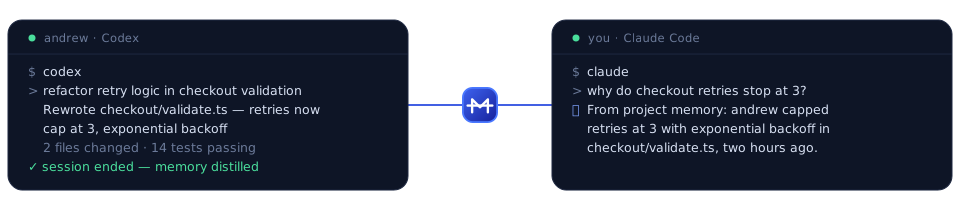
One session ends. Every agent remembers.
When Andrew's Codex refactors checkout validation, a redacted digest syncs
to the team. Next time you open the project, your Claude Code already knows.
Three quiet steps
| 01 · Watch — Session logs | 02 · Distill — Per-project memory | 03 · Inject — Context files |
|---|---|---|
| A tiny local daemon tails the JSONL session logs your tools already write — Claude Code, Codex, Gemini CLI, any JSONL logger. | Each session is distilled into a small per-project memory: decisions made, gotchas found, who owns what. | The memory lands between markers in CLAUDE.md, AGENTS.md and GEMINI.md — read by every tool at startup. |
A memory block, between markers
MemBridge owns only what sits between its markers. The rest of your file is
never touched.
<!-- membridge:begin -->
## Project memory · updated 2h ago
checkout retries cap at 3 with exponential backoff (validate.ts)
payment webhooks replay from stripe-cli in dev — never mocked
e2e tests need POSTGRES_ISOLATION=strict or they flake              ← new
andrew owns the pricing service — ask before touching rate tables   ← new
<!-- membridge:end -->
Small surface, sharp edges
- Team feed — a redacted digest syncs to your team — optionally.
Everything starts local: no cloud, no account, no API keys until you
join one. - Summaries by the agent itself — session summaries are written by the
agent that did the work, not reconstructed by a heuristic after the fact. - Copy-for-AI digest — one click copies a compact project digest for
any chat window that can't read your files. - MCP server — project memory is also exposed over MCP, for tools that
would rather query than read a file. - Custom adapters — point MemBridge at any tool that logs JSONL with a
small adapter. If it writes sessions, it can share them. - Secret redaction — keys, tokens and private paths are scrubbed before
anything leaves your machine.
There's more in the guide: the dashboard tour with
screenshots, session summaries and the Stop hook, team sync and privacy,
self-hosting, BYOK roadmaps, the CLI table, custom adapter config, and
development docs.
source-available · free core, zero runtime dependencies · membridge.me
Yorumlar (0)
Yorum birakmak icin giris yap.
Yorum birakSonuc bulunamadi