ocelin
Health Pass
- License — License: MIT
- Description — Repository has a description
- Active repo — Last push 0 days ago
- Community trust — 11 GitHub stars
Code Pass
- Code scan — Scanned 12 files during light audit, no dangerous patterns found
Permissions Pass
- Permissions — No dangerous permissions requested
No AI report is available for this listing yet.
Ocelin: a local Windows companion for Codex and Claude. Live sessions, app memory, conversation previews, searchable history and selectable taskbar integrations.
Ocelin
Formerly Clawdeck. A local companion for Codex and Claude Code, with Windows status, conversation previews, and a searchable session library. Choose your desktop surfaces; they share one monitor.
Website · Windows preview downloads · Desktop setup and compatibility
The browser core keeps zero runtime dependencies. The optional desktop package bundles Electron and Node. The GitHub repository is now m-sanchez/ocelin; old repository links redirect here. The npm package and clawdeck command remain compatible; ocelin is an additional CLI alias.
Windows companion
Download the x64 installer from Releases. Sign-in startup and lifecycle hooks are optional. The preview is unsigned; automatic updates are not enabled.
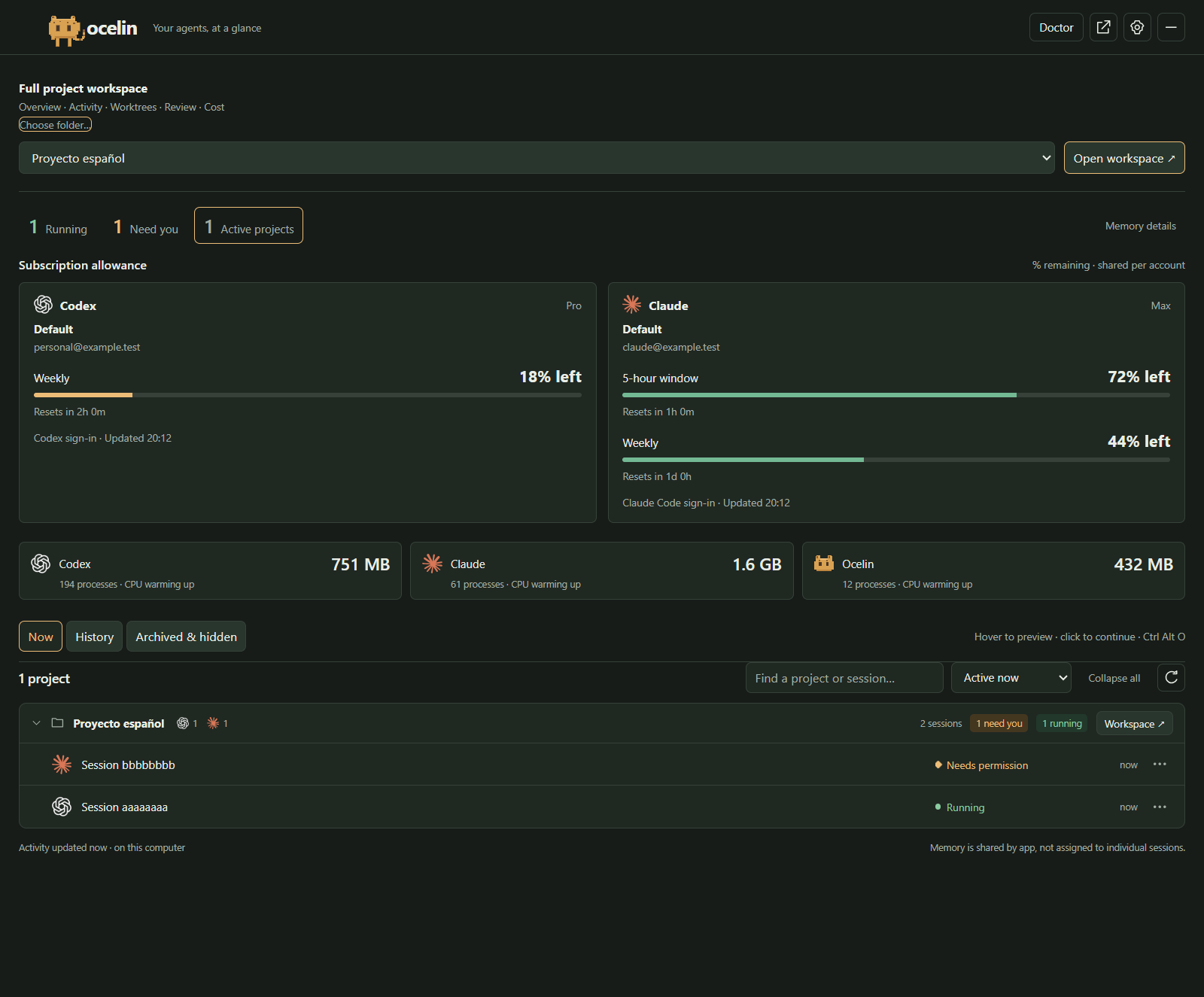
Now groups active sessions by project and shows measured app RAM. Hover a conversation to read its latest request and response; click to continue in the exact Codex or Claude task. History searches saved conversations, including those with missing project folders. Select old sessions to hide them in Ocelin, or archive/restore Codex sessions through its native API.
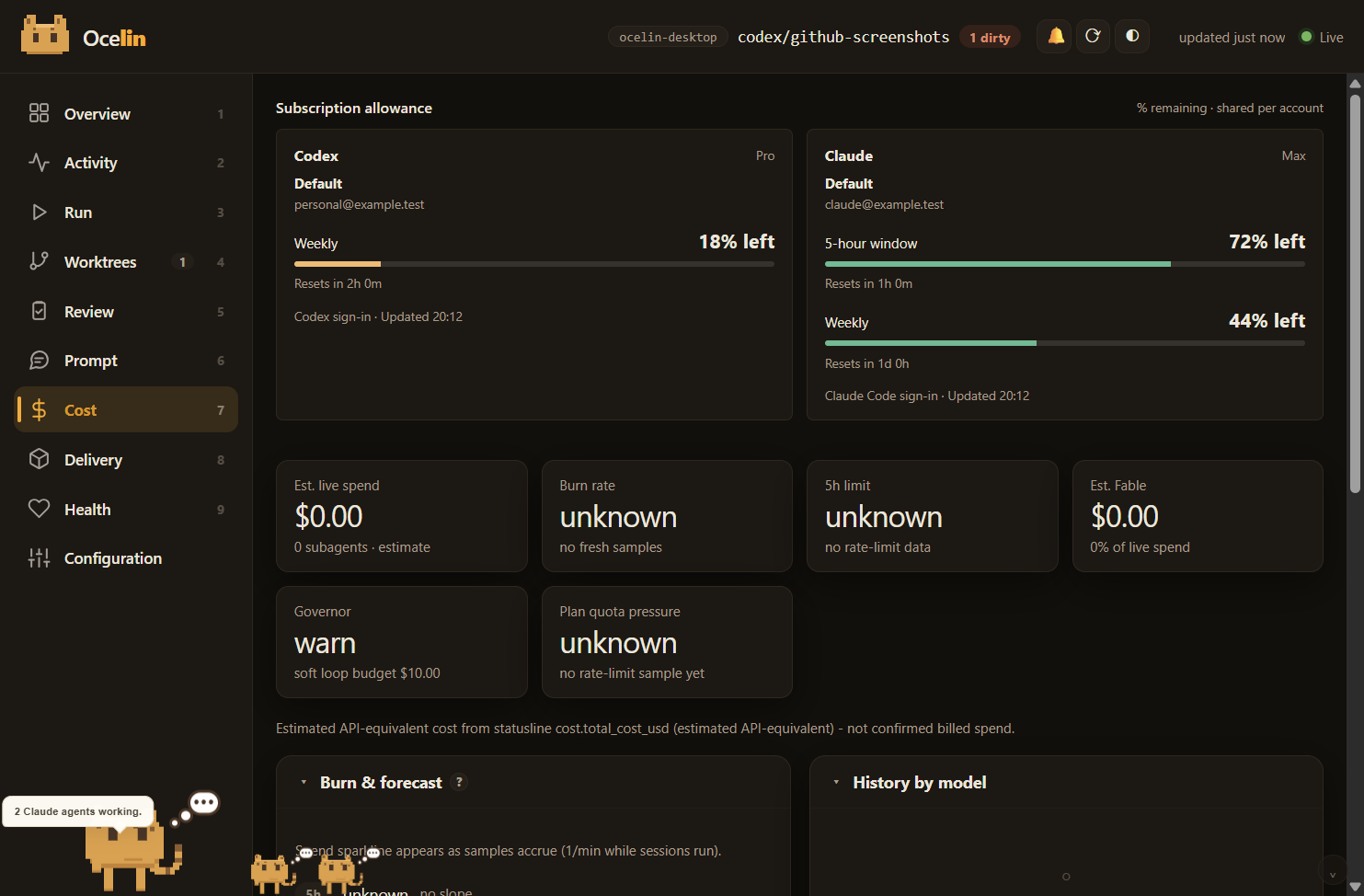
Subscription allowance shows the percentage left for each reported Codex and Claude session, weekly and model-specific limit, with reset countdowns. The desktop refreshes signed-in provider readings every two minutes; the project Cost page uses the same local snapshot. Missing or expired readings stay unavailable. Usage sources and account scope.
Connect additional signed-in local profiles in Settings → Account profiles for separate allowance cards and source labels on sessions. Use Open workspace at the top of the panel to return to the original project tools, or Choose folder… to open another project.
Windows options include the tray, Ctrl Alt O quick panel, floating bar, dashboard, a native App Tasks development bridge, and the optional Taskbar Widgets strip. Native shell features have additional OS/package requirements. What 0.6 implements and how it was validated.

From source (Node 22.12 or newer):
cd desktop
npm ci
npm start
Browser dashboard




An unofficial local dashboard for Claude Code and Codex. Point it at any project you
work on with either assistant and it shows what is actually happening: live
sessions, an event timeline, cost and context telemetry, git worktrees,
reviews, and delivery state - in one local web UI.
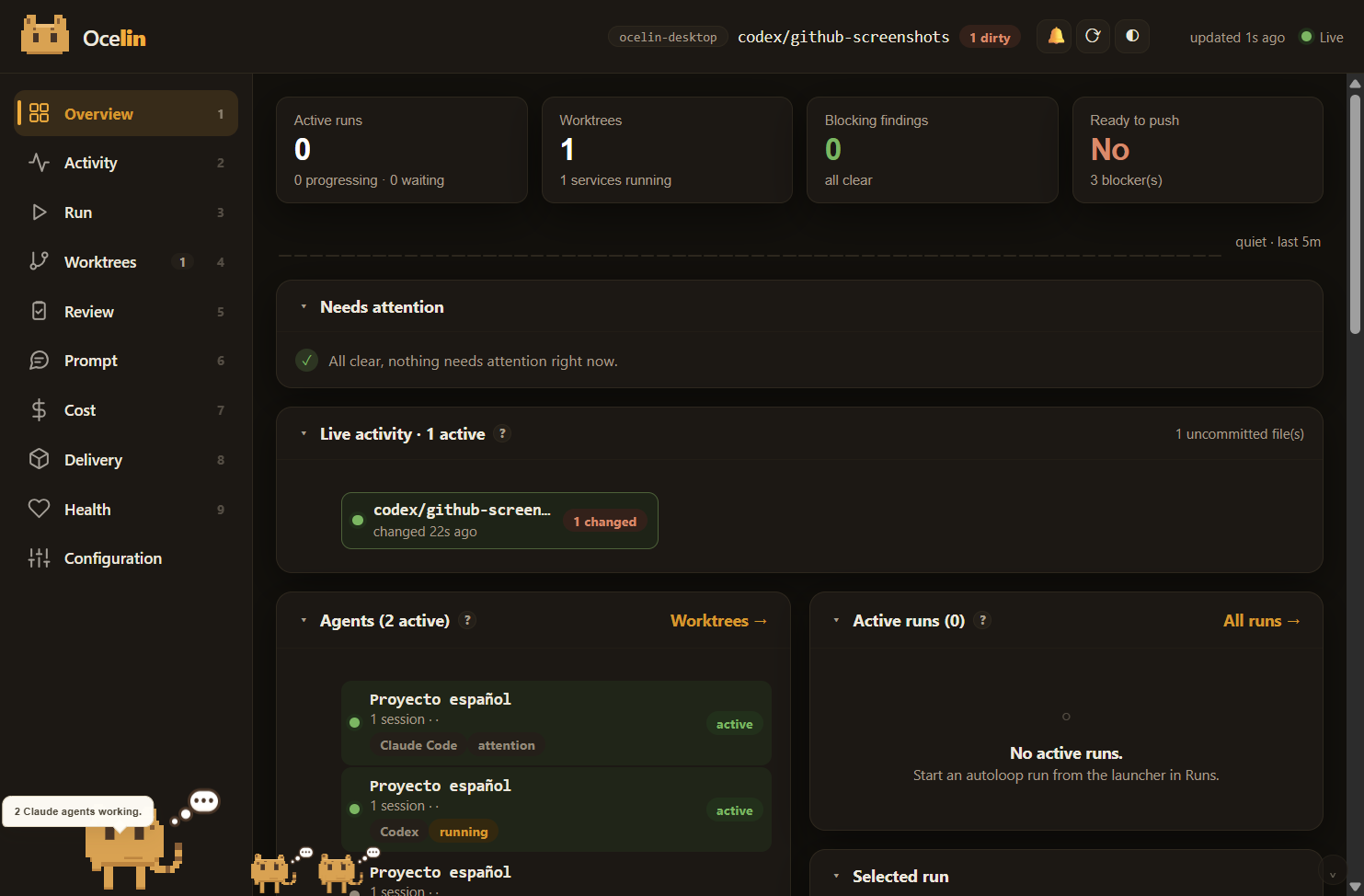
Existing project dashboard (screenshot from the earlier Clawdeck release):
Feature tour
Git + Claude Workbench (Delivery hub) - what stands between this branch
and a shipped change, connected to the code and to Claude.
- Readiness answers two questions separately, because they are different
questions: can the REMOTE change merge, and has all the LOCAL work reached
it. A dirty worktree blocks the second and not the first. Each axis isREADY | BLOCKED | UNKNOWN, and UNKNOWN is a real answer - "I cannot show
that you can merge" is not "you can merge". - Review Inbox imports the PR/MR discussion read-only, maps each comment to
the line it now points at (anchor-aware, so a line that moved by eight reads
as moved, not changed), and derives a state with its evidence attached. Fact,
derivation and model output are three different visual grammars; every derived
state has aWhy?that shows the reasons verbatim. - CI is read for the commit the change is on, never for "the latest run",
and covers every check context - a green Actions run beside a failing
external status isfailing, and an incomplete read isunknown, never a
pass. Failing jobs offer their output (tail only, secret-scanned) and a
scopedFix locallytask. - Attention is what needs a person, kept apart from what blocks delivery:
an unpushed commit blocks shipping and needs nobody's judgement, so it never
reaches the badge. - Decision ledger records why the change went the way it did. Claude can
draft; only a person can decide, and the record says which.
Ocelin never writes to the forge. There is no reply, resolve, approve or
merge action, no mutation document in the provider layer, and model output can
never move state - only a human action promotes advice into anything.
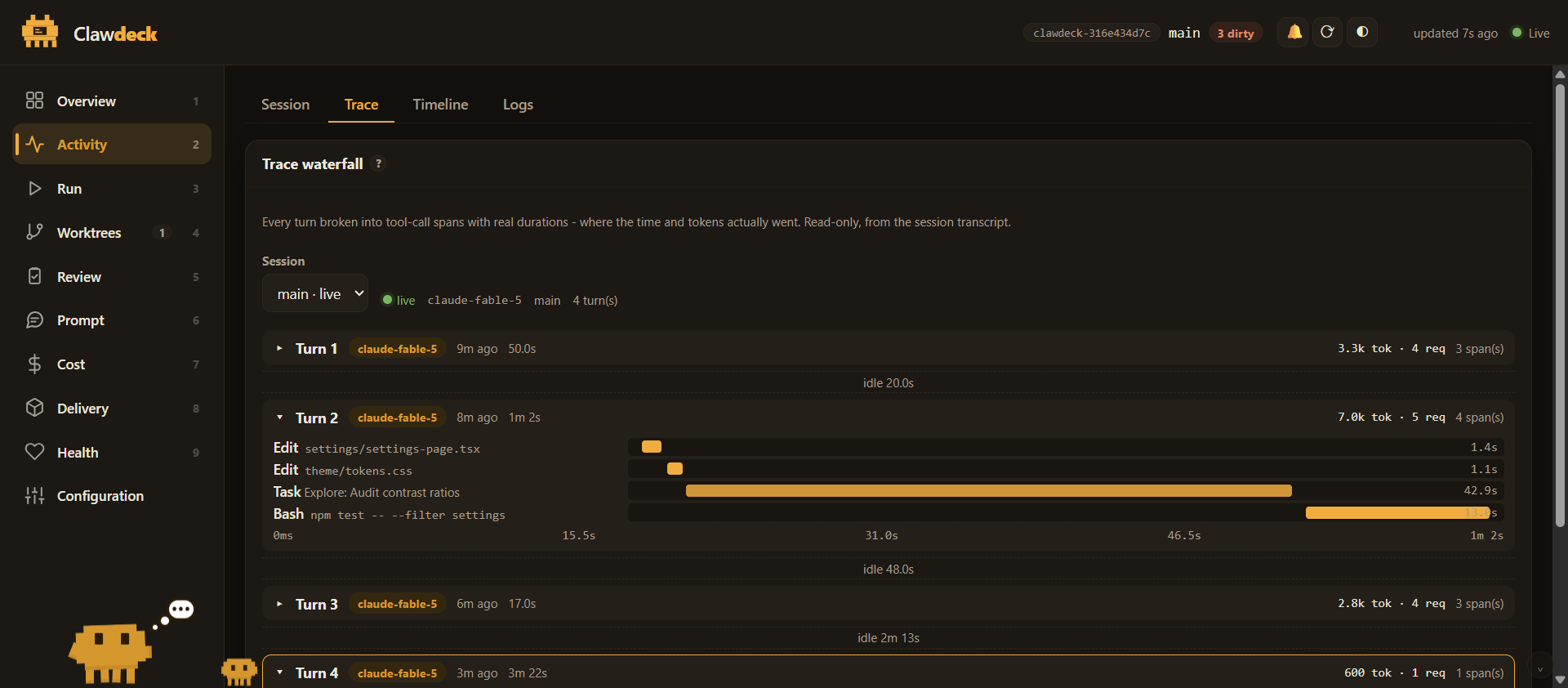
Trace waterfall - every turn of a session broken into tool-call spans
with real durations: subagent tasks, failing commands, and human-wait spans
(dashed, width-capped) at a glance.
Burn rate & forecast - $/hour from statusline cost deltas, 5h/7d
depletion slopes with ETA, per-model token history over 7d/30d/all-time
windows. Estimates are labelled as estimates; unknowns stay unknown.
Ask Ocelin (Prompt hub) - ask questions about panel state, answered by
a local claude -p child running tool-less in a sterile temp dir; the only
context sent is a compact, secret-scanned snapshot summary.
Also in the box:
- Config map (Configuration) - every rule, slash command, skill, agent,
MCP server, and hook the checkout declares to Claude Code, overlaid with
what recent sessions actually invoked. Dead config shows up dim. - MCP & skills analytics (Cost) - per-server call counts, error rates,
and durations from recent transcripts: evidence for whether a server earns
its context cost. - Host vitals (Health) - CPU, memory, and checkout-volume disk next to
the panel's own self-performance numbers. - Cheap refreshes - snapshots carry per-section content hashes, so
unchanged views skip re-rendering,/api/snapshotanswers 304, and the
page revalidates when you come back to the tab.
Principles:
- Zero dependencies. Pure Node stdlib on the server, browser-native ES
modules in the UI. No build step, nonode_modules. - Loopback-only. Binds
127.0.0.1, refuses foreignHostheaders, gates
privileged routes behind a per-launch bearer token. - Degrades gracefully. Everything works read-only on a bare git repo; more
signal appears as you opt in to the hooks, statusline bridge, and OTEL.
Ocelin is a community project. It is not affiliated with or endorsed by
Anthropic or OpenAI.
Quickstart
The 0.6 preview browser package is attached to the GitHub release. The npm registry still carries the earlier Clawdeck release.
npm install --global https://github.com/m-sanchez/ocelin/releases/download/v0.6.4/clawdeck-panel-0.6.4.tgz
ocelin run --checkout /path/to/your/project
Or from a clone:
git clone https://github.com/m-sanchez/ocelin.git
cd ocelin
node scripts/panel-run.mjs --checkout /path/to/your/project
That alone gives you the git-level views (worktrees, diff, commits, MR draft)
and session liveness from Claude Code and Codex's local transcript files — zero setup,
nothing written to your project, one loopback server that stops when you
close it.
Codex sessions are discovered automatically under CODEX_HOME/sessions
(~/.codex/sessions by default), matched to the observed checkout and its
git worktrees. Local desktop and CLI sessions appear with a Codex label;
the Session and Trace views show messages, tool results, durations, and
recorded token usage. Completed or interrupted turns show as idle.
Discovery polls up to 5,000 recent rollout files and reads bounded transcript
headers and tails; archived and cloud-only sessions are not included.
Codex cost is unknown, and the hook timeline, cost dashboard, task lists,
and subagent tree remain Claude Code integrations.
Use a clone or global install for init, which writes generated /panel slash commands referencing the install path. Temporary npm cache paths can be garbage-collected.
Install the integration (optional, recommended)
The event timeline, activity feed, and cost views are fed by a tiny hook +
statusline bridge you install into the observed project:
ocelin init --target /path/to/your/project --statusline
init copies the emitter hook (and its lib) into the project's.claude/hooks/, installs /panel slash commands, and prints the hook
registrations to paste into .claude/settings.json - or merges them for you
with --write-settings (only ever appends its own entries; backs up first).
Restart your Claude Code session afterwards.
What you get at each level
| Setup | What lights up |
|---|---|
| bare git repo | Overview, worktrees, diff/review views, MR draft, session pulse |
| + event hooks | live event timeline, per-session activity, delivery lifecycle |
| + statusline bridge | live cost, context-window, and model telemetry per session |
| + OTEL exporter pointed at the panel | token/cost metrics via OTLP-JSON |
| + forge token | MR/PR + pipeline status, merge tracking, notifications |
To point Claude Code's OTEL exporter at the panel, set these before
launching Claude (the panel prints its port and token on start; the/v1/metrics endpoint requires the panel token):
export CLAUDE_CODE_ENABLE_TELEMETRY=1
export OTEL_METRICS_EXPORTER=otlp
export OTEL_EXPORTER_OTLP_PROTOCOL=http/json
export OTEL_EXPORTER_OTLP_ENDPOINT=http://127.0.0.1:<panel-port>
export OTEL_EXPORTER_OTLP_HEADERS=x-panel-token=<panel-token>
Forge connectors
Ocelin auto-detects the project's git host from origin and speaks to it
read-only:
- GitHub (github.com + GHES) - PRs, review threads, and checks.
GITHUB_TOKENoptional for reading a public repo's status; needed for review
resolution and job logs. If theghCLI is signed in, Ocelin uses that
credential rather than asking you to configure a second one
(CLAWDECK_NO_GH_CLI=1turns that off). - GitLab (gitlab.com + self-hosted) - MRs and pipelines. Needs
GITLAB_TOKEN. - Bitbucket Cloud - PRs and Pipelines. Needs
BITBUCKET_TOKEN(a
repository/workspace access token). - Azure DevOps - PRs and builds. Needs
AZURE_DEVOPS_TOKEN(a PAT). - Gitea / Forgejo - PRs and commit status. Self-hosted hosts are
anonymous, so opt in withGITEA_URL(+GITEA_TOKENfor private repos).
Tokens live in the observed project's .claude/settings.local.json (or env),
or come from the signed-in gh CLI for GitHub, and never reach the browser.
Roadmap
See the delivery tracker and Windows compatibility notes. Native Windows local monitoring and the three selectable surfaces are implemented in the 0.4 preview. Future work includes WSL/remote sources, reserved-edge AppBar mode, and richer session hierarchy navigation.
Architecture
Claude Code hooks ──► durable spool (at-least-once) ──► single-writer store
                                                            │
statusline bridge ──► per-session telemetry records ────────┤
OTLP-JSON exporter ─► OTEL receiver ────────────────────────┤
                                                            ▼
                                             HTTP + SSE server (loopback)
                                                            ▼
                                             browser SPA (no build step)
The server never watches the filesystem; it polls adapters per request and on
a bounded SSE interval. See ARCHITECTURE.md and
docs/DECISIONS.md.
Security model
- Loopback bind + strict
Hostallowlist (anti-DNS-rebinding). - Per-launch bearer token, delivered to the browser only in the URL
fragment (never in served HTML, API bodies, logs, or Referers). - Separate per-launch ingest token for the event POST route.
- PID+nonce ownership checks so lifecycle scripts can never kill a reused PID.
- Single-writer lock on the canonical event store; a second panel degrades to
its own local store instead of corrupting the shared one. - Deep links to Claude are fail-closed secret-scanned: a prompt containing
suspected secret material refuses to become a URL. - The Workbench is read-only against every forge. REST calls are GETs, the
one GraphQL POST carries a frozen read-only query document, and no
reply/resolve/approve/merge action exists to be called. - A task brief goes to a file, never a URL. The deep link carries only the
task id, that path and a correlation marker, so review text and diffs never
enter browser or OS history. - CI job output is fetched per job, tail-bounded and secret-scanned in both
directions: a hit withholds the text, and a scanner that will not load
withholds it too. - No shell endpoint. Commands are a fixed allowlist with server-built argv.
Details: docs/SECURITY.md.
Development
npm test              # node --test
npm run self-test     # boots the server against this repo and checks /health
License
Reviews (0)
Sign in to leave a review.
Leave a reviewNo results found