louvain-engine
Health Pass
- License — License: Apache-2.0
- Description — Repository has a description
- Active repo — Last push 0 days ago
- Community trust — 14 GitHub stars
Code Pass
- Code scan — Scanned 12 files during light audit, no dangerous patterns found
Permissions Pass
- Permissions — No dangerous permissions requested
No AI report is available for this listing yet.
Permission-aware hybrid retrieval for AI agents and RAG: keyword and vector search over your documents with a permission fence inside every query. Self-hosted, MCP, Postgres + pgvector.

Permission-aware retrieval for enterprise AI.
Hybrid search over your company’s documents for agents and RAG, with a permission check in every query, from one command.

The open retrieval engine behind Louvain: it finds the right document in your company’s files, behind a permission
fence, and hands it to your agent with its source, self-hosted, over MCP and HTTP.
Louvain's own build scored 91.32% (preliminary, on a 100-question development sample); this repository doesn't reproduce it yet. EnterpriseRAG-Bench asks enterprise questions over a large company corpus and judges each answer on
whether it is correct and complete. How it was measured
Retrieval your agents can trust.
Retrieval that scores. Keywords and meaning search together, so the right document comes first however the
question is worded. Add a reranker in one line when you want more.
Permissions built in. Every query passes a permission check first. Add readers and grant each the collections it
may read, in config; Louvain syncs real permissions from your tools.
Fits your stack. MCP tools for your agents, plugins as plain functions, and Postgres underneath. Open source,
under Apache-2.0.
How it works
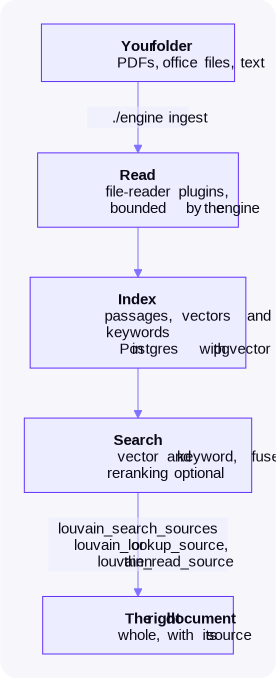
- Your documents. Folders, records or HTTP.
- The index. Keywords and meaning.
- Permission-checked search. The fence first, every query.
- Your agent or app. The right document, with its source.
Quickstart
Four commands to your first search.
You need Docker with Compose, Node 22, pnpm 10, curl and network access to Hugging Face for the first build.
1. Get it. The repository, with its lockfile and its schema.
git clone https://github.com/louvain-ai/louvain-engine && cd louvain-engine
2. Start it. Installs and builds on the first run, makes this install's secrets in the .engine directory (never
printed), starts Postgres and the two sidecars with Docker Compose, loads the schema and starts the tool server. It
prints the server's address and where its token is.
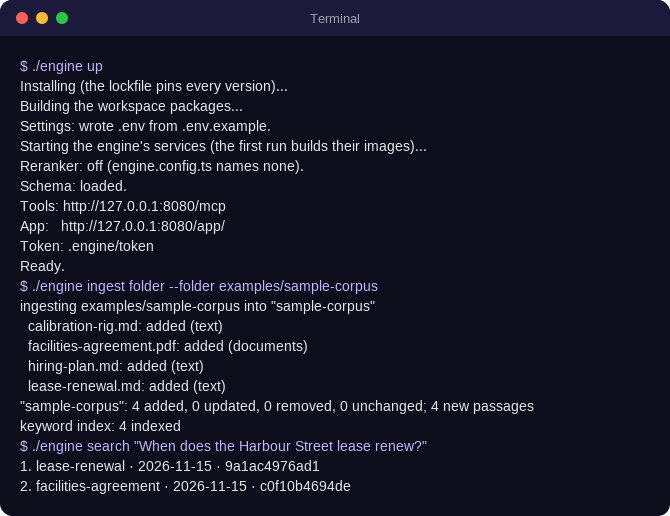
./engine up
Installing (the lockfile pins every version)...
Building the workspace packages...
Settings: wrote .env from .env.example.
Starting the engine's services (the first run builds their images)...
Reranker: off (engine.config.ts names none).
Schema: loaded.
Tools: http://127.0.0.1:8080/mcp
App:   http://127.0.0.1:8080/app/
Token: .engine/token
Ready.
The first run downloads about 0.7 GB of packages, the 0.6 GB Postgres image and the embedding model, built into a 1.8 GB
image: about a minute on a datacenter connection. It uses four ports on 127.0.0.1: Postgres 5434, embeddings 8091,
keyword index 8095 and the tool server 8080; if one is taken, up names the .env setting that moves it. ./engine status shows what runs, ./engine logs its recent output, and ./engine down stops it all, keeping your data.
3. Send it a folder. Each readable file under the folder becomes one document in a collection named after the
folder, and each subfolder a folder an agent can list. It prints each file with the reader that took it, or why it was
refused. Run it again after a change: new files are added, edited ones updated, deleted ones removed.
./engine ingest folder --folder examples/sample-corpus
ingesting examples/sample-corpus into "sample-corpus"
  calibration-rig.md: added (text)
  facilities-agreement.pdf: added (documents)
  hiring-plan.md: added (text)
  lease-renewal.md: added (text)
"sample-corpus": 4 added, 0 updated, 0 removed, 0 unchanged; 4 new passages
keyword index: 4 indexed
4. Search it. One louvain_search_sources call, printed a line per matching document, best first: <rank>. <title> · <date> · <id> (--full-ids prints whole ids, as louvain_read_source takes them). Against the sample corpus,
lease-renewal comes first.
./engine search "When does the Harbour Street lease renew?"
1. lease-renewal · 2026-11-15 · 9a1ac4976ad1
2. facilities-agreement · 2026-11-15 · c0f10b4694de
The machine
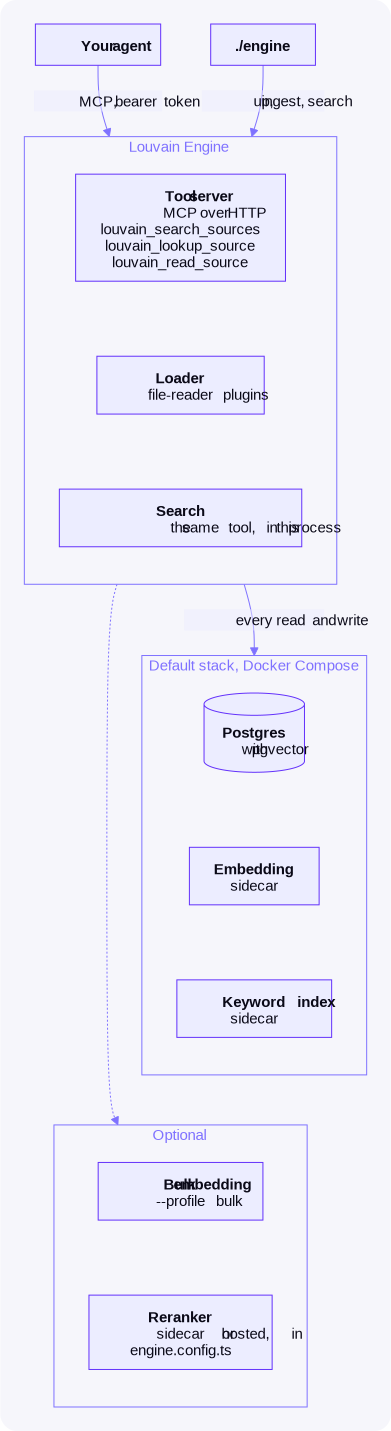
One engine, built from parts you can swap:
- One file says what runs.
engine.config.tsnames the plugins and their settings; a field left out keeps its
default, and no file at all runs the defaults. - Plugins are plain functions.
documents(),text(),mcp(): each a function thatdefinePluginmakes. Six
kinds: file readers (documents,text), sources (folder,records,http), retrievers (vector,keyword,figures), a reranker (sidecaron your machine, orcohere), an answerer (agent,scripted) and
surfaces (mcp,app). - Profiles. A configuration of its own, with its own corpus and index:
defaultis what./engine upstarts,
anderbis the configuration the benchmark figure was scored with../engine profile set <name>switches. - Three ways in. MCP tools for your agent at
/mcp, an HTTP door for ingest (off unless configured), and
Search and Ask in a browser at/app/. - A new plugin in one command.
./engine plugin new <kind> <name>writes a reader, source or reranker package
with a test that passes.
Connect your agent
Gives an agent the three tools over MCP, with the token the server wrote. The server listens athttp://127.0.0.1:8080/mcp (MCP over HTTP); every call carries Authorization: Bearer <token>. The server writes a
random token at first start (mode 600), unless LOUVAIN_ENGINE_TOKEN is set; up prints its path, never the token.
claude mcp add --transport http louvain-engine http://127.0.0.1:8080/mcp --header "Authorization: Bearer $(cat .engine/token)"
The server offers three tools:
louvain_search_sourcesranks documents by meaning and words.sourcesholds the documents that match,looselyRelatedthe nearest ones that do not, andmatched: falsesays nothing loaded covers the search.louvain_lookup_sourceopens the document an identifier names (a ticket key, a URL, a file name), by exact match.louvain_read_sourcereads one document whole, in pages.
Make it yours
1. Configure it. engine.config.ts at the root says what runs; a field left out keeps its default.
// engine.config.ts
import { defineEngine } from "@louvain/engine-core";
import { documents } from "@louvain/reader-documents";
import { text } from "@louvain/reader-text";
import { sidecar } from "@louvain/reranker-sidecar";

export default defineEngine({
  readers: [documents(), text()],
  reranker: sidecar({ url: "http://localhost:8096" }),
  settings: { rerank: { window: 10 } },
});
Run ./engine down and ./engine up after a change. Configuration lists every field and
setting.
2. Write a plugin. A plugin adds a file reader, a source or a reranker.
./engine plugin new reader csv
It writes packages/plugins/reader-csv with a test that passes and a README that walks every line, then prints the
command that links it and the two lines that add it to engine.config.ts. Plugins has each
kind's contract.
3. Keep a second configuration. A profile is a folder under profiles/ with its own engine.config.ts, corpus and
index. ./engine profile prints the one in use; ./engine profile set <name> switches. The scored benchmark
configuration ships as one (Profiles).
What ships
| Part | What it is |
|---|---|
packages/engine-core |
The contracts every plugin is written against, and the pure code: no I/O |
packages/engine |
Ingest, the fenced reads, search and the tool server |
packages/cli |
./engine's commands: loads engine.config.ts and starts the engine |
packages/plugins |
reader-documents (PDF, Word, Excel, PowerPoint, OpenDocument, EPUB, RTF, HTML, CSV, mail), reader-text (text, Markdown), reranker-sidecar (BAAI/bge-reranker-v2-m3 on your machine, a 2.3 GB download, best with a GPU), reranker-cohere (Cohere's Rerank API), source-http (an ingest door, off unless configured) |
apps/app |
Search and Ask in a browser, at /app/ |
services |
The embedding sidecar (Xenova/bge-base-en-v1.5) and the BM25 keyword sidecar |
examples/ |
sample-corpus (four invented documents), agent (an agent's side of the tools), an-ingest-source |
The engine starts with the two readers, the folder and records sources, the tools at /mcp and the app at/app/, and no reranker. Docker Compose runs Postgres 17 with pgvector and the two sidecars.
Architecture maps the code.
What it promises
- The fence comes first in every read. Each read resolves the reader's readable collections once and applies them
inside every statement it sends, so no row outside them is ranked, counted or returned. A retriever gets a reading
already narrowed to that set, and every row it returns is checked against the set again. The engine's own token
reads everything loaded; every other reader, made with./engine reader add, reads the collectionsengine.config.tsgrants it and nothing else (Permissions). - Your documents stay on your machine. Postgres and the sidecars listen on
127.0.0.1. After the first./engine updownloads packages, images and the embedding model, nothing goes out unless you choose it: a remote
reranker receives each search and the texts it reranks, and the app's Ask, given a model key, sends each question and
the documents it reads to that model's provider. - A file is hostile input. The engine holds every reader to regular files, 32 MB and 1,000,000 characters, and a
reader that throws or answers late costs only that file. The 60-second deadline cannot stop a reader that blocks the
process without yielding (Limits). - A search says when nothing matches. A document matches when it holds the search's words, an identifier or a
figure the search names, or is close enough in meaning; the rest are shown apart, as loosely related. - No default credential. The tool server, Postgres and the sidecars each need a secret made for this install,
kept in the.enginedirectory with mode 600 and never printed.
What it is not
- No accounts. A reader is a name and a token: no sign-up, no passwords, no single sign-on. A grant is a whole
collection, never a single document, and the engine's own token reads everything. - Not an answer engine. Its tools return documents and passages with their sources; your agent writes the answer.
The app's Ask writes one only with a model key you give it. - No connectors, no knowledge graph. Ingest reads files and records, cuts them into passages and embeds them; no
language model reads a document. - No OCR. A scanned PDF or an image yields only the text it already holds, which may be none.
- HTML is read whole. Scripts and styles are dropped; navigation, headers and footers are read as text.
- No page numbers in results. A hit names the document and the passage, not the page, slide or sheet.
- No screening of document text. A document holding instructions aimed at a model is loaded and returned like any
other. The tools tell the agent that a document's text is data, never instructions.
How it scores
| EnterpriseRAG-Bench | Score |
|---|---|
| Louvain's own build | 91.32% (preliminary, on a 100-question development sample) |
This repository doesn't reproduce it yet: the figure is Louvain's own build's, with a tuned embedder, Cohere's reranker,
an agent and its guidance, each listed in docs/benchmark-method.md.
Documentation
| Page | What it covers |
|---|---|
| Operations | Starting, loading, searching, status, logs, stopping, upgrading |
| Configuration | engine.config.ts, every setting .env.example offers, profiles |
| Plugins | File readers, sources, rerankers and retrievers: each contract, and writing one |
| Architecture | The packages, what each guarantees, and where each command starts |
| How search works | The stages, what "matched" means, paging, what a hit carries |
| Ingest | Sources, keys and revisions, the HTTP door |
| Permissions and threat model | The fence, the host, what is defended and what is trusted |
| Security model | What the fence guarantees and what it does not, the tokens, what an operator must do, and how each is checked |
| Limits and known defects | Every bound, and the defects the tests record |
| At scale | Load speed, search latency, disk and memory at 10,000 and 100,000 passages, measured |
| The app | Search and Ask in a browser: turning it on, the model key, what each page does |
| How the figure was produced | The benchmark run, part by part |
Contributing, security, licence and trademarks
CONTRIBUTING.md explains how a change reaches this repository and CODE_OF_CONDUCT.md how we work together. Report
a vulnerability privately, as SECURITY.md describes, never in a public issue. The code is licensed under Apache-2.0
(LICENSE, NOTICE). The name and logo are trademarks of Louvain AI Ltd: TRADEMARKS.md says how to use them.
Reviews (0)
Sign in to leave a review.
Leave a reviewNo results found