faramesh-core
Health Gecti
- License — License: MIT
- Description — Repository has a description
- Active repo — Last push 0 days ago
- Community trust — 29 GitHub stars
Code Gecti
- Code scan — Scanned 12 files during light audit, no dangerous patterns found
Permissions Gecti
- Permissions — No dangerous permissions requested
This tool provides a deterministic governance engine for AI agents. It enforces pre-execution policies, enables human approval workflows for sensitive actions, and maintains a tamper-evident audit trail for compliance.
Security Assessment
The light code audit scanned 12 files and found no dangerous patterns, hardcoded secrets, or requests for dangerous permissions. Because the tool's core function is execution control, it inherently interacts with system processes to enforce policies. However, it does not broadly expose sensitive user data or execute arbitrary, unchecked shell commands. It relies on a custom policy language (FPL) to govern agent actions safely. Overall risk is rated as Low.
Quality Assessment
The project demonstrates strong maintenance signals, with its most recent push happening today. It uses the permissive MIT license, making it highly accessible for integration. Community trust is currently in its early stages but shows positive momentum with 29 GitHub stars. Furthermore, the repository features professional CI/CD practices, including active workflows for testing and release gating.
Verdict
Safe to use.
Runtime governance engine for AI agents.

Pre-execution governance engine for AI agents.
One binary. One command. Every framework.








Faramesh: AI Governance and AI Agent Execution Control
Faramesh is a deterministic AI governance engine for AI agents and tool-calling systems.
It enforces execution control before actions run, adds human approval when needed, and writes
tamper-evident decision evidence for audit and compliance.
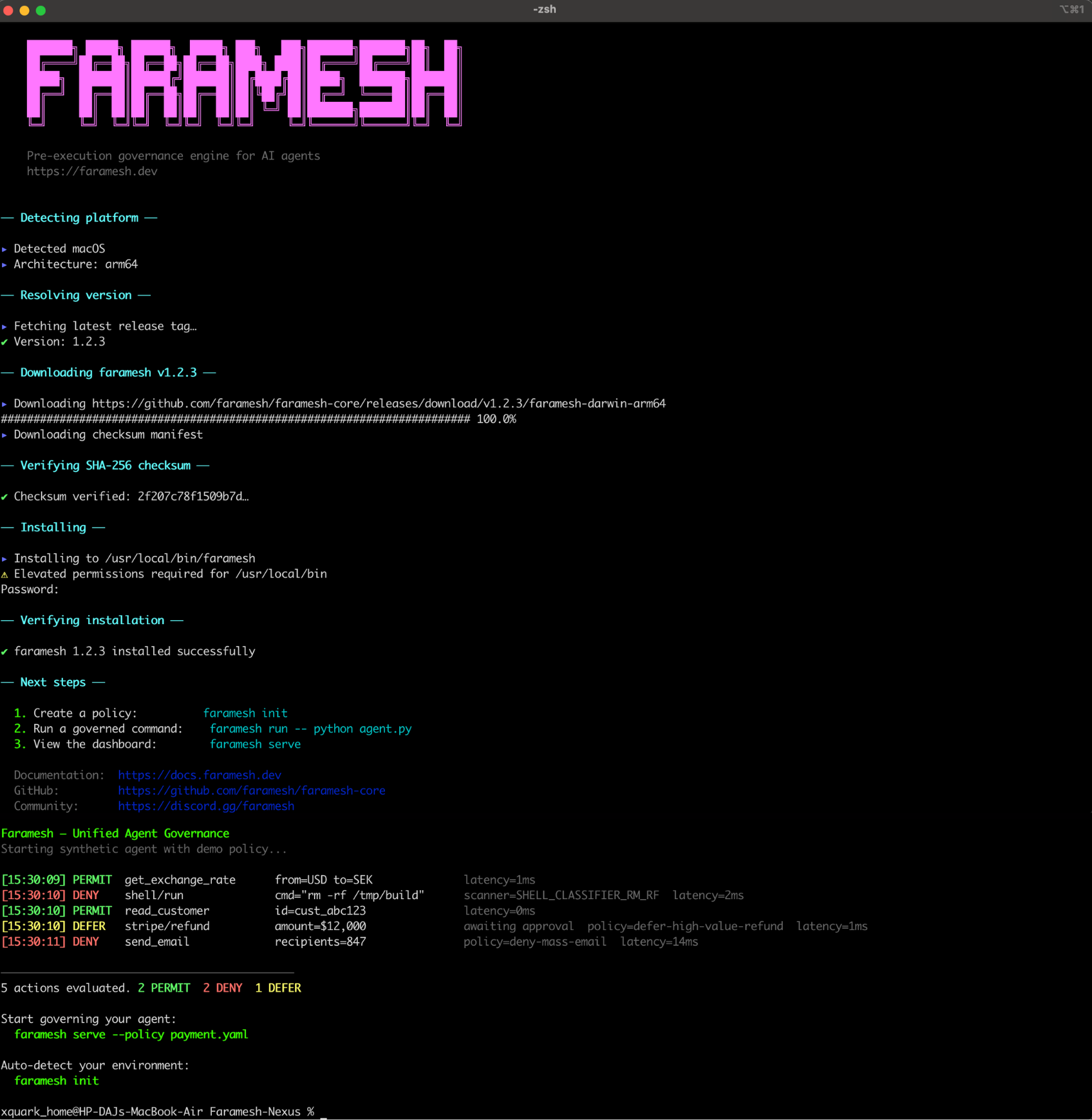
Governance demo view: policy, enforcement, and runtime workflow at a glance.





- Faramesh: AI Governance and AI Agent Execution Control
- What is Faramesh?
- Install
- Quick Start
- FPL - Faramesh Policy Language
- Supported Frameworks
- Use Cases
- Governing Real Runtimes
- Credential Broker
- Workload Identity (SPIFFE/SPIRE)
- Observability Integrations
- Cross-Platform Enforcement
- Policy Packs
- Repository Map
- Documentation Hub
- CLI Reference
- Architecture
- SDKs
- Documentation
- Community
- Contributing
- License
What is Faramesh?
Faramesh sits between your AI agent and the tools it calls. Every tool call is checked against your policy before it runs. If the policy says no, the action is blocked. If the policy says wait, a human decides. Every decision is logged to a tamper-evident chain.
Most "AI governance" tools add a second AI to watch the first. That's probability watching probability. Faramesh uses deterministic rules — code that evaluates the same way every time. No model in the middle. No guessing.
Install
# curl (fastest)
curl -fsSL https://raw.githubusercontent.com/faramesh/faramesh-core/main/install.sh | bash

# Homebrew
brew install faramesh/tap/faramesh

# npm package
npx @faramesh/cli@latest init

# Go toolchain
go install github.com/faramesh/faramesh-core/cmd/faramesh@latest
Quick Start
# Govern your agent — one command
faramesh run -- python agent.py
Faramesh Enforcement Report
  Runtime:     local
  Framework:   langchain

  ✓ Framework auto-patch (FARAMESH_AUTOLOAD)
  ✓ Credential broker (stripped: OPENAI_API_KEY, STRIPE_API_KEY)
  ✓ Network interception (proxy env vars)

  Trust level: PARTIAL
Watch live decisions:
faramesh audit tail
[10:00:15] PERMIT  get_exchange_rate      from=USD to=SEK              latency=11ms
[10:00:17] DENY    shell/run              cmd="rm -rf /"               policy=deny!
[10:00:18] PERMIT  read_customer          id=cust_abc123               latency=9ms
[10:00:20] DEFER   stripe/refund          amount=$12,000               awaiting approval
[10:00:21] DENY    send_email             recipients=847               policy=deny-mass-email
FPL — Faramesh Policy Language
FPL is the standard policy language for Faramesh. Every policy starts as FPL. It is a domain-specific language purpose-built for AI agent governance — shorter than YAML, safer than Rego, readable by anyone.
agent payment-bot {
  default deny
  model "gpt-4o"
  framework "langgraph"

  budget session {
    max $500
    daily $2000
    max_calls 100
    on_exceed deny
  }

  phase intake {
    permit read_customer
    permit get_order
  }

  rules {
    deny! shell/* reason: "never shell"
    defer stripe/refund when amount > 500
      notify: "finance"
      reason: "high value refund"
    permit stripe/* when amount <= 500
  }

  credential stripe {
    backend vault
    path secret/data/stripe/live
    ttl 15m
  }
}
Why FPL?
| FPL | YAML + expr | OPA / Rego | Cedar | |
|---|---|---|---|---|
| Agent-native primitives | Yes — sessions, budgets, phases, delegation, ambient | Convention-based | No | No |
Mandatory deny (deny!) |
Compile-time enforced | Documentation convention | Runtime only | Runtime only |
| Lines for above policy | 25 | 65+ | 80+ | 50+ |
| Natural language compilation | Yes | No | No | No |
| Backtest before activation | Built-in | Manual | Manual | No |
Multiple input modes, one engine
FPL is the canonical format. You can also write policies as:
- Natural language —
faramesh policy compile "deny all shell commands, defer refunds over $500 to finance"compiles to FPL, validates it, and backtests it against real history before activation. - YAML — always supported as an interchange format.
faramesh policy compile policy.yaml --to fplconverts to FPL. Both formats compile to the same internal representation. - Code annotations —
@faramesh.tool(defer_above=500)in your source code is extracted to FPL automatically.
deny! — mandatory deny
deny! is a compile-time constraint. It cannot be overridden by position, by a child policy in an extends chain, by priority, or by any subsequent permit rule. OPA, Cedar, and YAML-based engines express this as a documentation convention. FPL enforces it structurally.
Supported Frameworks
All 13 frameworks are auto-patched at runtime — zero code changes required.
| Framework | Patch Point |
|---|---|
| LangGraph / LangChain | BaseTool.run() |
| CrewAI | BaseTool._run() |
| AutoGen / AG2 | ConversableAgent._execute_tool_call() |
| Pydantic AI | Tool.run() + Agent._call_tool() |
| Google ADK | FunctionTool.call() |
| LlamaIndex | FunctionTool.call() / BaseTool.call() |
| AWS Strands Agents | Agent._run_tool() |
| OpenAI Agents SDK | FunctionTool.on_invoke_tool() |
| Smolagents | Tool.__call__() |
| Haystack | Pipeline.run() |
| Deep Agents | LangGraph dispatch + AgentMiddleware |
| AWS Bedrock AgentCore | App middleware + Strands hook |
| MCP Servers (Node.js) | tools/call handler |
Use Cases
- AI governance for production agent systems where every tool call must be policy-checked.
- AI agent guardrails for coding agents, customer support agents, and payment workflows.
- AI execution control for MCP tools, API actions, shell actions, and delegated sub-agents.
- Compliance-ready decision evidence with deterministic replay and tamper-evident provenance.
Governing Real Runtimes
OpenClaw
faramesh run -- node openclaw/gateway.js
Faramesh patches the OpenClaw tool dispatch, strips credentials from ~/.openclaw/, and governs every tool call through the policy engine. The agent never sees raw API keys.
NemoClaw
faramesh run --enforce full -- python -m nemoclaw.serve --config agent.yaml
NemoClaw runs inside Faramesh's sandbox. On Linux, the kernel sandbox (seccomp-BPF, Landlock, network namespace) prevents the agent from bypassing governance.
Deep Agents (LangChain)
faramesh run -- python -m deep_agents.main
Faramesh patches BaseTool.run() and injects AgentMiddleware into the LangGraph execution loop. Multi-agent delegation is tracked with cryptographic tokens — the supervisor's permissions are the ceiling for any sub-agent.
Claude Code / Cursor
faramesh mcp wrap -- node your-mcp-server.js
Faramesh intercepts every MCP tools/call request. The IDE agent connects to Faramesh instead of the real MCP server. Non-tool-call methods pass through unchanged.
Credential Broker
Faramesh strips API keys from the agent's environment. Credentials are only issued after the policy permits the specific tool call.
| Backend | Config |
|---|---|
| HashiCorp Vault | --vault-addr, --vault-token |
| AWS Secrets Manager | --aws-secrets-region |
| GCP Secret Manager | --gcp-secrets-project |
| Azure Key Vault | --azure-vault-url, --azure-tenant-id |
| 1Password Connect | FARAMESH_CREDENTIAL_1PASSWORD_HOST |
| Infisical | FARAMESH_CREDENTIAL_INFISICAL_HOST |
Workload Identity (SPIFFE/SPIRE)
Faramesh can consume SPIFFE workload identity at runtime and expose identity controls in the CLI.
faramesh serve --spiffe-socket <path>enables SPIFFE workload identity resolution from the Workload API socket.faramesh identity verify --spiffe spiffe://example.org/agentverifies workload identity state.faramesh identity trust --domain example.org --bundle /path/to/bundle.pemconfigures trust domain and bundle.
In a SPIRE-based deployment, CA issuance and SVID lifecycle management are handled by SPIRE/SPIFFE components. Faramesh consumes the resulting SPIFFE identity and trust data for policy decisions and credential brokering.
Observability Integrations
Faramesh exposes Prometheus-compatible metrics on /metrics via --metrics-port. This is the integration point for common observability platforms:
- Grafana: scrape via Prometheus or Grafana Alloy, then build dashboards and alerts.
- Datadog: use OpenMetrics scraping against
/metricsand correlate with decision/audit events. - New Relic: ingest Prometheus/OpenMetrics data from
/metricsfor governance and runtime monitoring.
Cross-Platform Enforcement
| Platform | Layers | Trust Level |
|---|---|---|
| Linux + root | seccomp-BPF + Landlock + netns + eBPF + credential broker + auto-patch | STRONG |
| Linux | Landlock + proxy + credential broker + auto-patch | MODERATE |
| macOS | Proxy env vars + PF rules + credential broker + auto-patch | PARTIAL |
| Windows | Proxy env vars + WinDivert + credential broker + auto-patch | PARTIAL |
| Serverless | Credential broker + auto-patch | CREDENTIAL_ONLY |
Policy Packs
Ready-to-use FPL policies in examples/:
| File | Description |
|---|---|
starter.fpl |
General-purpose starter policy — blocks destructive commands, defers large payments |
payment-bot.fpl |
Financial agent with session budgets, phased workflow, and credential brokering |
infra-bot.fpl |
Infrastructure agent with strict sandbox, Terraform governance, and duty delegation |
customer-support.fpl |
Support agent with intake/resolve phases, credit limits, and mass-email protection |
mcp-server.fpl |
MCP server wrapper policy for IDE agents (Claude Code, Cursor) |
Repository Map
faramesh-core/
├── cmd/                  # CLI entrypoints
├── internal/             # Governance engine, adapters, policy runtime
├── sdk/                  # Official SDKs (Node, Python)
├── deploy/               # Kubernetes, ECS, Nomad, systemd, Cloud Run examples
├── examples/             # Ready-to-run FPL policy examples
├── packs/                # Policy packs
└── docs/                 # Product and architecture documentation
Documentation Hub
CLI Reference
See the full CLI reference for all 30+ commands. Key commands:
| Command | What it does |
|---|---|
faramesh run -- <cmd> |
Govern an agent with the full enforcement stack |
faramesh policy validate <path> |
Validate an FPL or YAML policy |
faramesh policy compile <text> |
Compile natural language to FPL |
faramesh audit tail |
Stream live decisions |
faramesh audit verify |
Verify DPR chain integrity |
faramesh agent approve <token> |
Approve a deferred action |
faramesh agent kill <id> |
Emergency kill switch |
faramesh credential register <name> |
Register a credential with the broker |
faramesh session open |
Open a governance session |
faramesh incident declare <desc> |
Declare a governance incident |
faramesh mcp wrap <server> |
Wrap an MCP server with governance |
Architecture
flowchart TB
    subgraph agentProc ["Agent Process"]
        FW["Framework Dispatch"]
        AP["Auto-Patch Layer"]
        SDK["Faramesh SDK"]
    end

    subgraph kernelEnf ["Kernel Enforcement"]
        SECCOMP["seccomp-BPF"]
        EBPF["eBPF Probes"]
        LANDLOCK["Landlock LSM"]
        NETNS["Network Namespace"]
    end

    subgraph daemonProc ["Faramesh Daemon — 11-Step Pipeline"]
        KILL["1. Kill Switch"]
        PHASE["2. Phase Check"]
        SCAN["3. Pre-Scanners"]
        SESS["4. Session State"]
        HIST["5. History Ring"]
        SEL["6. Selectors"]
        POLICY["7. Policy Engine"]
        DEC["8. Decision"]
        WAL_W["9. WAL Write"]
        ASYNC["10. Async DPR"]
        RET["11. Return"]
    end

    subgraph credPlane ["Credential Plane"]
        BROKER["Credential Broker"]
        VAULT["Vault / AWS / GCP / Azure / 1Pass / Infisical"]
    end

    FW --> AP --> SDK
    SDK -->|"Unix socket"| KILL --> PHASE --> SCAN --> SESS --> HIST --> SEL --> POLICY --> DEC --> WAL_W --> ASYNC --> RET
    DEC -->|PERMIT| BROKER --> VAULT
    DEC -->|DENY| RET
    DEC -->|DEFER| HUMAN["Human Approver"]
    EBPF -.->|"syscall monitor"| agentProc
    SECCOMP -.->|"immutable filter"| agentProc
    NETNS -.->|"traffic redirect"| daemonProc
If the WAL write fails, the decision is DENY. No execution without a durable audit record.
SDKs
| Language | Path | Package |
|---|---|---|
| Python | sdk/python |
pip install faramesh |
| TypeScript / Node.js | sdk/node |
npm install faramesh |
Both SDKs provide govern(), GovernedTool, policy helpers, snapshot canonicalization, and gate() for wrapping any tool call with pre-execution governance.
Documentation
Full documentation at faramesh.dev/docs.
Repository docs for crawlers and contributors:
Search Topics (SEO)This repository targets high-intent technical topics across agent governance and runtime control:
- AI governance
- AI agent governance
- AI agent security
- AI execution control
- Agent execution control
- Policy as code for AI agents
- Deterministic policy engine
- MCP governance and Model Context Protocol guardrails
- AI compliance and agent audit trail
Community
Help shape Faramesh and track what is next:
- Contribution guidelines: CONTRIBUTING.md
- Roadmap and milestones: GitHub Milestones
- Roadmap discussions/issues: Roadmap-labeled issues
Contributing
See CONTRIBUTING.md for development setup, coding standards, and contribution workflow.
License
Yorumlar (0)
Yorum birakmak icin giris yap.
Yorum birakSonuc bulunamadi