brigadestack
Health Gecti
- License — License: MIT
- Description — Repository has a description
- Active repo — Last push 0 days ago
- Community trust — 83 GitHub stars
Code Basarisiz
- rm -rf — Recursive force deletion command in .github/workflows/ci.yml
- network request — Outbound network request in .github/workflows/ci.yml
Permissions Gecti
- Permissions — No dangerous permissions requested
Bu listing icin henuz AI raporu yok.
Brigade Stack: run coding agents anywhere and keep one record of the work. Shared tasks, claims, verification receipts, handoffs, and MCP and skills sync for Claude Code, Codex, Cursor, OpenCode, and T3 Code.

Run agents anywhere. Same memory everywhere.
Website · Docs · Quickstart · Compare · Changelog


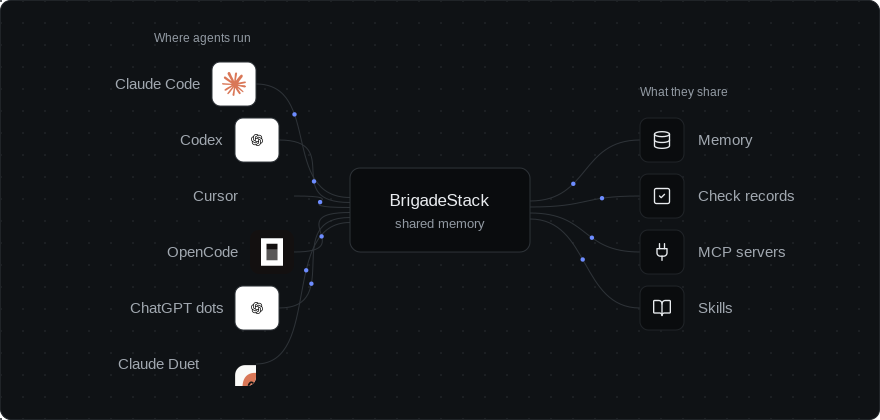
BrigadeStack gives the agent tools you already use one shared memory and one set of MCP servers and skills. It keeps a record of the work they check.
Install with pipx (Python 3.11 or newer) or npm (Node.js 22 or newer). The command is brigadestack. brigadestack on PyPI is the Python package. The brigade-cli PyPI package (the same code under the old name) and the @escoffier-labs/brigade npm compatibility package install the same CLI as brigade, so existing users keep their command and pipx upgrade brigade-cli keeps working.
pipx install brigadestack
npm install -g brigadestack
Install only one npm package globally. brigadestack and @escoffier-labs/brigade both link brigade, so npm stops with EEXIST on the second one. If @escoffier-labs/brigade is installed and you want the new name, run npm uninstall --global @escoffier-labs/brigade first, then npm install --global brigadestack. Keeping @escoffier-labs/brigade and running npm update --global @escoffier-labs/brigade also works.
Sections marked * describe the 0.32.0 beta. It is published as daily pre-release builds of brigadestack, which install the brigade command: pipx install --pip-args='--pre' brigadestack. Stable is 0.31.0.
Shared memory, shared tools
Claude Code, Codex and Cursor each keep their own notes and MCP config, so what one agent learns on Monday is gone when another starts on Tuesday.
BrigadeStack keeps memory as markdown cards in your repository. An agent that learns something durable writes a handoff. A reviewer files it as a card. Commit the card, and any checkout finds it with brigadestack memory search.
Claude Code also gets recall at session start. Codex gets memory through its handoff inbox and an agent-run memory search.
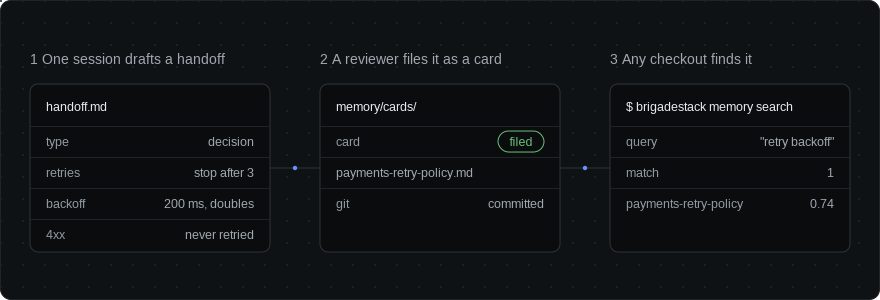
This is real output, with the home directory shortened to ~.
$ cd ~/api
$ brigadestack handoff draft --type decision \
    --title "Payments client retry policy" \
    --summary "Retries stop after 3 attempts with jittered backoff." \
    --fact "Backoff starts at 200 ms and doubles." \
    --fact "A 4xx response is never retried." \
    --action create-card --target-card payments-retry-policy.md \
    --content-file card.md
handoff draft: ~/api/.codex/memory-handoffs/20261118-014553-payments-client-retry-policy.md
id: 20261118-014553-payments-client-retry-policy
inbox: .codex/memory-handoffs
action: create-card
target_card: payments-retry-policy.md
lint: ok
$ cp card.md memory/cards/payments-retry-policy.md
$ git add memory && git commit -qm "memory: payments retry policy"
$ git worktree add -q ../api-2 -b second && cd ../api-2
$ brigadestack memory search "retry backoff"
memory search: retry backoff (1 match(es))
- memory/cards/payments-retry-policy.md  [0.74]  payments-retry-policy
One list of MCP servers and skills
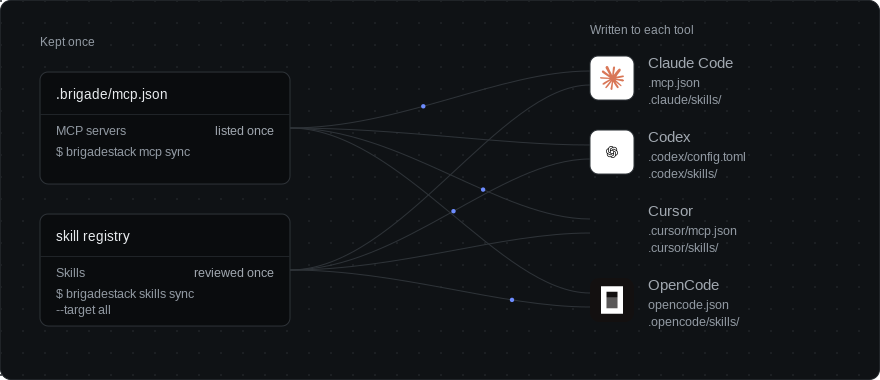
MCP servers and skills follow the same rule as memory. List a server once in .brigade/mcp.json, and brigadestack mcp sync writes it into each set-up tool's config, through adapters for Claude Code, Codex, Cursor, OpenCode and Grok. Antigravity needs --user-scope, and VS Code is included when the repository has a .vscode folder. It previews until --write and keeps Codex and OpenCode native auth*. brigadestack skills sync --target all previews the same way for skills.
* In the 0.32.0 beta, sync also keeps Claude Code's own auth helper and refuses to remove or re-point an entry that has one.
Then prove it
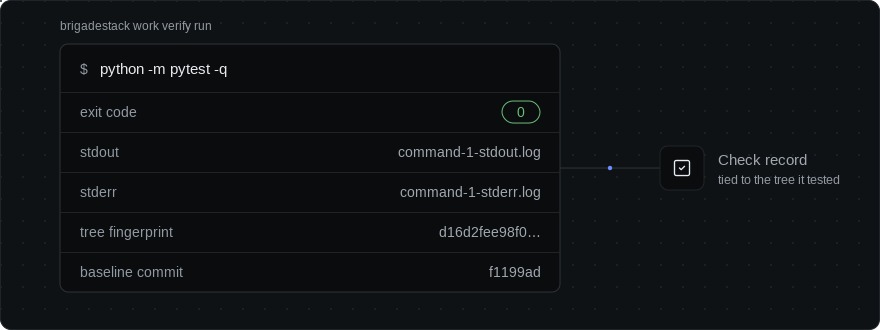
"Tests pass" is a claim. brigadestack work verify run turns it into a record. It runs the command and keeps the command, the exit code, the logs and a fingerprint of the tree that was tested. Another agent can open it and see what ran against which code.
Records live under .brigade/work/verify-runs/, one folder per run. A failing command leaves a failed record too.
Know what a change touches
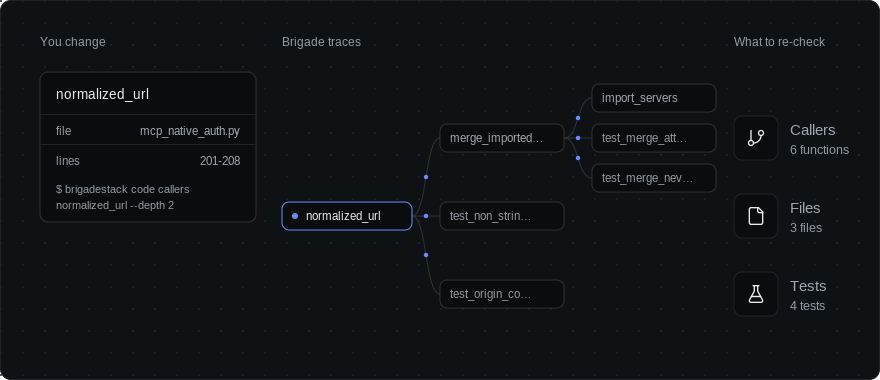
The code graph is a local index of your repository's symbols and the calls between them. brigadestack setup installs the optional engine, and brigadestack code sync builds the index. brigadestack code callers <symbol> shows who calls a function, impact adds callees, and affected <files> lists the tests that reach changed files. Below is a real answer for one function here.
Modes*
strict is the default. Checks run through brigadestack work verify run, and Claude Code's stop hook asks for a record before a session finishes. observe records checks and blocks nothing. off drops the check rules and keeps memory and briefs. Safety rails (secret scanning and pre-push checks) are a separate setting, on by default in every mode.
* observe and the names strict and off are in the 0.32.0 beta, as the capture shows. Version 0.31.0 calls them engineer and yolo and has no observe. The beta still accepts the old names.
$ brigade work mode show
work mode: strict; safety rails: on (~/api)
$ brigade work mode set observe
work mode: observe; safety rails: on (~/api)
$ brigade work mode set off
work mode: off; safety rails: on (~/api)
Quick start
Wire a repository, write a first handoff, and run a first check. Add --dry-run to the first command to preview it.
brigadestack operator quickstart --target . --harnesses codex,claude
brigadestack handoff draft --type setup --title "Test command" \
  --summary "Run pytest -q from the repo root before every push." \
  --action no-card --target-document TOOLS.md \
  --content "Run pytest -q from the repo root."
brigadestack work verify run --command "git diff --check"
The first command writes .brigade/, a handoff inbox for each tool you name, and the MCP config. The second drafts a handoff, and lint refuses what the ingester would reject. The third records the command, exit code and logs. Keep .brigade/ state out of commits unless you mean to share it. See the first 10 minutes.
Works with
| Tool | What you get |
|---|---|
| Claude Code, Codex, Cursor, OpenCode | Workspace instructions, handoff inboxes, and MCP and skill config. |
| ChatGPT Dot | Memory, skills, Hub messages and T3 fleet dispatch, through a connector you host. |
| Claude Duet | Memory, skills, Hub messages and read-only fleet views, through a connector you host. |
| T3 Code | Session presence only. |
Across machines
Agents on several machines share memory through a hub service you run on a network you control. A card pushed from a laptop turns up in a search on a desktop. Task ownership, messages and model policy live in the same place. The fleet docs cover setup.
Limits
A check record shows what ran. It does not show that the tests are good. A handoff is a draft until someone files it as a card. The packaged hub and the Dot listener are Linux only. Dot and Duet are not woken instantly: each checks for work when a session or scheduled run starts.
MCP servers
brigadestack memory serve-mcp --stdioserves memory cards, the work brief andwrite_handoff, which drafts a handoff and never edits a card.brigadestack skills serve-mcp --stdioserves the reviewed skill registry, read-only: search, read and lint skills.
Commands · Execution model · Contributing · Issues · MIT license
Questions and ideas: Discussions.
BrigadeStack is built by Escoffier Labs. Principal engineer: Solomon Neas.
The Python CLI may send a passive version request. Telemetry lists its fields and opt-outs.
About the downloads badgeThe downloads badge sums brigadestack and brigade-cli on PyPI (excluding mirrors) and brigadestack and @escoffier-labs/brigade on npm over the same 30 completed UTC days. Downloads include automation and do not count unique people. The metric JSON records each source, the period, and the last successful refresh. npm platform companions are excluded. Daily refreshes retain the previous metric if a source fails validation or its latest day is more than three UTC days old.
Yorumlar (0)
Yorum birakmak icin giris yap.
Yorum birakSonuc bulunamadi