Spice
Health Pass
- License — License: NOASSERTION
- Description — Repository has a description
- Active repo — Last push 0 days ago
- Community trust — 85 GitHub stars
Code Pass
- Code scan — Scanned 12 files during light audit, no dangerous patterns found
Permissions Pass
- Permissions — No dangerous permissions requested
No AI report is available for this listing yet.
A foundation for building decision systems — the missing layer above execution agents.





Agents can execute.
But they don’t know what to do next.
Spice is a decision-layer runtime — a brain above agents. inspired by the rise of execution agents like OpenClaw and the idea of world model.
While execution agents (Claude Code, OpenClaw, Codex) are getting better at doing things,
Spice focuses on the missing layer:
👉 What should be done next — and why.
⚡ Why it matters
Today, we have powerful agents that can do almost anything:
- write code
- analyze data
- automate workflows
But when you sit down to use them, you still face the same problem:
What should I do next?
That’s the hard part.
The real bottleneck is:
Decision-making.
Spice is designed to solve that.
🧠 What is Spice?
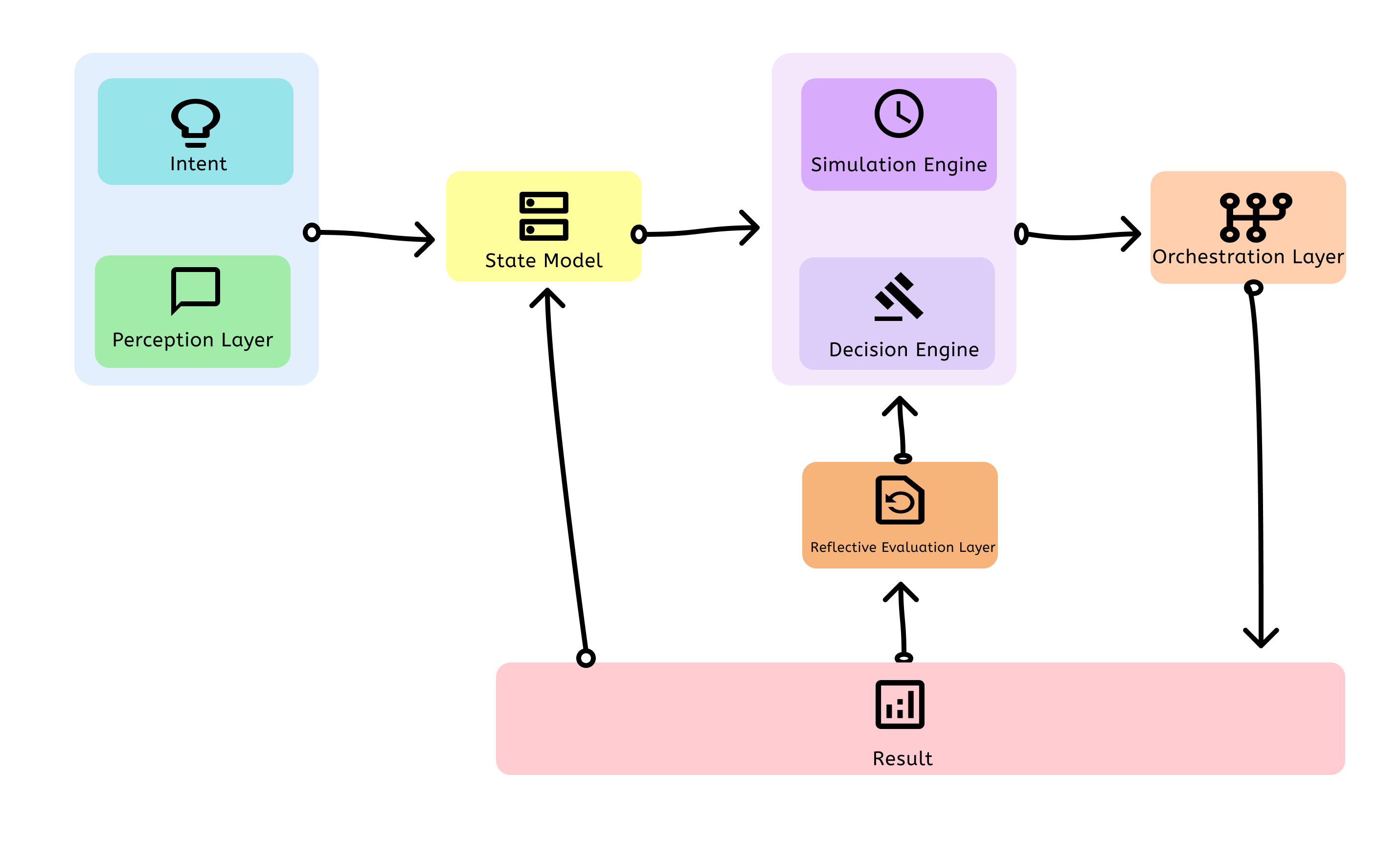
Spice provides a structured cognitive loop inspired by the concept of world model :
perception → state model → simulation → decision → execution → reflection
It allows AI systems to:
- understand context (state)
- reason about possible futures (simulation)
- make structured decisions (decision)
- delegate actions to agents (execution)
- learn from outcomes (reflection)
🌱 Meet Spice Personal
Spice is a general decision runtime. —
To make this concrete, we built our first reference application:
It is not just a demo.
It is an AI that helps you:
- think through real decisions (e.g. career, product, strategy)
- structure your situation as state
- explore possible futures
- decide what to do next
- and optionally act via external agents
From:
question → reasoning → decision → action → outcome
All in one loop.
🧩 Example: from idea → decision → next step
1. Scenario
"I want to quickly build a lightweight tool for a small group of friends."
A simple, real-world goal with clear constraints
2. What Spice does
Input: Real-world intent with constraints

starts from intent
Decision → Comparison
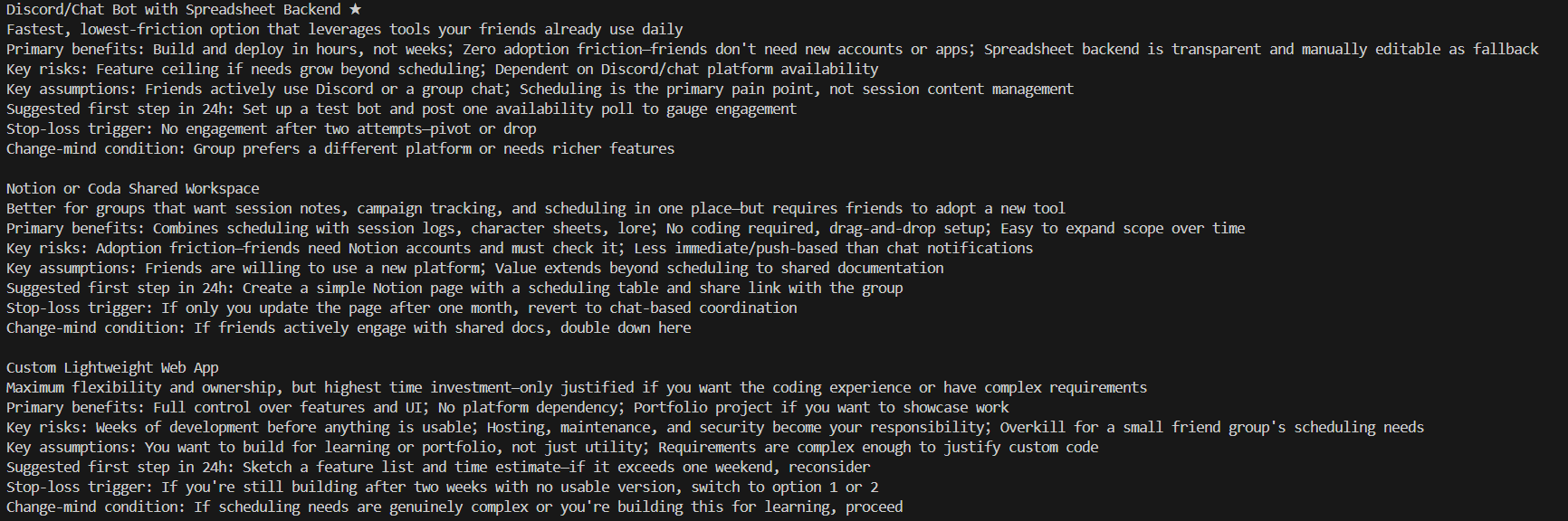
From options → structured decision space
Commitment → Next step

Decision becomes action
3. About execution (next step)
Spice focuses on the decision layer.
In a full workflow, the selected decision can be passed to external agents (e.g. codex and claude code) for execution.
This example stops at decision + next step.
➡️ Next, we will take this exact scenario and connect it to an external agent to actually build the tool end-to-end.
Decision → Execution → Outcome → Reflection
This is the full loop Spice is designed to enable.
🌍 Beyond Personal
Spice Personal is just one reference.
The underlying model is domain-agnostic.
Spice is a general decision runtime that can be applied to any domain where:
- there is context (state)
- there are possible futures (simulation)
- decisions need to be made
- actions can be executed by agents
This includes:
- personal decision making
- product and business strategy
- software development workflows
- operations and automation systems
Spice is not limited to one use case.
It is a foundation for building decision systems.
👨🔧 Spice: Decision Layer Architecture
⚙ Install(Extend the Spice framework to other domains)
Install from source (latest features, for development)
git clone https://github.com/Dyalwayshappy/Spice.git
cd Spice

python -m venv .venv
source .venv/bin/activate  # Windows: .venv\Scripts\activate

pip install -U pip
pip install -e .
Install from PyPI (stable, recommended)
pip install spice-runtime
Upgrade to latest version
pip install -U spice-runtime
spice-runtime --version
🚀 Quick Start
Spice is a decision-layer runtime.
The easiest way to try Spice is through the reference application: Spice Personal.
1. Initialize your workspace
spice-personal init
This creates a local workspace at:
.spice/personal/
and generates a default configuration file.
2. Ask your first question
spice-personal ask "What should I do next?"
Since no model is configured yet, Spice will guide you with a structured Decision Card:
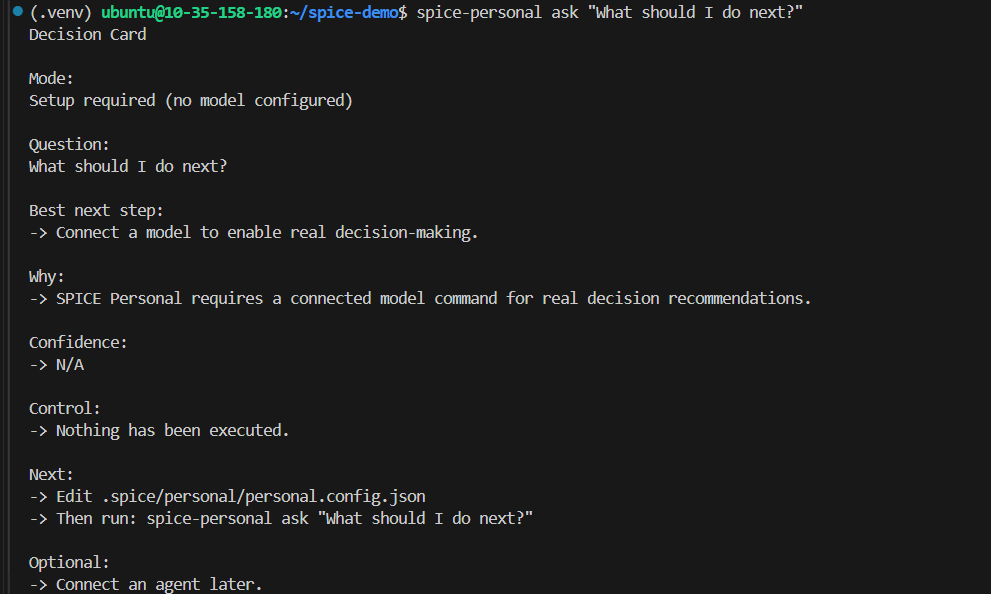
This helps you understand the next step instead of failing silently.
3. Connect a model
Edit the generated config file:
.spice/personal/personal.config.json
Configure your model provider (e.g. OpenRouter) and set your API key:
export OPENROUTER_API_KEY=...
4. Run your intent
spice-personal ask "your intent"
Now Spice will produce a real decision, not just a setup guide.
5. (Optional) Interactive mode
spice-personal session
6. (Optional) Connect external agents
Spice can delegate actions to external agents (e.g. Claude Code, Codex).
This enables:
- gathering real-world evidence
- executing tasks based on decisions
- closing the loop from decision → action
To enable this, configure your agent in:
.spice/personal/personal.config.json
This is where Spice moves beyond reasoning — into action.
Now Spice can:
search for relevant information
call external tools(Currently supports wrappers for CodeX and ClaudeCode.)
and make decisions grounded in real-world signals
✨ Features
Spice transforms your world into a structured decision system.
It enables a new way to think, decide, and act:
Perception
Understand your world and extract meaningful signalsState Modeling
Turn it into a structured decision modelSimulation
Explore possible futures before taking actionDecision
Compare trade-offs and then give you decision-making assistance.Execution (optional)
Delegate actions to external agents (e.g. Claude Code, Codex)Reflection
Learn from outcomes and continuously improve decisions
🔗 SDEP (Spice Decision Execution Protocol)
SDEP is the protocol defined by Spice for connecting the decision layer with external execution agents.
Spice decides what should be done.
SDEP handles how that decision is executed and how results flow back.
1. Why SDEP
Most AI systems tightly couple reasoning and execution.
SDEP introduces a clean separation:
Decision layer (Spice) → determines intent and direction
Execution layer (agents/tools) → performs real-world actions
This allows Spice to act as a brain above agents, instead of being tied to any single tool.
2. What SDEP does
SDEP is responsible for:
Encoding execution intent
Turning decisions into structured, executable requestsDispatching to external agents
(CLI tools, subprocesses, remote services, etc.)Receiving structured results
Capturing outputs, status, and signals from executionFeeding outcomes back into the system
Enabling state updates, reflection, and next decisions
3. Execution Flow
Decision → ExecutionIntent → Agent → Result → Outcome → Reflection
- Spice produces a decision
- SDEP encodes it as an execution intent
- External agents execute the task
- Results are returned and structured
- Spice updates state and continues reasoning
4. What this enables
- Plug into different execution agents (Claude Code, Codex, etc.)
- Keep decision logic independent from execution tools
- Build auditable, replayable decision systems
- Evolve execution without changing the brain (same brain different agent)
Spice is not an execution agent.
It is the decision layer above agents.
🔌 Wrapper Ecosystem (External Agents)
Spice supports an open wrapper ecosystem.
Even if an external agent does not natively support SDEP, it can still be integrated through a wrapper.
1. What is a wrapper?
A wrapper is a protocol bridge between Spice and external agents.
Spice (SDEP) ↔ Wrapper ↔ External Agent
- Spice speaks in ExecutionIntent / ExecutionResult (SDEP)
- Agents speak in their own formats (CLI, JSON, HTTP, SDK, etc.)
- The wrapper translates between the two
2. Why wrappers matter
SDEP is a newly launched protocol that connects the decision layer with external execution agents; its ecosystem still needs development.
Wrappers make Spice immediately compatible with the existing ecosystem:
- Integrate CLI agents, SDK-based tools, and remote services
- Avoid modifying existing agents
- Enable gradual adoption of SDEP
3. Integration model
- Native SDEP agents → connect directly
- Non-SDEP agents → connect via wrapper
- Multiple agents → route by capability or context
4. Our view
Wrappers exist to make Spice useful today.
They allow us to integrate with existing agents without requiring changes.
But we believe this is a transitional layer.
In the long term, we expect more agents to adopt SDEP natively —
enabling a clean, direct connection between decision systems and execution.
Wrappers make Spice practical.
SDEP is where the real value compounds.
📁 Project Structure
spice/
├── spice/                     # 🧠 Core decision runtime framework
│   ├── core/                  #    Runtime loop + state store
│   ├── protocols/             #    Observation/Decision/Execution contracts
│   ├── decision/              #    Decision policy primitives
│   ├── domain/                #    DomainPack abstractions
│   ├── domain_starter/        #    New-domain scaffold templates
│   ├── executors/             #    Executor interface + SDEP adapter
│   ├── llm/                   #    Optional LLM core/adapters/providers
│   ├── memory/                #    Context/memory components
│   ├── replay/                #    Replay utilities
│   ├── shadow/                #    Shadow-run evaluation
│   ├── evaluation/            #    Eval helpers
│   ├── entry/                 #    Core CLI/tooling (quickstart/init domain)
│   └── adapters/              #    External system adapters
├── tests/                     # ✅ Core test suite
├── docs/                      # 📚 Architecture + protocol docs (incl. SDEP)
├── examples/                  # 🧪 Runtime and SDEP examples
├── pyproject.toml             # 📦 spice-runtime package metadata
├── README.md                  # 📝 Core project overview
├── LICENSE                    # ⚖️ MIT
└── .gitignore                 # 🙈 Ignore rules
🗺️ Roadmap
Spice is an evolving decision-layer system.
We’ve built the core runtime, personal reference app, and SDEP-based execution loop.
Next, we focus on expanding capabilities and ecosystem.
PRs are welcome — the system is designed to be modular and extensible.
Current
- Decision runtime (perception → state → decision → reflection)
- Personal reference app (CLI + onboarding)
- SDEP (Decision → Execution protocol)
- Wrapper ecosystem for external agents
- End-to-end loop (decision → execution → outcome)
Next
Richer decision modeling
Better simulation, trade-off analysis, and multi-step reasoningStronger memory layer
Long-term state, context compression, and memory providersMore execution integrations
Expand agent ecosystem (CLI, APIs, tools, services)Multi-step decision workflows
From single decisions → structured plans and execution chainsBetter observability
Inspect decisions, execution traces, and state transitions
Longer-term
Domain expansion
Apply Spice to new domains beyond personal (software, ops, research)Native SDEP ecosystem
More agents supporting SDEP directly (less reliance on wrappers)Persistent decision systems
Systems that continuously learn and evolve over time
🌌 Vision
We believe the future of AI is not just execution —
but better ways to think and decide.
Spice is an attempt to build a new layer in the AI stack:
a decision layer above agents.
Our goal is simple:
Everyone should have a Spice.
A system that:
- understands your world
- maintains your state
- helps you think through decisions
- and takes action when needed
Not just a tool.
Not just a chatbot.
But a personal decision brain
that evolves with you over time.
We've recently been considering the commercialization path for Spice, and to achieve our vision, we'll be moving towards a General AI Brain. We're currently preparing a very compelling demo, so stay tuned!
We are still early.
But we believe this direction leads to:
- more thoughtful decisions
- more capable systems
- and a new way to interact with AI
Spice is not just an assistant.
It is a step toward a decision brain for everyone.
Finally,Thanks to everyone on LinuxDo for their support! Welcome to join https://linux.do/ for all kinds of technical exchanges, cutting-edge AI information, and AI experience sharing, all on Linuxdo!
⭐ Star History
⭐ Star us if you find Spice interesting
Everyone should have a Spice — a decision brain for thinking and action.
Reviews (0)
Sign in to leave a review.
Leave a reviewNo results found