nextpy
Health Warn
- License — License: Apache-2.0
- Description — Repository has a description
- Inactive repo — Last push was 877 days ago
- Community trust — 2347 GitHub stars
Code Pass
- Code scan — Scanned 12 files during light audit, no dangerous patterns found
Permissions Pass
- Permissions — No dangerous permissions requested
This framework is designed for building self-modifying software and optimizing code generation. It provides a prompt engine to control LLM outputs, manage session states, and compile prompts dynamically.
Security Assessment
A light scan of 12 files found no dangerous patterns, hardcoded secrets, or dangerous permissions. However, as a framework designed to build "self-modifying software," it inherently deals with dynamic code execution and manipulation. While the scanned codebase appears clean, the abstract nature of its execution requires a Medium risk rating. Users should be aware that the prompts and AI models they connect to this framework could potentially generate or execute unintended code depending on how the guardrails are configured.
Quality Assessment
The project utilizes the permissive Apache-2.0 license, making it suitable for open-source and commercial use. It has strong community interest, evidenced by over 2,300 GitHub stars. Despite the high star count, the repository has been inactive for over two years (last push was 735 days ago). Furthermore, the creator's README explicitly notes that the project is still in an early, experimental "just for friends" stage, indicating it may lack production-ready stability or active support.
Verdict
Use with caution. The codebase appears safe and open-source, but its experimental nature, requirement for dynamic code execution, and severe lack of recent maintenance make it unsuitable for mission-critical production environments.
🤖Self-Modifying Framework from the Future 🔮 World's First AMS
[!NOTE]
Hey there, Friend!
This project is still in the "just for friends" stage. If you want to see what we're messing with and have some thoughts, take a look at the code. We'd love your feedback or contributions.
What is Nextpy?
Nextpy is a framework for building self-modifying software.
Key Features
🚧 Guardrails
- Set clear boundaries: Users can precisely define what the AI system can and cannot do. This safeguard ensures that the AI system remains a dynamic, self-improving system without overstepping established limits.
🏗️ Greater control with structured outputs
More effective than chaining or prompting: The prompt engine unlocks the next level of prompt engineering, offering significantly greater control over LLMs compared to few-shot prompting or traditional chaining methods.
Superpowers to prompt engineers: It gives full power of prompt engineering, aligning with how LLMs actually process text. This understanding enables you to precisely control the output, defining the exact response structure and instructing LLMs on how to generate responses.
🏭 Powerful prompt engine
The philosophy is to handle more processing at compile time and maintain better sessions with LLMs.
Pre-compiling prompts: By handling basic prompt processing at compile time, unnecessary redundant LLM processing is eliminated.
Session state with LLMs: Maintaining state with LLMs and reusing KV caches can eliminate many redundant generations and significantly speed up the process for longer and more complex prompts. (only for open-source models)
Optimized tokens: The engine can transform many output tokens into prompt token batches, which are cheaper and faster. The structure of the template can dynamically guide the probabilities of subsequent tokens, ensuring alignment with the template and optimized tokenization. (only for open-source models)
Speculative sampling (WIP): You can enhance token generation speed in a large language model by using a smaller model as an assistant. The method relies on an algorithm that generates multiple tokens per transformer call using a faster draft model. This can lead to up to a 3x speedup in token generation.
🤖 Better AI Generations:
🧠 More Effective Than Chaining or Prompt Engineering - Next.py aligns with LLM processing patterns, enabling precise output control and optimal model utilization.
💡 Optimized for Code Generation - Regardless of the LLMs, prompts, or fine-tuning used, the underlying app framework significantly impacts the efficiency of code generation. Next.py's architecture is specifically engineered to maximize efficiency.
💾 Session State with LLM - Efficiently maintain state with LLMs, leveraging KV caches to convert multiple output tokens into prompt token batches. This approach reduces redundant generations, accelerating the handling of lengthy and intricate prompts. (only for open-source models)
🧪 Detect Syntax Errors: Test LLM-generated code, identifying and correcting LLM hallucinations, invalid Nextpy methods, and automatically generating prompts for seamless fixes.
🧱 Modularity
Multiplatform: The AI system does not have to run on a single location or machine. Different components can run across various platforms, including the cloud, personal computers, or mobile devices.
Extensible: If you know how to do something in Python or plain English, you can integrate it with Nextpy.
❤️ Developer-First: ❤️
- 📘 Transferable Knowledge - Learning Next.py teaches you framework-agnostic fundamentals and the best Python libraries, improving your python development expertise and enabling you to excel across any framework.
📦 Containerized & scalable
.🤖 files: The underlying agents can be effortlessly exported into a simple .agent or .🤖 file, allowing them to run in any environment.
Agentbox (optional): The AI system should be able to optimize computing resources inside a sandbox. You can use Agentbox locally or on a cloud with a simple API, with cloud Agentbox offering additional control and safety.
Performance
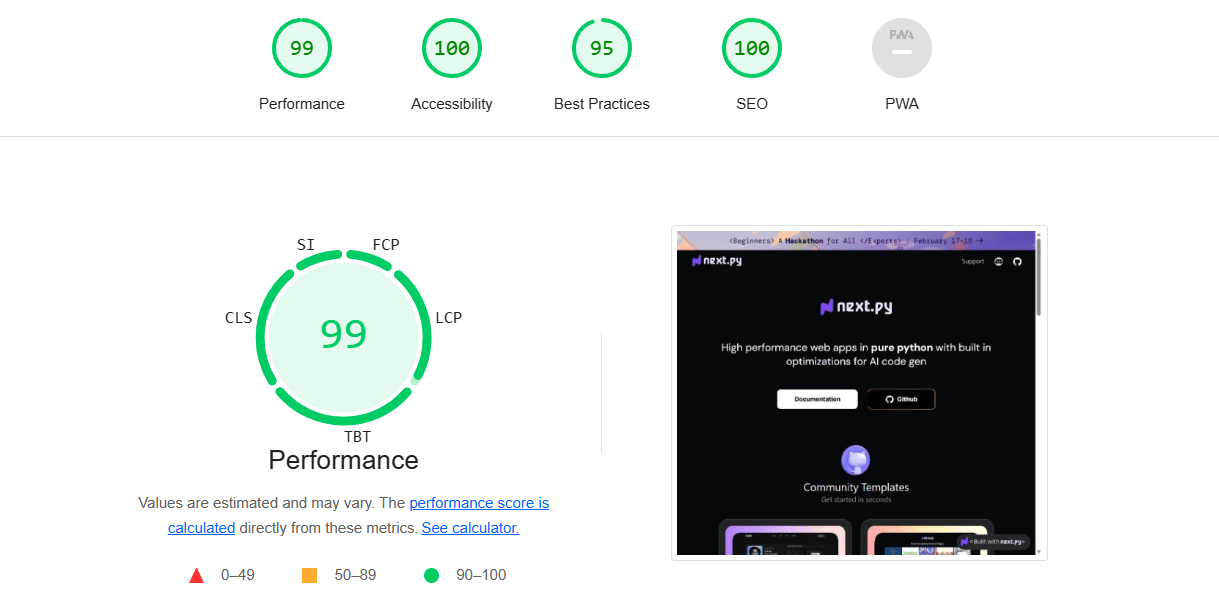
- ⚡ 4-10x faster than your Streamlit app: Our compiled software achieves a staggering 4-10x performance leap over Streamlit. See the difference for yourself at nextpy.org, boasting a PageSpeed score of 99/100.
🙏 Thanks
NextPy Framework is a cutting-edge software development framework optimized for AI-based code generation, built on the spirit of cooperation within the open-source community. It seamlessly integrates key components from landmark projects like Guidance, DSPy, Llama-Index, FastAPI-Mail, LangChain, ReactPy, Reflex, Chakra, Radix, NumPy, and Next.js, while also drawing insights from the React and Rust ecosystems.
One of the interesting modules is the generative UI module, which currently uses a forked version of Reflex, Reacton, and Solara.
We are deeply grateful to the open-source creators, contributors, and maintainers whose work has provided the foundation for NextPy. Your commitment to innovation and openness has been vital in shaping this framework. Your contributions have not only enhanced NextPy but are also advancing the new era of AI-powered software development. Thank you for being the catalysts and enablers of this transformational journey.
Reviews (0)
Sign in to leave a review.
Leave a reviewNo results found