aiplane
Health Gecti
- License — License: AGPL-3.0
- Description — Repository has a description
- Active repo — Last push 0 days ago
- Community trust — 23 GitHub stars
Code Basarisiz
- eval() — Dynamic code execution via eval() in .agents/skills/take-screenshots/screenshot.mjs
- os.homedir — User home directory access in .agents/skills/take-screenshots/screenshot.mjs
- process.env — Environment variable access in .agents/skills/take-screenshots/screenshot.mjs
- rm -rf — Recursive force deletion command in .github/workflows/ci.yml
Permissions Gecti
- Permissions — No dangerous permissions requested
Bu listing icin henuz AI raporu yok.
croit AIplane — one plane for all your AI. Self-hosted AI infrastructure connecting applications and users with models, agents, tools and enterprise data: an OpenAI-compatible LLM gateway, server-side agent execution, MCP, RAG, memory, sandbox, identity, RBAC and quotas. Routes across vLLM, SGLang, Ollama and hosted APIs.
croit AIplane
One plane for all your AI.
croit AIplane is a self-hosted AI infrastructure layer connecting your applications and users to private and public models, agents, tools and enterprise data.
Keep the OpenAI-compatible clients you have and the inference stack you run. Add server-side agent execution, MCP, RAG, memory, tools, identity, policy, routing and usage controls in one place — the things a plain chat-completions call cannot do, done inside AIplane rather than rebuilt in every application.
Models. Agents. Tools. Your control.
Point an existing OpenAI SDK at it and the model can search the web, fetch a URL, run code in a throwaway sandbox, render a document or query your own indexed corpora during the completion. Your application still makes one ordinary request and receives one ordinary answer. No agent framework, no client rewrite. That is what make any LLM agentic means here.
AIplane was previously called croit LLM Gateway. The OpenAI-compatible LLM gateway is still in here — it is one subsystem of the platform, not the whole product. Existing deployments keep working: see
docs/renaming.md.
Private inference is the first-class case. vLLM, SGLang, llama.cpp and Ollama are recognised for what they are, not treated as one generic OpenAI endpoint: AIplane learns each backend's real context window and how that server spells "think harder", so long conversations are compacted here instead of being truncated there in silence. Hosted providers and OpenAI-compatible aggregators plug in exactly the same way. Any model. Any tool. Your infrastructure.
Who it is for: platform and infrastructure teams who run their own GPUs (or plan to), have to give employees and applications governed access to models, and would rather add one plane than rebuild every application around an agent SDK.
It ships as a single self-hosted Rust binary with SQLite for state — no vector database, no message broker, no separate frontend to deploy. AGPL-3.0.
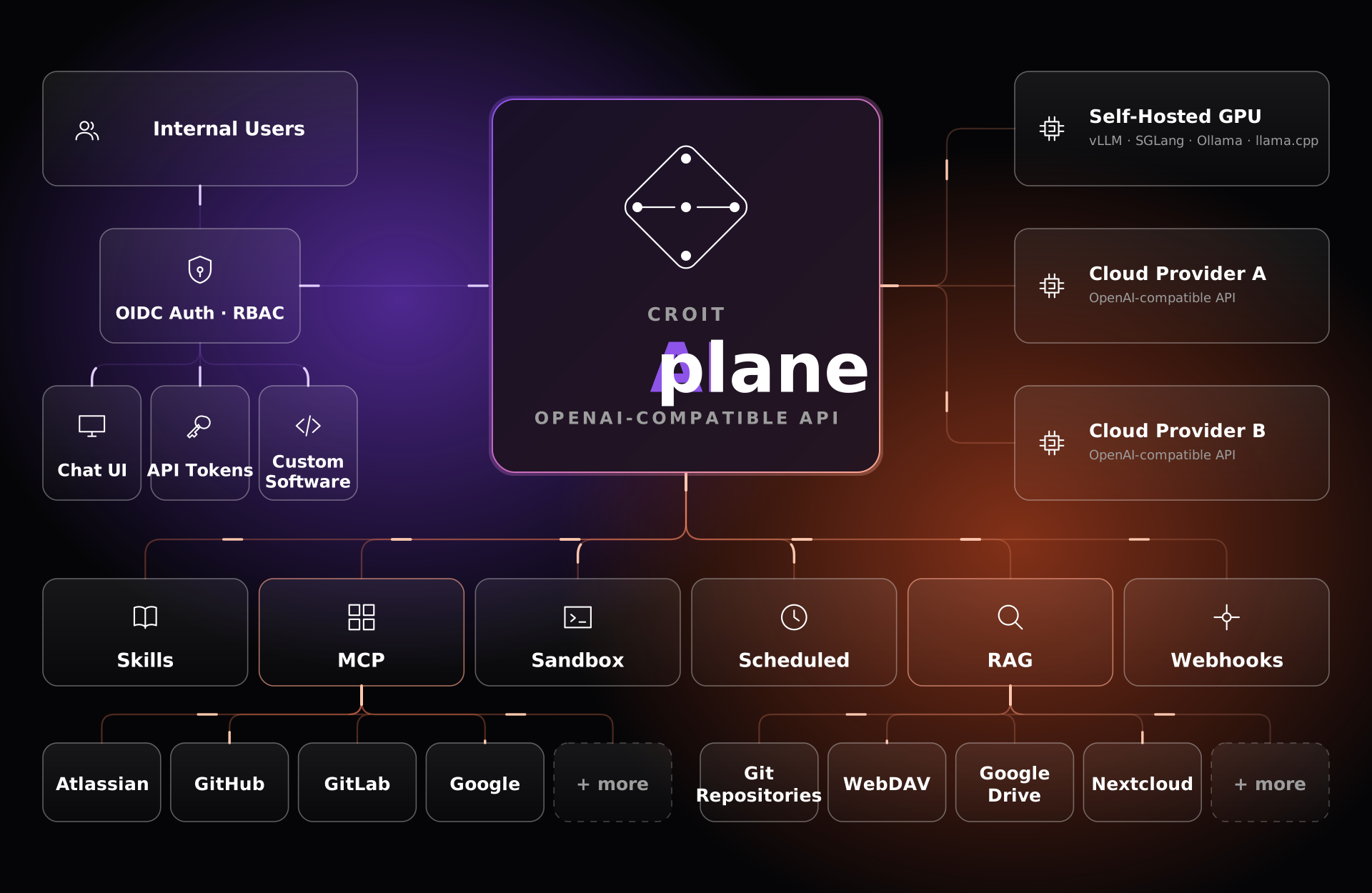
How it fits
        Applications  ·  Agents  ·  Users
    (OpenAI SDKs, Claude Code, OpenCode, Open WebUI,
     curl, the built-in chat UI)
                            |
                     OpenAI / Anthropic wire
                            |
                            v
                     croit AIplane
   +-------------------------------------------------+
   |  Agent runtime      tools run mid-completion     |
   |  MCP connectors     per-user, OAuth or token     |
   |  Tools + sandbox    web, documents, code         |
   |  RAG + memory       your corpora, durable facts  |
   |  Identity + policy  OIDC login, RBAC, gwk_… keys |
   |  Routing            pools, aliases, failover     |
   |  Usage + limits     per user / token / model     |
   +-------------------------------------------------+
                            |
              one OpenAI-compatible client out
                            |
       +--------------------+--------------------+
       |                    |                    |
     vLLM               SGLang           hosted OpenAI-
   llama.cpp            Ollama          compatible APIs
                                     (OpenAI, OpenRouter,
                                        LiteLLM proxy, …)
Everything in the middle box is the part a reverse proxy does not give you, and the reason to put AIplane in the path at all.
See it work
An ordinary OpenAI client. The only change is base_url:
from openai import OpenAI

client = OpenAI(base_url="https://aiplane.example.com/v1", api_key="gwk_…")

answer = client.chat.completions.create(
    model="qwen",                       # a stable alias; the real model can change underneath
    messages=[{"role": "user", "content":
               "What did we ship in the billing service last week? "
               "Check our repo index and write the release note."}],
)
print(answer.choices[0].message.content)
One request in, one finished answer out. In between, AIplane offered the model the tools this token is allowed to use, the model called rag_search over your indexed repository and then search_web to check an upstream changelog, and AIplane executed each call and fed the result back — several model round-trips the client never saw. Your code has no tool loop, no tool_calls branch and no agent framework in it.
The same is true of POST /v1/messages, so Claude Code points at your own models with two environment variables.
Contents
- What it does
- Use cases
- Works with your stack
- Try it
- Tools the model can call
- The built-in web UI
- Scheduled actions
- Webhooks
- Conversation compaction
- Voice conversation
- Built with
- Integrations (per-user MCP connectors)
- Claude Code against your own models
- OpenCode against your own models
- Quick start (from source)
- Setup wizard
- Configuration
- Using AIplane
- Production deployment (container + systemd)
- Documentation
- Contributing
- License
What it does
Roughly in the order that matters when you are deciding whether to put this in your path.
- OpenAI-compatible API —
POST /v1/chat/completions(streaming + non-streaming),POST /v1/embeddings,POST /v1/images/generations+POST /v1/images/edits,POST /v1/audio/transcriptions,POST /v1/audio/speech(text-to-speech, when a speech pool is configured), andGET /v1/models. Point any OpenAI SDK at it. - Anthropic-compatible API —
POST /v1/messages(streaming + non-streaming) andPOST /v1/messages/count_tokens, so Claude Code can be pointed straight at AIplane and run against whatever models you serve. Same routing, tokens, limits, tools and usage accounting as the OpenAI surface; AIplane translates between the two dialects. - TypeSafe System One-compatible API —
POST /v1/systemonepreserves the typednoul,choice, andscorecontract, so the official TypeSafe SDK can use AIplane as its base URL while AIplane supplies authentication, aliases, routing, limits, and usage accounting. - Any OpenAI-compatible server, without per-server settings — vLLM, Ollama, llama.cpp, SGLang or a hosted provider. AIplane identifies what each backend is and works out the things the OpenAI wire does not carry: the real context window (so long conversations are compacted here rather than truncated there, in silence) and how that server spells "think harder" (so the effort control actually reaches the model). Detected on apply and on a Test button, overridable per model, and warned about when an override exceeds what the server serves. See
docs/upstreams.md. - Server-side tools — AIplane runs tools mid-completion (web search, fetch-URL, document rendering, code execution, RAG, network lookups, and more); the client just sees a normal completion. Full list in Tools the model can call.
- Integrations (per-user MCP connectors) — an admin-curated catalog of MCP servers (Google Workspace, GitHub, Atlassian, GitLab, …) that each user connects to with their own account at
/integrations. OAuth (with dynamic client registration where supported) or a user-supplied token; tokens are encrypted at rest and refreshed in the background. The connected servers' tools then become available to the model, scoped to that user's own permissions. See Integrations. - RAG — operator-managed, indexed codebases that the chat model can search.
- Agent Skills — drop a
SKILL.mdbundle (or.skillarchive) in and the chat model loads it on demand to follow your house style, brand, or domain playbooks — progressive disclosure, no fine-tuning. Admins upload/view/delete global skills at/admin/skills(live, no restart, RBAC-gated per role); every user can also add their own private skills at/skills, usable only in their own chats. See Agent Skills. - OIDC login — browser sign-in against your identity provider; AIplane then issues its own
gwk_…API tokens. Provider secrets come only from the environment. - Per-user tokens + RBAC — tokens are SHA-256-hashed at rest and revocable. Roles (mapped from OIDC claims) gate which models and server-side tools each user may use.
- Multi-backend routing — named upstream pools (
chat/transcription/embedding/image/speech/system_onekinds, plus internal capability pools). Each pool load-balances across its backends with per-backend health probes and a per-backend maintenance switch that takes effect on the next request. Models are discovered live from each backend's/modelsendpoint, so loading a model on a backend makes it routable with no config change. - Model aliases + fallback — give clients a stable name (a per-backend alias like
qwen) that routes to whatever real model is loaded, so swapping the model needs no client change; the same alias on several backends is a load-balanced group. Optional fallbacks cover an unknown model name or a known model whose backends are all down. All configured per backend/pool at/admin/upstreams. Seedocs/upstreams.md. - Provider-neutral automatic model routing — expose any configured alias as a normal OpenAI/Anthropic model while a System One selector chooses among its allowed candidates. Per-alias quality/cost objective, instructions, confidence fallback, session affinity, versioned shadow rollout, and decision audit are configured under
/admin/models; provider health and replica failover stay in the existing pool router. Seedocs/automatic-routing.md. - KV-cache-aware routing — pick
prefix_affinityand a conversation keeps landing on the replica that already holds its KV prefix, instead of alternating between GPUs and paying a full prefill on every turn. Clients that can name their session (x-aiplane-affinity, which Claude Code sets per launch viaANTHROPIC_CUSTOM_HEADERS) get exact affinity by weighted rendezvous hash; everything else is matched block-wise against an approximate per-pool index of which replica was recently sent which prompt prefix — so a new session can also start warm on the replica already holding the shared system prompt. A two-threshold load valve hands throughput back when a replica is genuinely busier.least_inflightand weightedround_robinremain available. Seedocs/upstreams.md. - Outages pause instead of failing — when every replica of a model is down or saturated, AIplane holds the request and retries routing until one returns (
[gateway] upstream_wait_secs, default 120s) rather than failing it. Nothing has reached the client, so an agent turn survives an upstream restart. A model stays known across a gateway restart too, so an outage is always a retryable529/503withRetry-After— never the404that tells a client the model doesn't exist. Seedocs/upstreams.md. - Usage accounting, rate limits & quotas — every call is metered per user/token/model (requests, tokens, and — with per-model prices — spend), shown on
/usagewith a per-API-token breakdown and drill-down. Set hard rate limits and quotas at/admin/limits(requests / tokens / cost, over a rolling hour / day / week / month), scoped globally, per-role, per-user, or per API token; over-budget callers get a429. A token can also be scoped to specific models, so a key you hand to a third party reaches only what you listed — the owner scopes their own token at/tokens, an operator scopes any token at/admin/tokens, and the two lists intersect, so each side can only narrow. Self-hosted pools can be marked exempt (a per-pool toggle at/admin/upstreams) so their usage is still recorded and shown on/usage, but never counts against a limit or quota. - Chat UI — a mobile-friendly chat at
/chatwith persisted multi-conversation history, token-by-token streaming, file attachments, voice dictation, shareable/exportable conversations, and resume-on-reconnect (every turn is written to SQLite as it happens). - Scheduled actions — per-user prompts that run on a cron schedule (hourly / daily / weekly / monthly, or a raw cron expression), each evaluated in its own timezone. A friendly builder assembles the cron and shows the next run times live; every fire opens a chat you can read back in the UI — a fresh one each time, or (optionally) continuing the previous run's conversation as history. See Scheduled actions.
Use cases
- Self-hosted company AI. Put AIplane in front of your vLLM or SGLang boxes and everyone gets one endpoint, one model list and one login — while the GPUs, model names and replica counts change underneath.
- Governed access for employees. OIDC groups map to gateway roles, roles decide which models and which tools a person may use, and every call is metered per user and per token. A department can be given a monthly budget that actually stops at the limit.
- Add tools and MCP to an application you are not going to rewrite. The application keeps issuing plain chat completions; the tools it gains are configured in AIplane, not in its code.
- Route between private and external models. Keep the cheap and confidential traffic on your own hardware and let a hosted model cover what it cannot serve, with fallbacks for the case where a pool is down.
- Expose stable model names. Clients address
qwenorfast; you repoint the alias when the real model changes. No coordinated client release. - Hand a scoped key to a third party. A token can be limited to specific models, specific tools and its own spending quota, and revoked on its own.
- Give engineers their own coding agent. Claude Code and OpenCode point at AIplane and run against your own models, with the same accounting as everything else.
Works with your stack
AIplane is a layer, not a replacement. Bring the inference stack you already run.
| Your stack | How it fits |
|---|---|
| vLLM, SGLang, llama.cpp, Ollama | Detected as what they are, with the per-server differences the OpenAI wire does not carry (real context window, how "think harder" is spelled) handled for you. See docs/upstreams.md. |
| Hosted APIs and aggregators — OpenAI, an OpenRouter endpoint, a LiteLLM proxy | Any OpenAI-compatible base URL plus a key is a backend; upstream AIplane speaks the OpenAI wire only, so a provider reaches it through its OpenAI-compatible endpoint. Put them in their own pool, or alongside self-hosted backends in one, and let aliases and fallbacks decide what serves what. |
| OpenAI SDKs, Open WebUI and other OpenAI-compatible clients | They keep working unchanged — AIplane is the endpoint they already know how to talk to. |
| Claude Code, OpenCode | Speak the Anthropic Messages API, which AIplane serves at POST /v1/messages. |
| MCP servers | AIplane is an MCP client: an admin curates the catalog, each user connects with their own account, and those tools join the model's toolbox. |
What AIplane adds on top is the agent runtime, the identity and RBAC story, and the accounting — the parts none of the above provide, and the reason to put it in the path.
Try it
One container, one environment variable:
docker run -d --name aiplane -p 8080:8080 \
  -e AIPLANE_SESSION_KEY="$(openssl rand -hex 32)" \
  -v aiplane-data:/var/lib/gateway \
  ghcr.io/croit/aiplane:production
Open http://localhost:8080. A fresh install lands in the setup wizard, which
asks for your identity provider, proves it with a real sign-in, and hands you an
admin account. Then add a backend at /admin/upstreams (base URL of your vLLM /
SGLang / Ollama server, plus a key if it wants one), mint a token at /tokens,
and you have the endpoint from See it work. There is no config
file at any point — everything else lives in the database and is edited in the UI.
Keep the session key you generated: it signs sessions and seals every secret
in the database, so it belongs in your password manager next to the volume.
Honest friction, before you start the clock. The wizard cannot be completed
without a working OIDC provider — it will not write a configuration it has not
proven with an actual login, which is right for production and a real obstacle
for a ten-minute evaluation. Any provider that publishes a discovery document
works, including a throwaway Keycloak or Dex you start alongside it. There is
deliberately no local-admin shortcut today; if you are evaluating and have no
IdP to hand, that is the barrier you will hit first, and closing it is a known
product gap rather than an oversight.
Running it properly afterwards: Production deployment,
Docker Compose, Kubernetes.
Tools the model can call
This is the part most "OpenAI-compatible proxy" projects don't have. AIplane can execute tools server-side, in the middle of a completion: the model asks to search the web, read a PDF you attached, render a branded PDF, run code in a throwaway sandbox, or query an indexed codebase — AIplane runs it, feeds the result back, and the client just receives one ordinary completion with the finished answer. It works identically through the raw /v1/chat/completions API and the built-in chat UI.
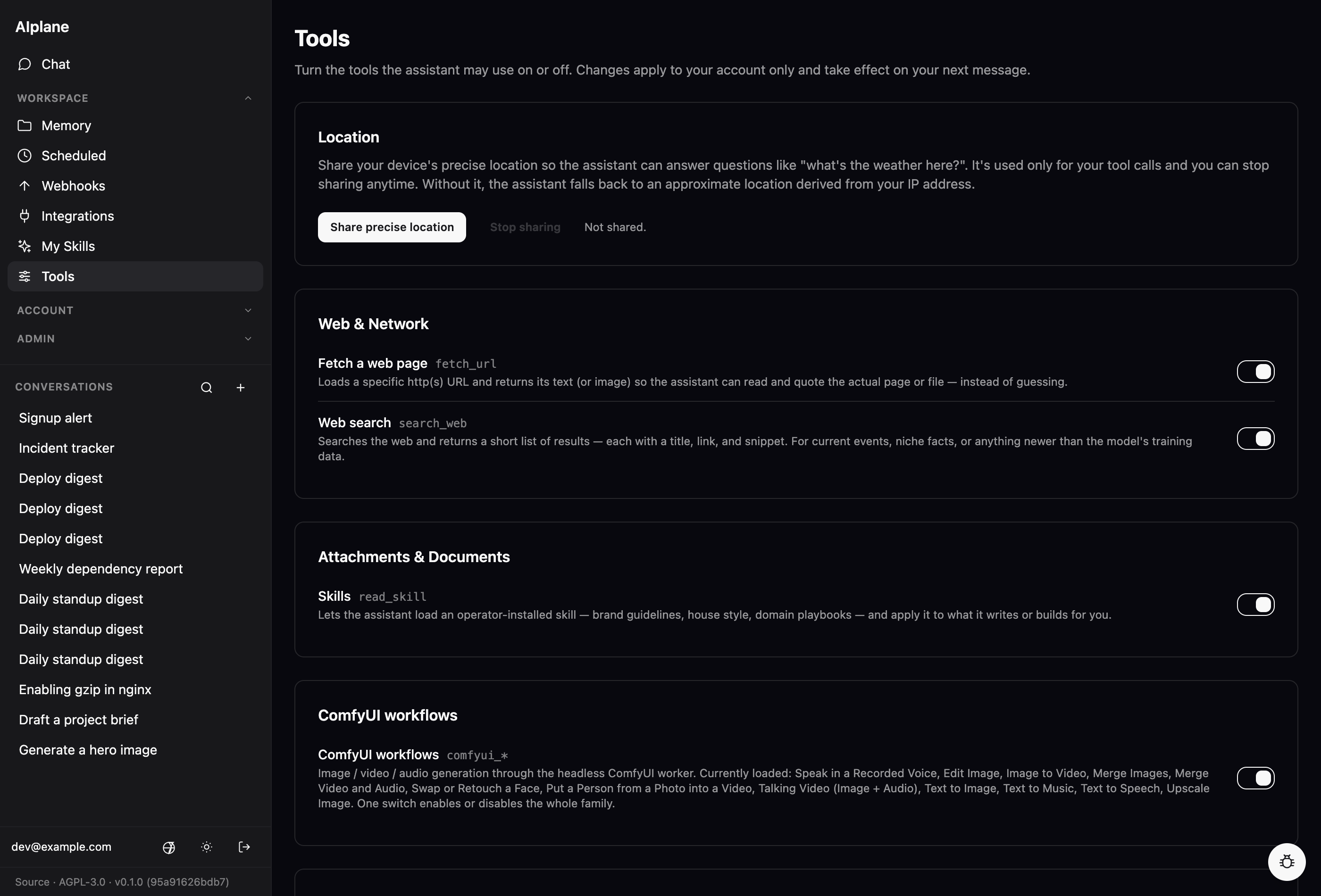
Every tool is RBAC-gated per role, and each user can flip their own grants on and off on the /tools page:
| Category | Tools | What the model can do |
|---|---|---|
| Web & retrieval | search_web, fetch_url, wikipedia |
Search the web (SearXNG or Brave — configured under Web search on /admin/models, with optional per-query domain and recency filters), fetch any URL (HTML is reduced to readable text — headings, lists, links, tables and code survive, scripts and markup don't, so a page costs a few KB instead of a few hundred; raw: true when the markup itself is the point — images → viewable, other binary → metadata), and pull encyclopedic summaries. |
| Documents | fetch_attachment, upload_attachment, offer_download, import_file, list_attachments, typst_* |
Read files the user attached — including two-tier PDF reading (extract the text layer first; rasterize scanned pages for a vision model if that comes back empty) with page ranges so a long document is read one window at a time instead of only its first pages — attach files back into its own reply, hand over any file the conversation already holds as a download (copied inside storage, so a big payload never gets pasted into the reply as text), pull a text file into the editable canvas so it can be changed a passage at a time instead of rewritten, list every file in the conversation (uploads + earlier tool outputs) so assets get reused instead of regenerated (attachments resolve by id or bare filename, newest wins), and render PDF/PNG documents from operator-defined Typst templates (invoices, letters, reports) whose field data lives in the canvas — visible, versioned, downloadable, and editable by hand. |
| Automatic document OCR (opt-in) | baidu/Unlimited-OCR via the internal ocr pool |
Send uploaded images, and PDFs without a usable text layer, to the PDF-aware OCR sidecar and add the result as untrusted document context — cached by document hash, page-ordered, metered, with per-document status in the chat UI. The feature is inactive until you enable OCR at /admin/settings → Chat and a healthy ocr backend is configured. See docs/ocr.md. |
| Document canvas | create_document, edit_document, delete_document, … |
Build up a long document (report, spec, article) across turns and edit it section-by-section in a live side panel, then export it to PDF/DOCX/PPTX — instead of regenerating the whole thing every reply. Every change is a new version; the model can list the history and roll back (list_document_versions, restore_document_version), and several documents can coexist per conversation. You can edit any document by hand in the panel — your save is a version of its own, labelled as yours, and the assistant is told the document moved under it (with the id to re-read) so its next edit builds on your wording instead of reverting it. Abandoned drafts can be cleared away without losing anything: delete_document is a soft delete — the document leaves the canvas and the model's listing but keeps its history, and undelete_document brings it back. Formats: markdown, text, html, json, toml, typst (draft the source in the canvas, render via render_typst/export_document — sections anchor on = headings), and yaml (text-edited so comments survive). See docs/file-conversions.md. |
| Images | generate_image, edit_image |
Generate an image from a text prompt (diagrams, mockups, marketing visuals) and, where the backend supports it, edit an existing image (image-to-image) — rendered inline in the reply. Routes to an image-kind upstream pool (any OpenAI /images/*-compatible backend: a hosted provider or a self-hosted model). edit_image appears only when a backend advertises edit support, and is refused against non-GDPR-compliant backends. |
| QR codes | generate_qr_code |
Generate a QR code natively in AIplane (no sandbox, no backend) — URLs, WiFi access, vCard/MeCard contacts, mailto:/tel:/geo:, SEPA GiroCode payments — as PNG or SVG, with custom colors and an optional centered logo from a chat attachment (error correction auto-raised to H). Attached inline in the reply. |
| Code & sandbox (opt-in) | run_in_sandbox, generate_document, export_document, convert_document, edit_presentation, capture_webpage, browse_page, render_typst, render_excalidraw, read_sandbox_output |
Run Python/shell in an isolated gVisor VM (data crunching, format conversion, plotting; run_in_sandbox persists its workdir across a conversation turn so the model can iterate), turn Markdown into PDF/DOCX/PPTX, convert between office/PDF/image formats, edit an uploaded .pptx in place, screenshot a web page, drive a browser across several steps (browse_page — click, fill a form, get past a consent banner, then read the result: the session stays open for the whole turn), render Typst or Excalidraw, and page through a large sandbox result without pulling it all into context. The web tools appear only when the sandbox runner is configured for network egress — AIplane asks it at startup, so on an offline runner the model is never offered a browser it cannot use, and run_in_sandbox doesn't even show a network option. Enabled at /admin/settings → Tools — see docs/sandbox.md and docs/file-conversions.md. |
| Memory | remember, recall, update_memory, forget |
Persist durable facts about the user (preferences, projects) and recall them in later conversations — and correct or drop one when it changes, so a changed fact replaces the old one instead of leaving two contradicting memories behind. Anything filed as a preference is different in kind: it says how an answer should be shaped, so it rides in the system context of every conversation from the first token, rather than waiting for the model to think of calling recall. Project context and facts stay behind recall and are advertised there as a count, so the model knows there is more to ask for. Turning the Memory switch off on /tools stops the injection too — the switch means "don't use this", not "hide the tools". |
| Scheduled actions | schedule_action, list_scheduled_actions, delete_scheduled_action |
Set up recurring prompts from inside a conversation — "every Monday, summarise last week's tickets" — reaching the same cron scheduler the /scheduled page drives. Each run opens a conversation you can read afterwards, on the model you were talking to. Creating or deleting one needs your confirmation (via ask_user) and an action created this way always runs without tools: a scheduled prompt later runs as you, unattended, so it is not something a model should be able to plant on its own. |
| Notifications | notify_user |
Reach you when you're not watching the conversation — long sandbox work finished, or a scheduled action found something worth knowing — as a Web Push notification on your phone or desktop. Hard-limited to one per reply, and only where you enabled notifications. |
| Asking you | ask_user |
When a choice would change what it builds and guessing would waste the work, the assistant asks — inline, mid-answer, with optional buttons plus a free-text field — and waits for your reply instead of ending the turn with a question. Times out and proceeds on a stated assumption if nobody answers. |
| Network & ops | dns_lookup, whois_lookup, tls_cert, lookup_ip |
DNS-over-HTTPS records, RDAP domain registration, TLS-certificate inspection ("is this cert about to expire?"), and GeoIP for any IP or hostname. |
| Location | get_user_location |
Use the approximate IP-based location that's always in context, or ask the browser for precise GPS when the task needs it. |
| Utility | convert_currency, get_current_timestamp, company_echo |
Convert currencies at daily ECB rates, get the timezone-aware current time, and echo a message back verbatim (company_echo is a built-in smoke test for the tool-call loop). |
| Knowledge base | rag_list_collections, rag_search, rag_grep |
Search operator-indexed codebases/corpora and get back the matching chunks with file paths, line ranges, and scores. Search is hybrid — dense vectors fused with FTS5/BM25 — so exact identifiers land as well as paraphrase, and a path_glob scopes a query to part of the corpus. rag_grep covers what ranking can't express: a regular expression over the indexed text, returning matching lines with line numbers and context (bounded by result/row/time limits, since it has no index behind it). |
| Integrations | mcp__<server>__* |
Call the tools of any bridged MCP server. Each server's tools are namespaced so two servers can't collide. |
| Canvas plumbing | read_document, list_documents, edit_document_section |
Read a canvas document back, list the conversation's documents, and edit one section of one — the finer-grained companions to the canvas tools above. |
| Knowledge base (document sets) | rag_query_documents, rag_list_documents, rag_fetch_document |
Answer questions about a set of indexed documents rather than a passage: filter, sort and total by the fields an extraction profile pulled out (vendor, date, amount, project), list a folder with the stored per-document summaries, and pull one document's full extracted text. See RAG. |
| Media & bundles | load_image_url, zip_attachments, render_video |
Fetch an image from a URL and keep it as a reusable conversation attachment, bundle several files the conversation already holds into one .zip download, and assemble a video from a declarative JSON timeline — cut clips with transitions, animated text, a logo and a music bed, re-renderable from the same timeline (render_video needs the sandbox). |
| ComfyUI workflows (opt-in) | comfyui_<workflow> |
One tool per workflow the operator has installed — image, video, or audio generation on a self-hosted ComfyUI. The catalog is live-reloadable at /admin/comfyui; see docs/comfyui.md. |
| Skills | read_skill |
Load an operator-installed skill — brand guidelines, house style, domain playbooks — then apply it: pull the SKILL.md, then any referenced asset (e.g. an SVG to inline). |
Tools turn themselves on. Tools start off to keep the model's tool list short — short lists are cheaper and the model picks tools more accurately. When a request needs a capability the model doesn't currently have, it calls a built-in enable_tools tool to switch the relevant ones on; their real schemas appear on the next turn and stay on for the rest of the conversation. So the model reaches for exactly what it needs, when it needs it, without the operator wiring per-conversation tool lists — all still bounded by what the user's role permits.
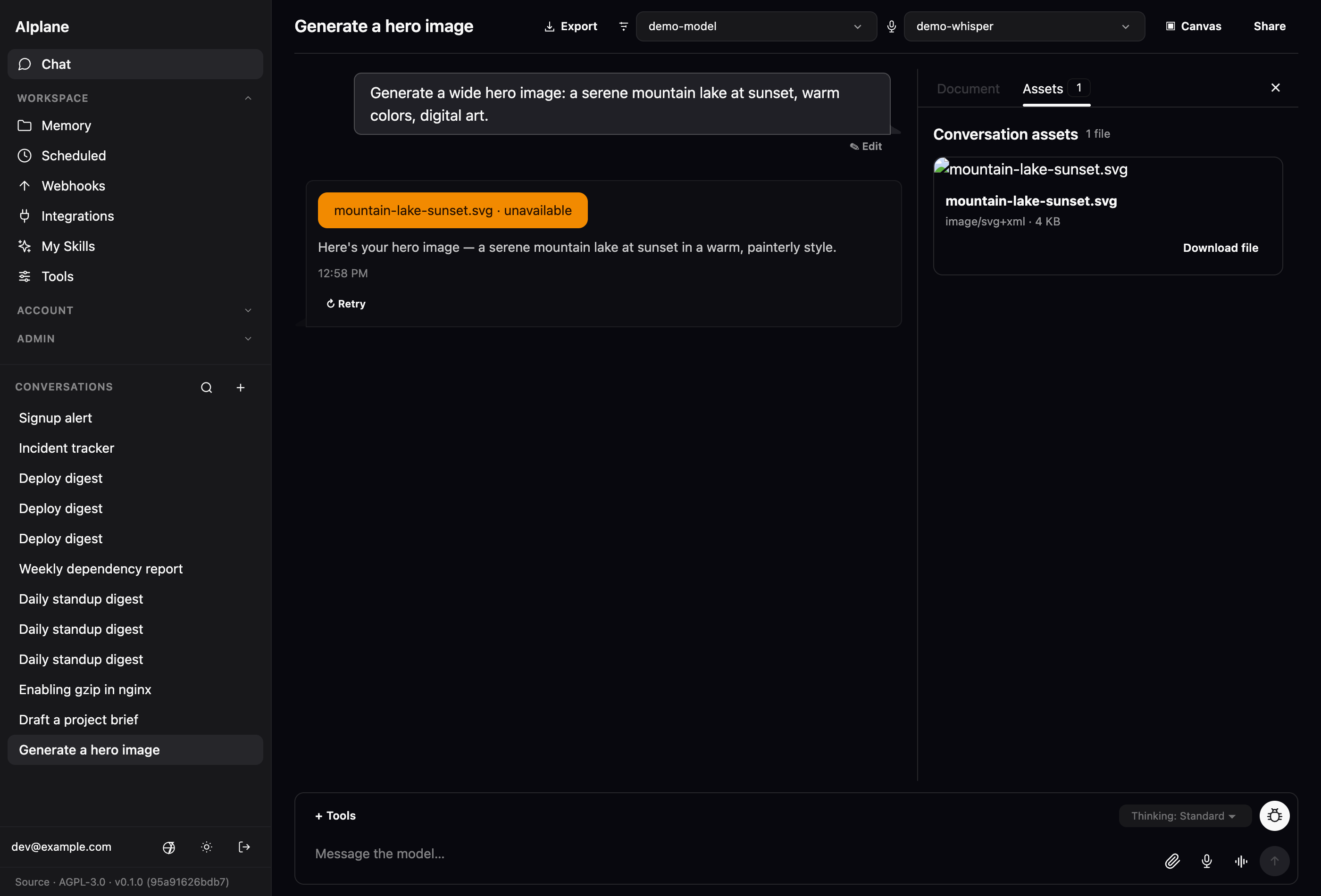
The built-in web UI
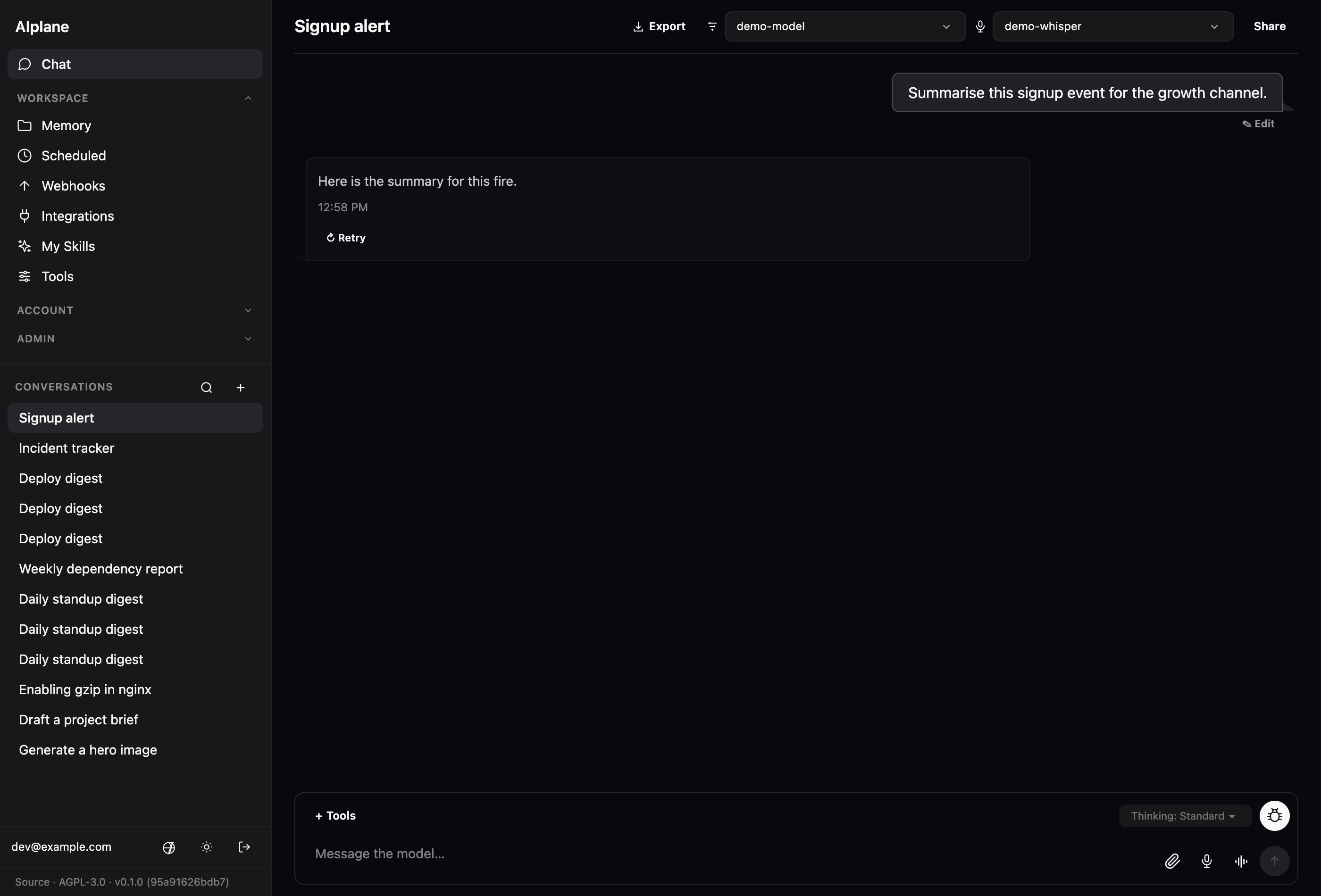
Beyond /chat, AIplane ships a small operator and account UI — no separate dashboard to deploy. It is a SvelteKit single-page app AIplane serves as static files from its own root, so there is still only one process and one port. Admin screens are gated to the admin role.
UI text is currently English. The gateway's server-side strings still ship in six languages (English, German, French, Spanish, Russian, Chinese) and the translation gate that keeps them in sync is still enforced at build time, but the in-app language switcher has not been carried over to the SPA yet.
 |
 |
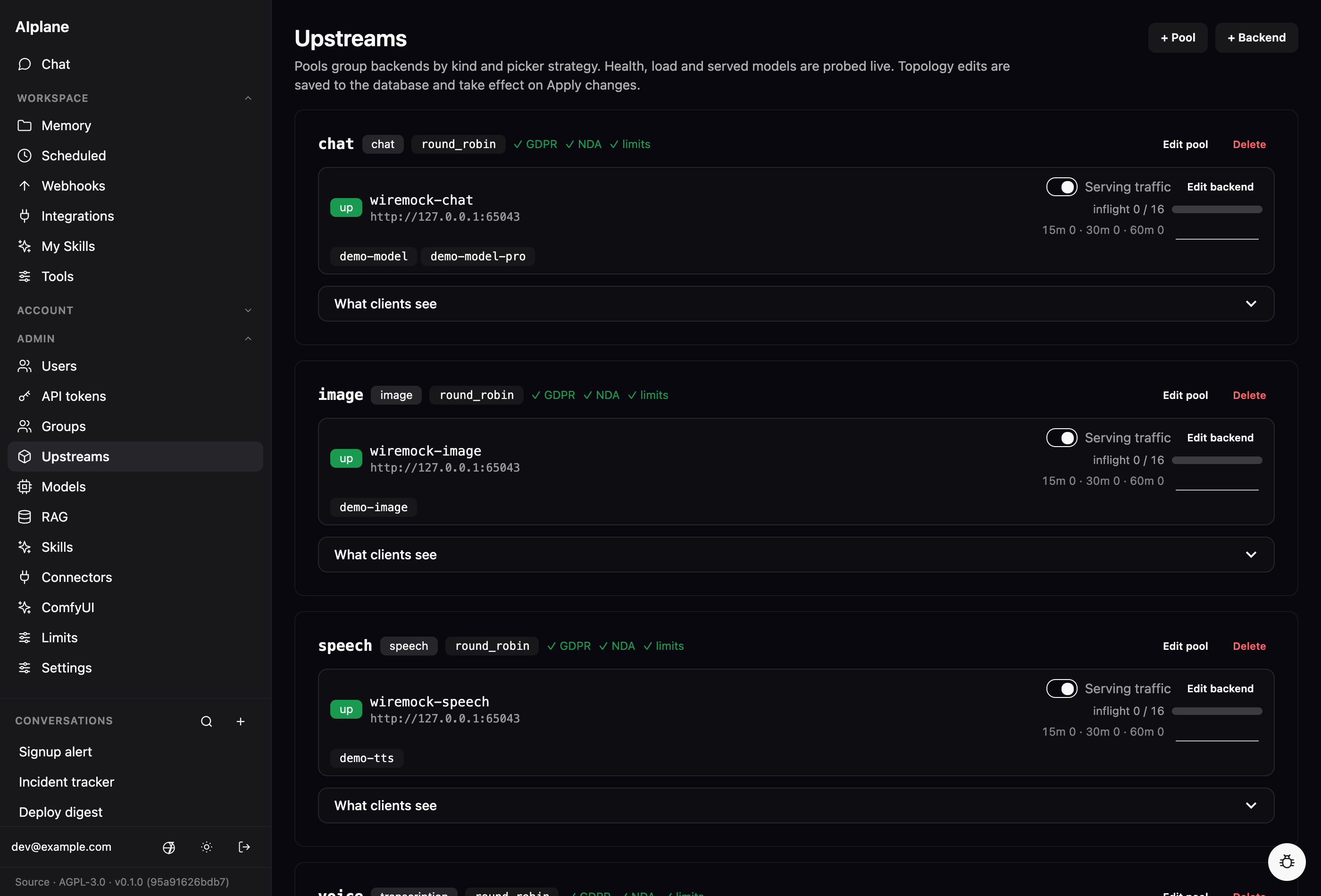
Upstreams (/admin/upstreams) — one page for pools and backends: live health, in-flight load, and discovered models per pool, with inline add/edit/delete of pools and backends (API key stored encrypted, so a new backend goes live on "Apply changes" without a restart). A sticky bar counts unapplied topology edits until you reload the runtime registry. |
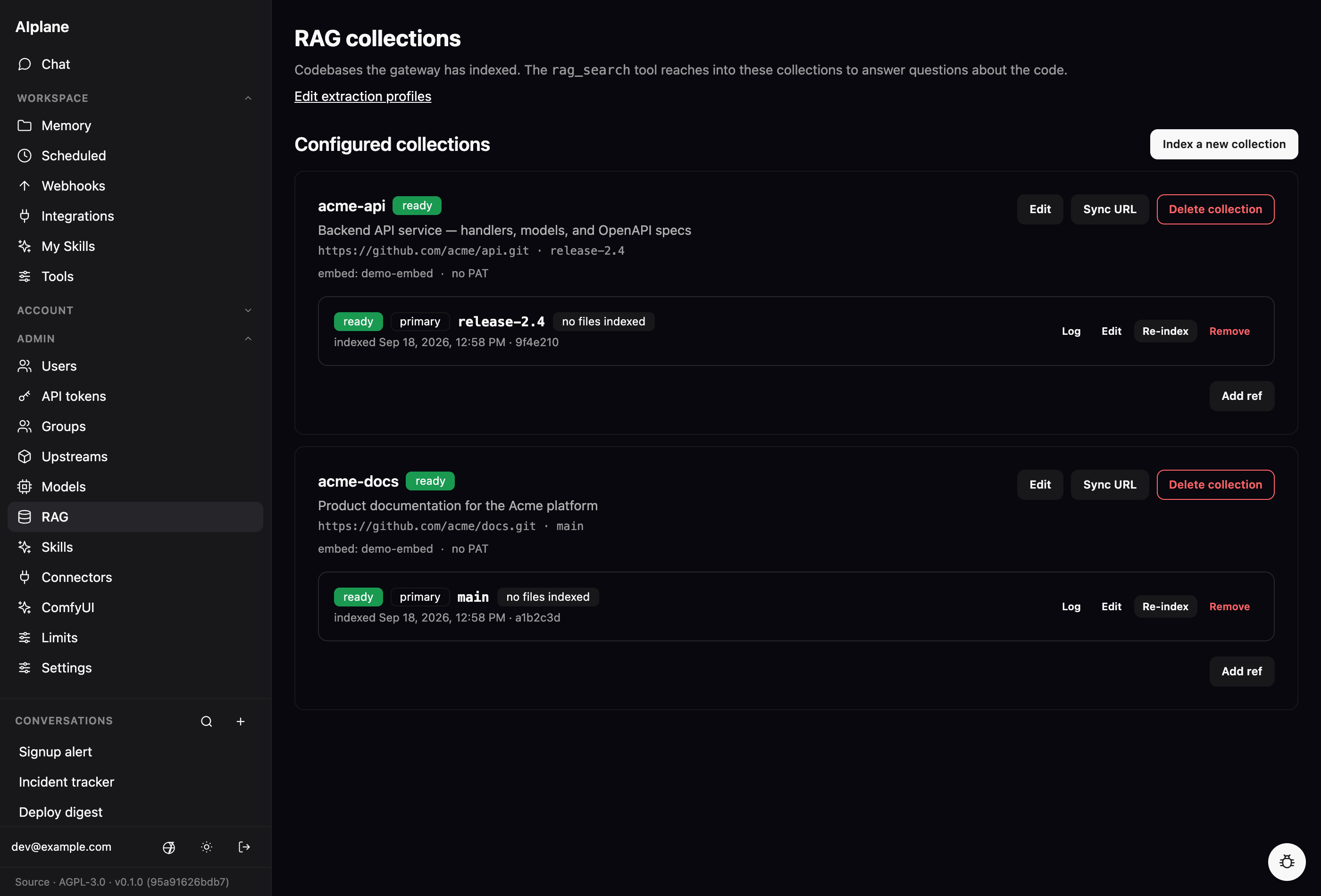
RAG (/rag) — index a codebase or file source, manage its refs and indexing log, and edit document extraction profiles at /rag/profiles. |
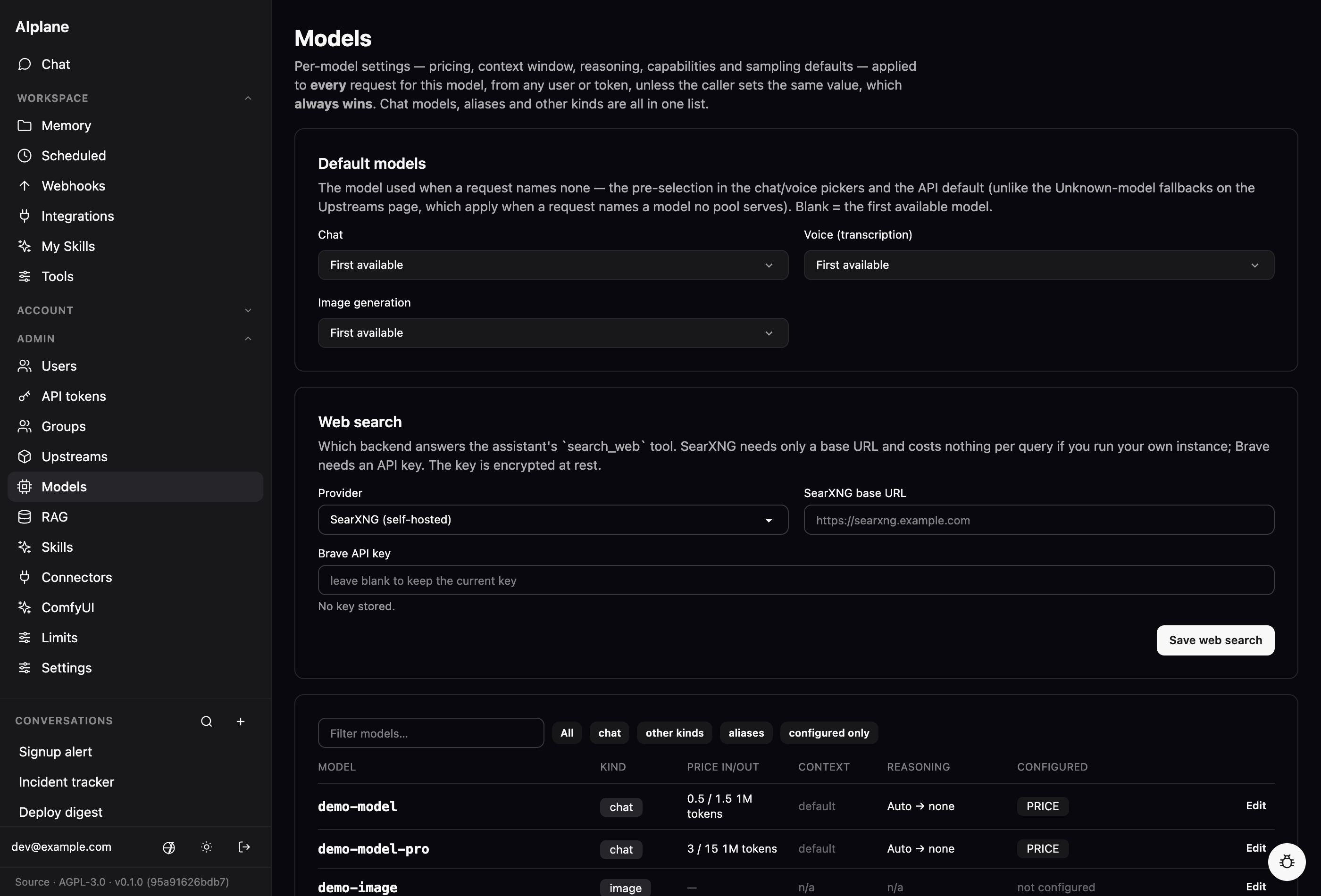
There's also /tokens (mint, rotate, and revoke your gwk_… API tokens — scope each token to a subset of your tools and of your models, give it its own spending quota, and see what it has cost this month), /usage (your own request/token usage, plus spend when per-model prices are set), /memory (view and edit what the assistant has remembered about you), /scheduled (prompts that run on a cron schedule — see Scheduled actions), /admin/models (server-wide sampling defaults, per-model reasoning budgets, per-model context windows that drive conversation compaction, per-model prices (input/output per 1M tokens) that turn token usage into spend on /usage, the per-feature default model pre-selected for chat, voice, image generation, and the RAG embedding picker, and the web-search backend the search_web tool uses — SearXNG URL or Brave API key, the key encrypted at rest), /admin/limits (rate limits & quotas — see below), and /admin/users (registered users with their resolved roles). The users page can also let an admin impersonate another user for debugging — every impersonation is audited and shows a persistent banner, and an impersonation session expires 8 hours after it started (it never gets the sliding renewal an ordinary login does). Impersonation is opt-in: it's off unless you enable gateway.allow_impersonation at /admin/settings (default off), in which case the Impersonate buttons appear and POST /api/v0/admin/users/{id}/impersonate is accepted; otherwise the buttons are hidden and that endpoint returns 403.
 |
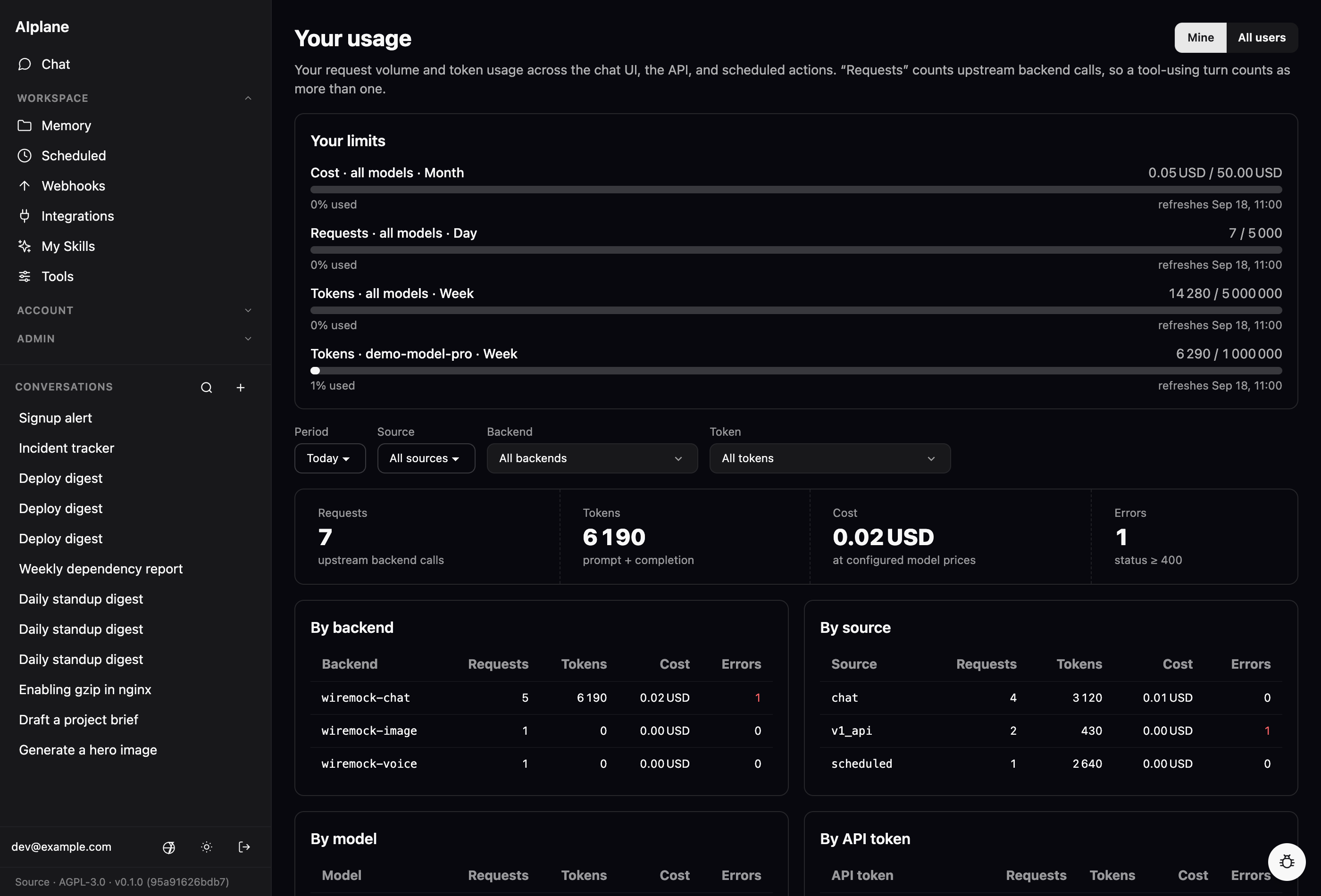 |
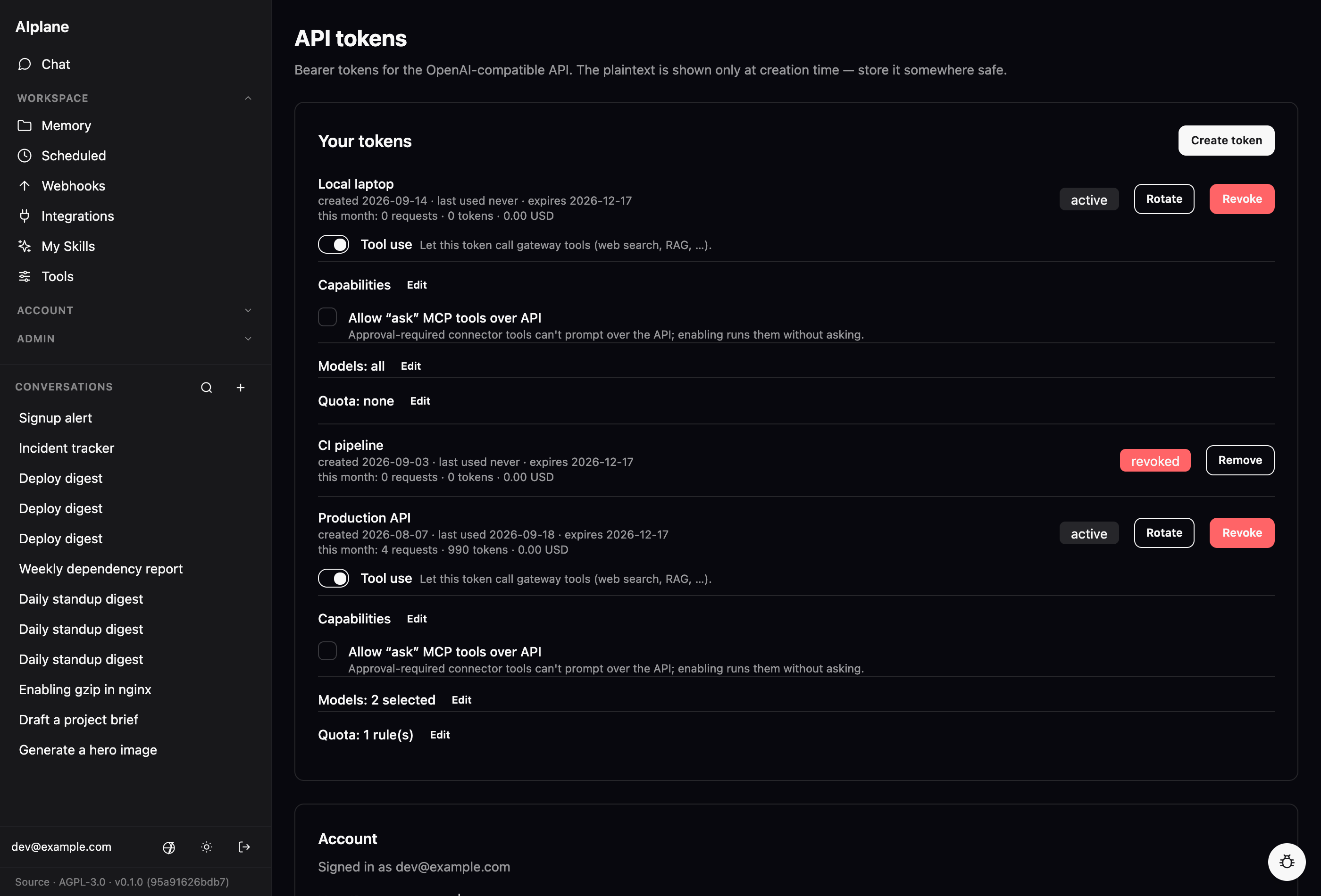
API tokens (/tokens) — mint, rotate, revoke, per-token tool and model scoping, a per-token quota, and what each token has cost this month. |
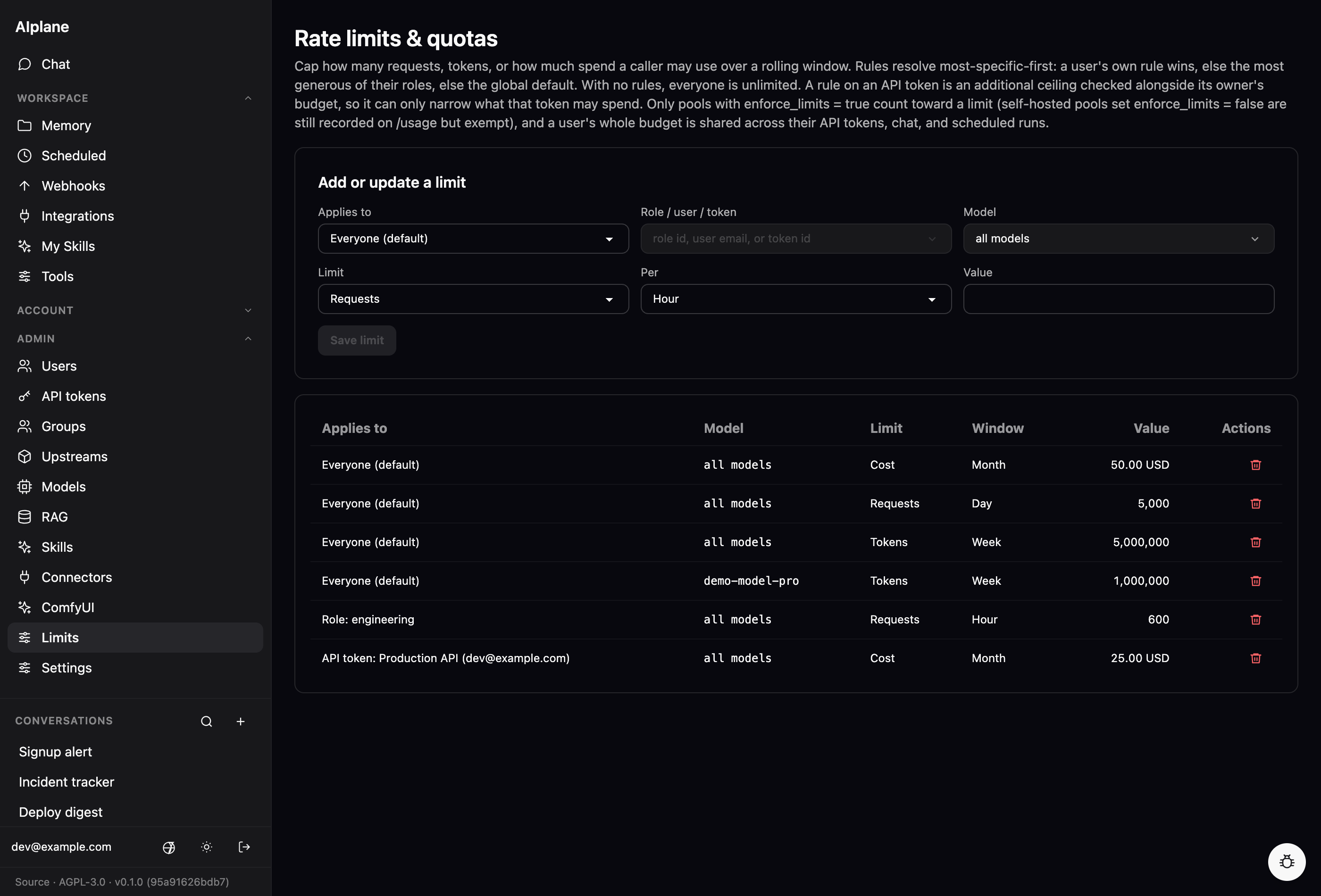
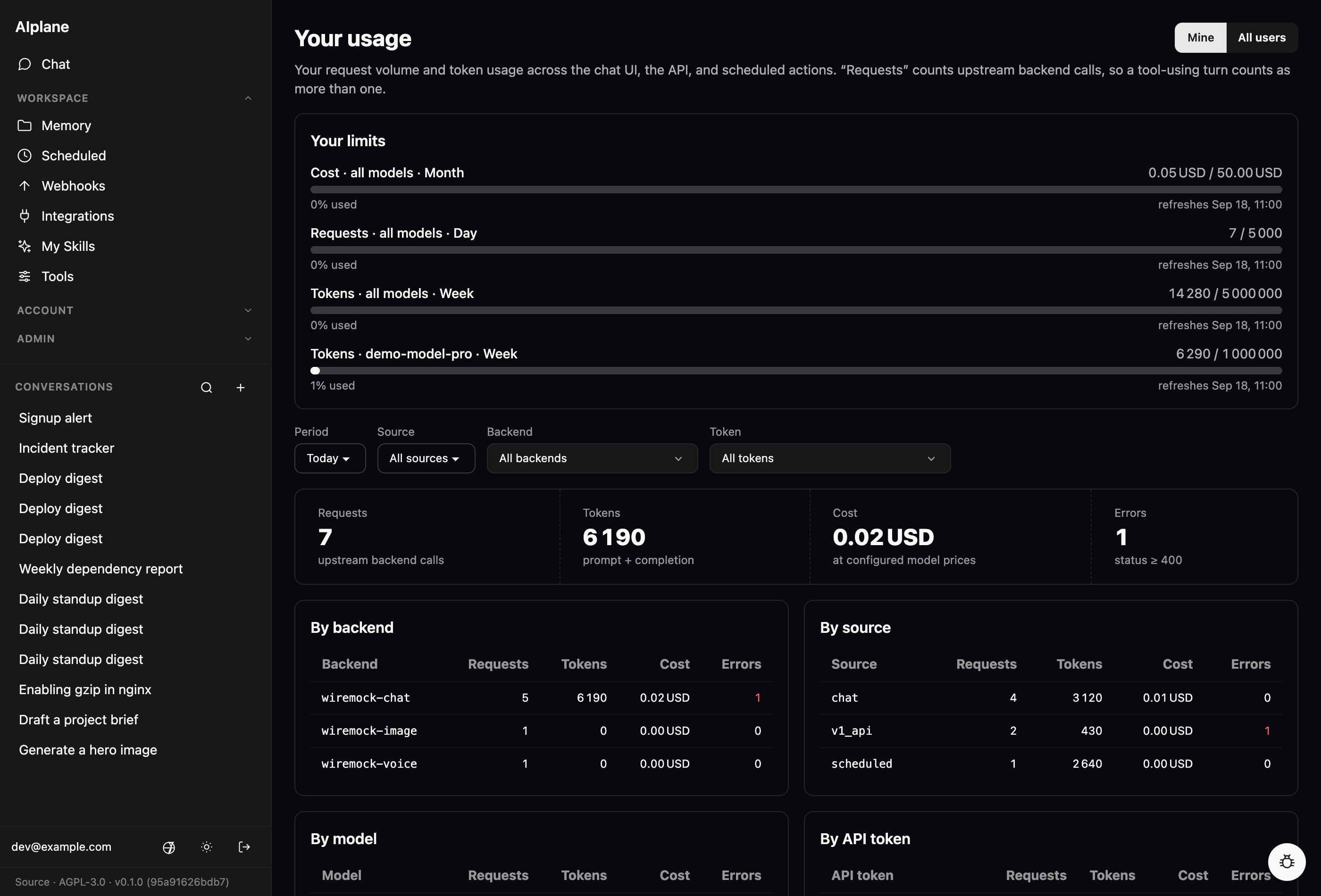
Usage (/usage) — your own request/token volume, broken down by backend, source, and model. |
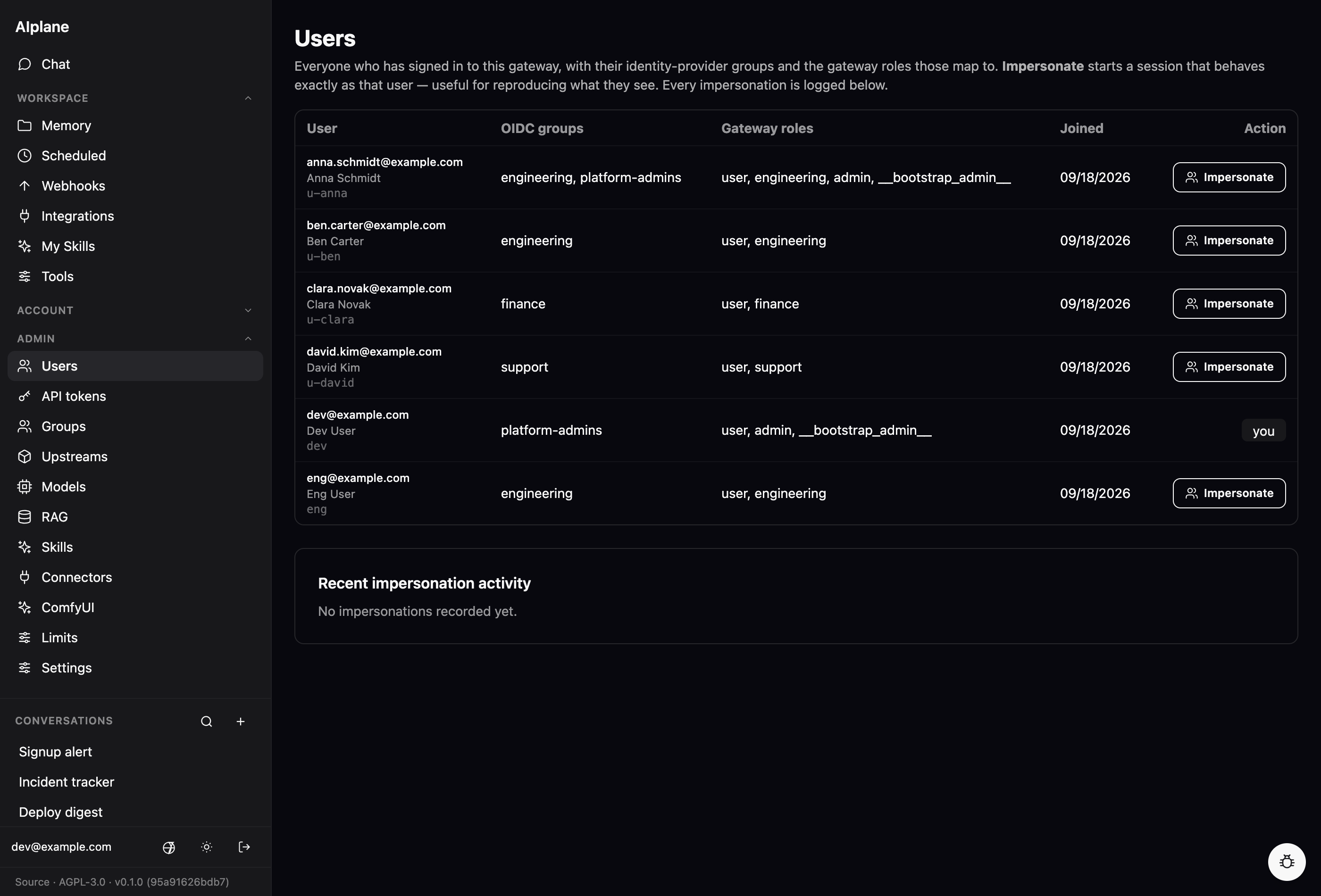
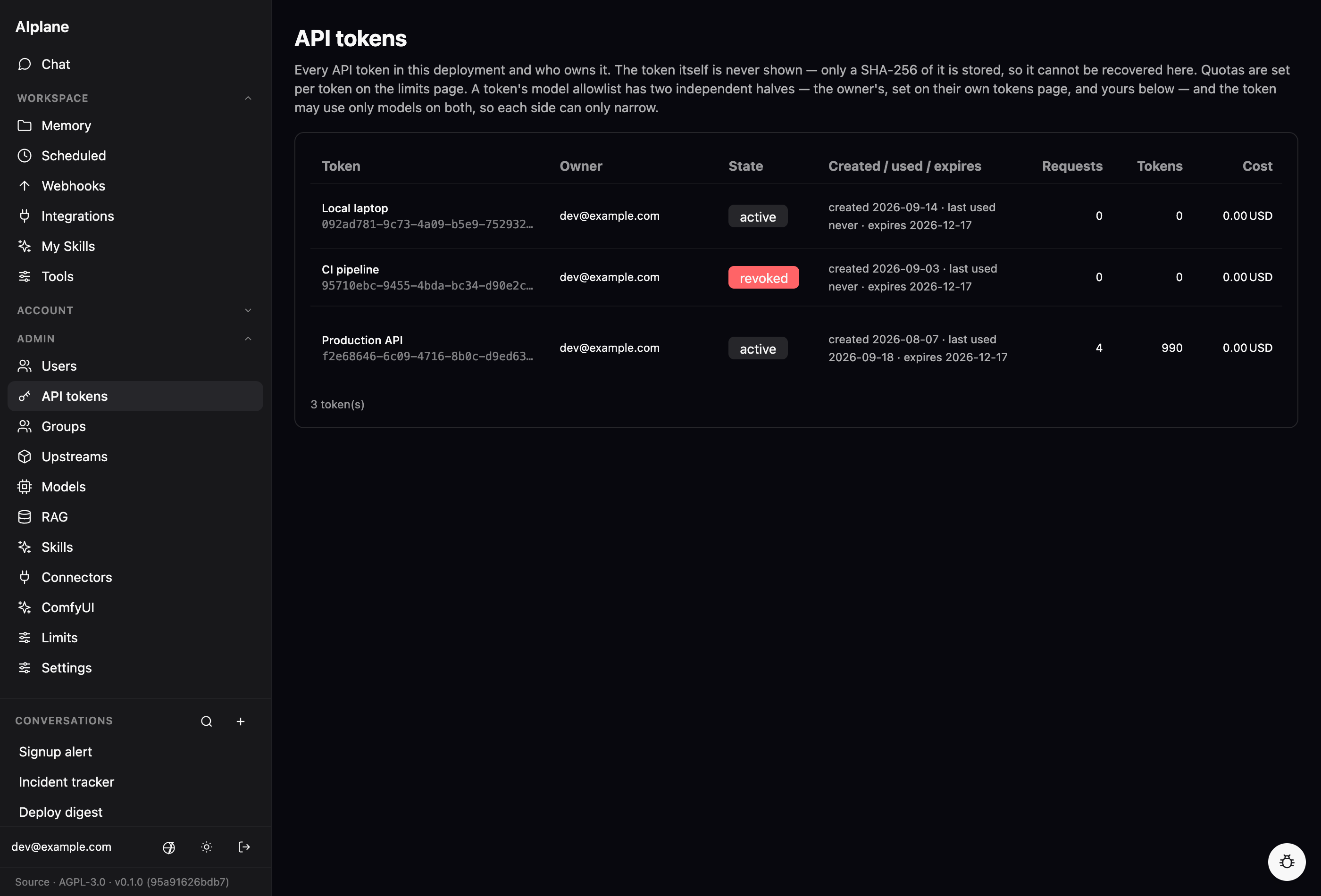
Rate limits & quotas. At /admin/limits, cap how many requests, how many tokens, or how much spend a caller may use over a rolling hour / day / week / month — scoped globally, per role, per user, or per API token. The first three resolve most-specific-first (user → most-generous role → global default); with none configured everyone is unlimited. A user's whole budget is shared across their API tokens, chat, and scheduled runs.
A per-token rule is different in kind: it is an additional ceiling checked alongside the owner's budget rather than another tier of that hierarchy, so both must pass and minting a token can only ever narrow what its owner may spend, never widen it. Owners set a quota on their own tokens at /tokens; admins set one for any token at /admin/limits (subject API token). An over-budget caller gets a 429 that says which ceiling tripped (or a graceful notice in chat). Self-hosted pools can be marked exempt at /admin/upstreams so their usage is still recorded on /usage but never counts against a limit. Everyone sees their own live limit bars on /usage.
 |
 |
Rate-limit editor (/admin/limits) — global / role / user / API-token rules across requests, tokens, and cost. |
Your limits (/usage) — live bars of used-vs-limit with reset times, plus spend once models are priced. |
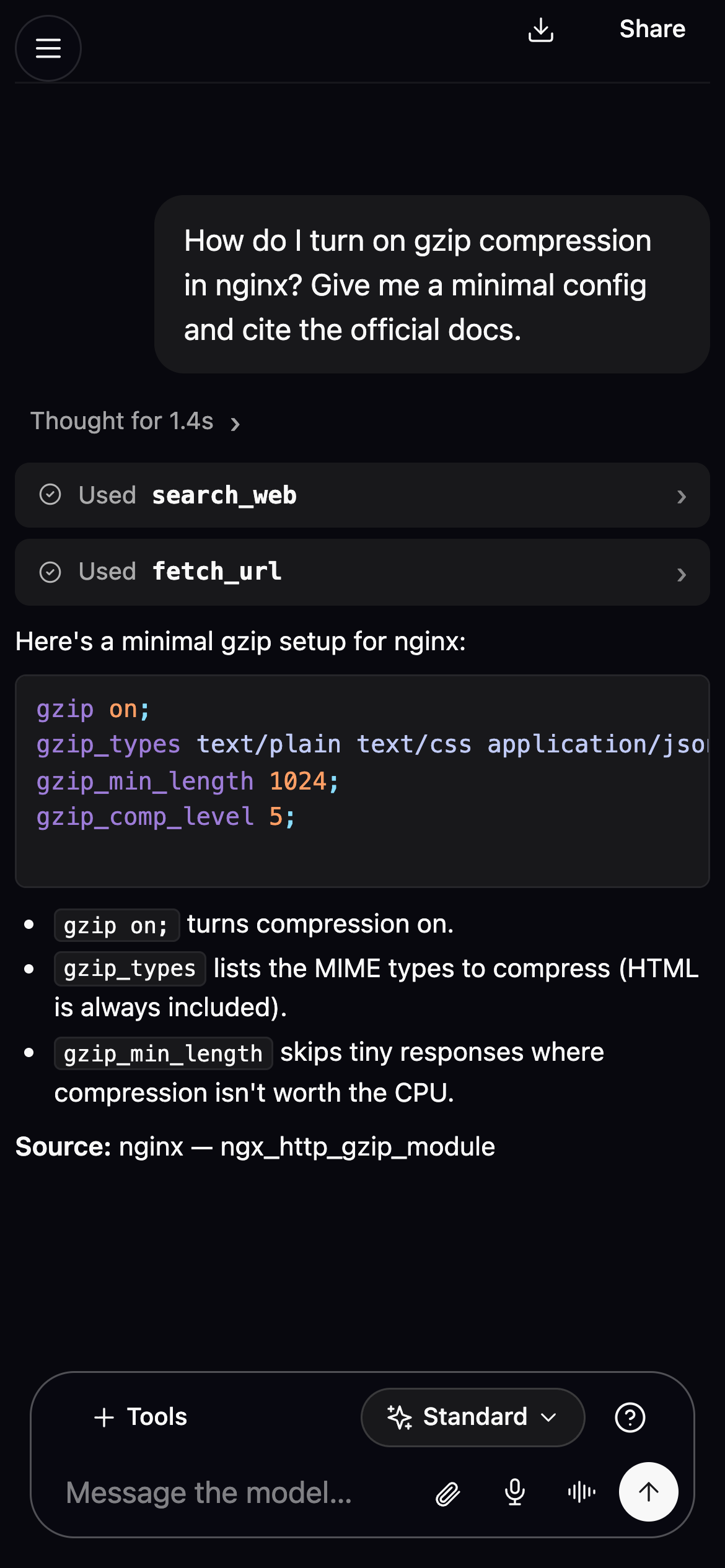
The /chat page itself does more than stream replies: fork a conversation, share it via a public link, pin favourites, export to Markdown or PDF, edit-and-retry a turn, dictate with the voice button, and set per-conversation reasoning effort. See docs/ui.md.
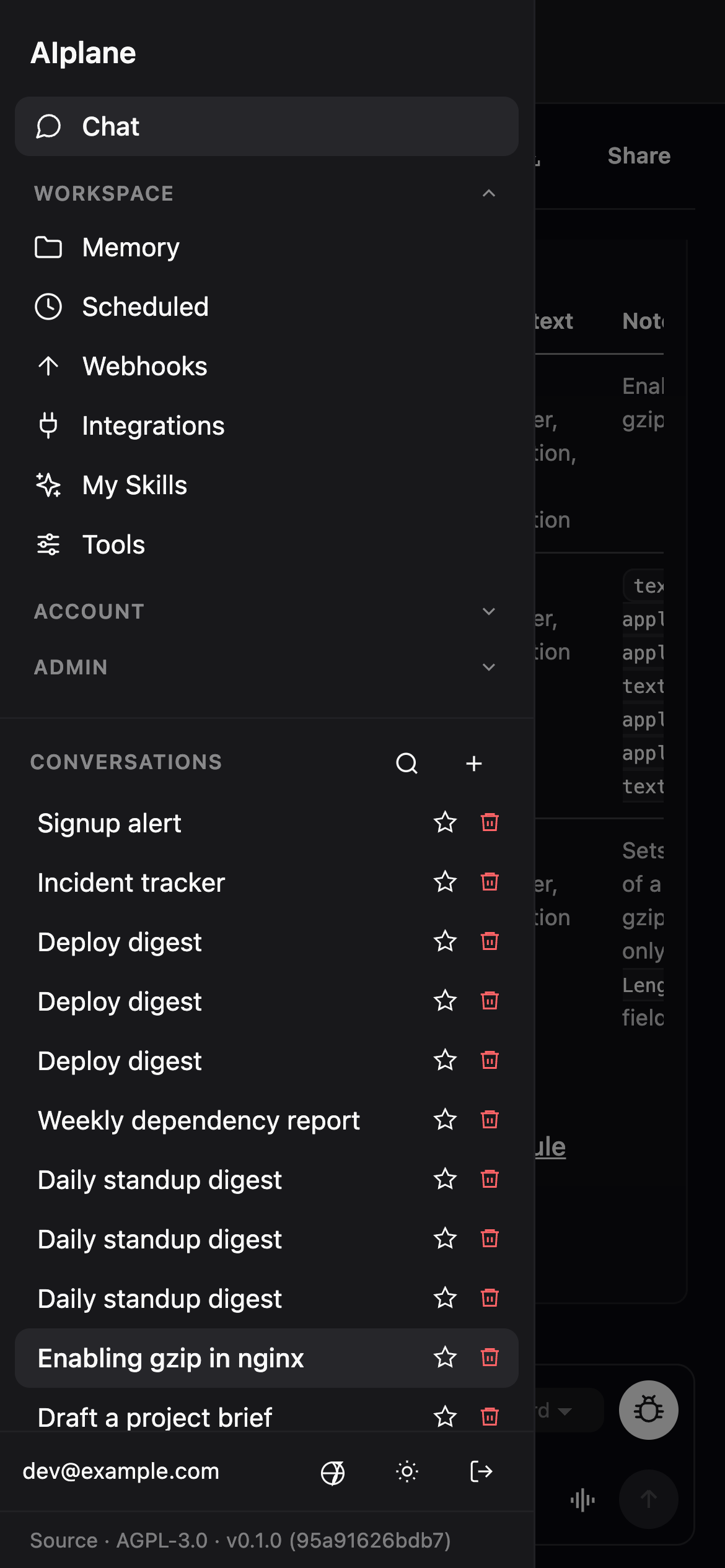
Mobile. The whole UI is responsive — on a phone the sidebar collapses into a hamburger drawer and the chat, composer, and admin pages reflow to a single column, so AIplane is fully usable from a browser on the go.
 |
 |
Scheduled actions
Every signed-in user can have prompts run automatically on a schedule at /scheduled — a daily standup digest, a weekly repo summary, an hourly health check. Each scheduled action is just a saved prompt plus a model, a schedule, and a timezone; when it fires, AIplane opens a chat session driven by the same engine as the interactive /chat page, so the result lands as an ordinary conversation you can open and read afterward. By default each run starts a fresh conversation; turn on reuse and each run instead continues the previous run's chat — replaying the last few rounds as history — so the model builds on what it said last time. Schedules are per-user and private (scoped by user, behind the normal session login — no admin role needed).
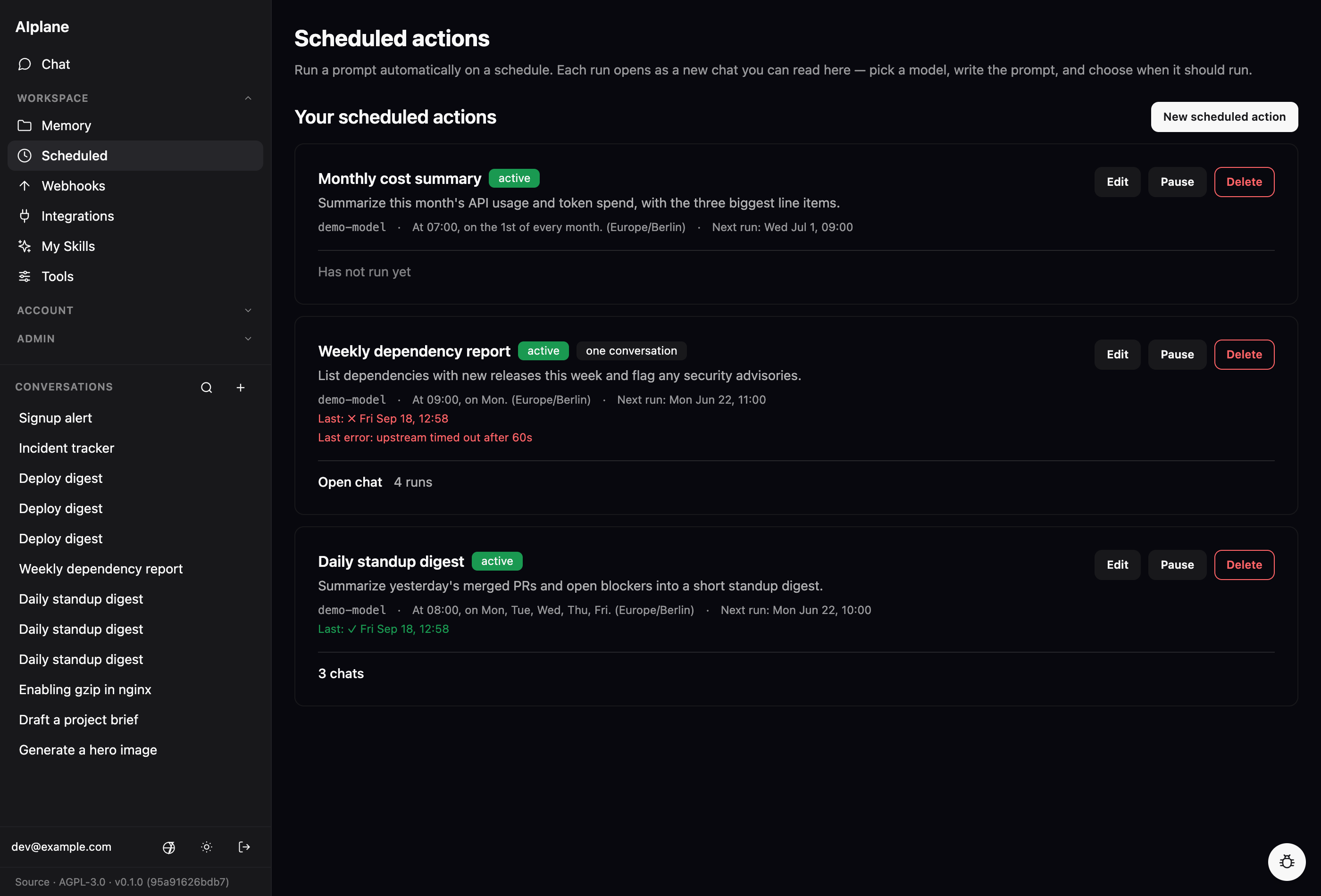
The schedule builder. Pick Hourly, Daily, Weekly, Monthly, or Advanced. The friendly modes expose just the fields they need (a minute; a time; weekday checkboxes; a day-of-month) and AIplane assembles a standard 5-field cron expression from them — non-technical users never have to see cron. Advanced takes a raw minute hour day-of-month month day-of-week expression for anything the presets can't express. Either way the expression is evaluated in the IANA timezone you choose (e.g. Europe/Berlin), and a live preview — computed server-side via POST /scheduled/preview so it can't drift from what the scheduler actually does — shows a plain-English summary plus the next three run times. Each action also has a tools toggle (web search, RAG, attachments — same set as in chat).
How runs fire. A background worker polls every 30 seconds and runs every action whose next occurrence is due, claiming each one atomically first so a slow run or a restart can't double-fire. If AIplane was down across one or more scheduled slots, the missed occurrences collapse into a single catch-up run on the first poll after startup rather than replaying as a backlog. Actions can be paused (the worker skips them) and resumed, edited, or deleted from the same page.
Webhooks
The event-driven twin of scheduled actions: instead of a clock, an inbound HTTP call fires the run. At /webhooks a signed-in user saves a prompt plus a model, gets back a secret trigger URL (/hooks/gwh_…), and points any external service at it — a CI pipeline, a GitHub or Discord webhook, a monitoring alert, a form handler, or a quick curl. When something calls the URL, AIplane appends whatever the caller sends in the request body (JSON or plain text) to the saved prompt as a clearly delimited untrusted block, then runs it through the same engine as /chat, so the result lands as an ordinary conversation you can open afterward.
Sync or async. A per-webhook checkbox picks the behaviour: an async webhook returns 202 Accepted immediately and runs in the background; a synchronous webhook makes the caller wait and returns the model's answer as a JSON envelope ({"status","session_id","output"}) — handy for integrations that want the reply inline.
Fresh chat or reuse. Like scheduled actions, a webhook either opens a fresh chat per fire (the default) or reuses the previous fire's chat so the model sees prior fires as history (a running incident log, a rolling digest) — with a replay-rounds cap so the context can't grow without bound.
Run history. Every fire — and every rerun — is logged. Each webhook has a Runs page listing its most recent runs (up to 50), each showing when it fired, whether it succeeded, and a link to its generated chat for the full details. From there you can rerun any past run: its exact payload is replayed with a prompt you can tweak, into a fresh chat you watch live. So you can iterate on the prompt without asking the external service to re-send anything.
Security. The secret in the URL is the credential — only its hash is stored, so the full URL is shown once on create (rotate to mint a new one; the old URL stops working immediately). Tools default off: because a webhook is triggered by an anonymous external caller feeding attacker-controllable text to a model that would run as you, granting it your tools (web search, RAG, connectors) is a deliberate, warned opt-in. Webhooks are per-user and private, and can be paused, edited, rotated, or deleted from the same page. (Rate limiting and quotas are handled separately, across all request surfaces.)
Conversation compaction
A chat replays its whole history to the model on every turn, so a long conversation's prompt grows until it crowds the model's context window. AIplane compacts automatically: once a turn's measured prompt size (the upstream's own prompt_tokens) crosses a fraction of the model's context window, a background task — off the turn's critical path, like title generation — summarises the oldest turns into a single dense summary. The next turn then replays [request context] + [summary] + [most recent turns verbatim] instead of the full history. As the conversation keeps growing it's re-compacted: the previous summary plus the newly-aged turns fold into a fresh summary, so context stays bounded across an arbitrarily long chat.
Nothing is lost from the UI — the summarised turns stay in the transcript, scrollable above an "earlier messages condensed" divider; they're just not sent upstream. Tool results from the folded turns are fed into the summariser (they're never replayed as normal history, yet are often the load-bearing context).
Tuning lives at /admin/settings → Chat (all optional): enabled (default true), trigger_ratio (fraction of the window at which it fires, default 0.7), default_context_window (fallback window in tokens for models without a per-model value, default 32768), keep_recent_turns (how many recent turns stay verbatim, default 6), min_turns_to_compact (anti-thrash floor, default 4), and summary_max_tokens (default 1024). Per-model context windows are set at /admin/models; a blank field falls back to default_context_window.
Voice conversation
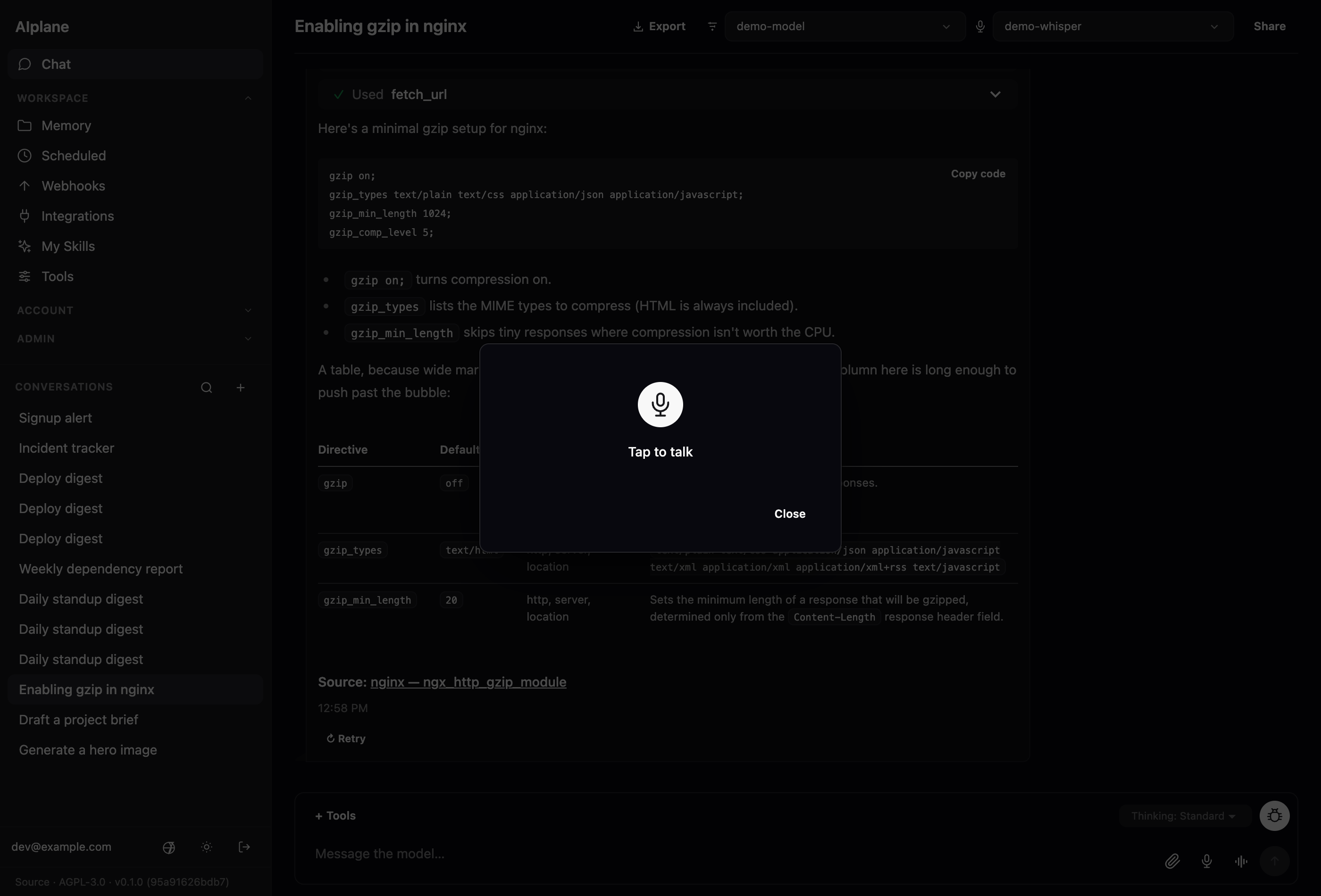
Talk to the assistant and hear it answer. Voice mode is a pipeline — AIplane is not the AI, it wires access to one: your speech is transcribed (Voxtral, the existing transcription pool), sent to the normal chat model with a voice directive that keeps replies to a spoken sentence or two, and the reply is spoken back through a text-to-speech pool you configure. Every exchange persists as an ordinary chat turn in plain text, so you can scroll back and read (or continue in text) any time.
It appears in the chat composer only when a speech upstream pool is configured and a transcription model is available — otherwise the toggle is simply absent (like transcription, it degrades away). Same access layer as everything else: TTS is also exposed to API callers at POST /v1/audio/speech.
Configure it by adding a speech-kind pool at /admin/upstreams — self-hosted (Qwen3-TTS, Kokoro, XTTS via openedai-speech, LocalAI) or cloud (OpenAI api.openai.com/v1, or any provider that speaks OpenAI's /v1/audio/speech). An optional per-language voice map picks a voice per spoken language (de, en, …; the default applies when none matches). Flag the pool's compliance on a non-EU provider (e.g. OpenAI) — voice mode sends the spoken text there. See docs/upstreams.md.
Which voice you hear is the user's own choice, not just the operator's. Fill the pool's selectable voices list (one id per line) and a voice picker appears in the chat header next to the mic-model one; the pick is stored per user and beats the language map on every synthesis. It stays hidden while there is nothing to choose, and a voice the operator later removes from the list silently falls back to the language default instead of reaching the provider as an unknown id. The language map keeps answering the other question — which voice a given spoken language defaults to — and holds one voice per language, which is why the menu is its own list.
How it works: push-to-talk (hold the mic) → release → the transcript is submitted with the voice directive → as the reply streams, complete sentences are spoken one at a time. Non-speakable bits (code, tables) become a short spoken marker like "the code is shown on screen." It's half-duplex — while the assistant speaks, the mic is inert (no echo loop). The reply's language follows what you spoke; only the opening greeting uses the UI language. Always-listening (voice-activity) mode and barge-in are a planned next phase.
Built with
- Rust (edition 2024, toolchain pinned to 1.95 via mise) — a workspace of nine crates:
gateway(the binary and its/v1proxy),aiplane-core,aiplane-runtime,aiplane-features,aiplane-tools,aiplane-api,session-core,shared, andsandbox-runner. - rama 0.3.0-rc1 — HTTP server, router, middleware, and proxying.
- SvelteKit 2 / Svelte 5 (
web/) — the web UI, built withadapter-staticinto plain files. Chat streams over a JSON event protocol on SSE; every other action is a typed call against the/api/v0OpenAPI contract. - daisyUI v5 + Tailwind v4 — design system, compiled to a single content-hashed CSS bundle at build time.
- sqlx + SQLite — persistent state (users, tokens, sessions, chat history, RAG collection registry). Bulk RAG content — chunk text, lexical index, vectors — lives in per-collection stores under the RAG data directory, not in the main DB.
The UI is compiled ahead of time and shipped as static files the binary serves from AIPLANE_STATIC_DIR, so no Node runs in production — it is still one container, one process, one port.
Integrations (per-user MCP connectors)
Each signed-in user can connect their own accounts — Gmail/Calendar/Drive, GitHub, Atlassian (Jira/Confluence), GitLab, Slack, Kiwi.com flight search, and any other MCP server — at /integrations, so the model can act on their behalf with their permissions. It's a self-hosted, per-user connector store comparable to the connectors in desktop AI apps.
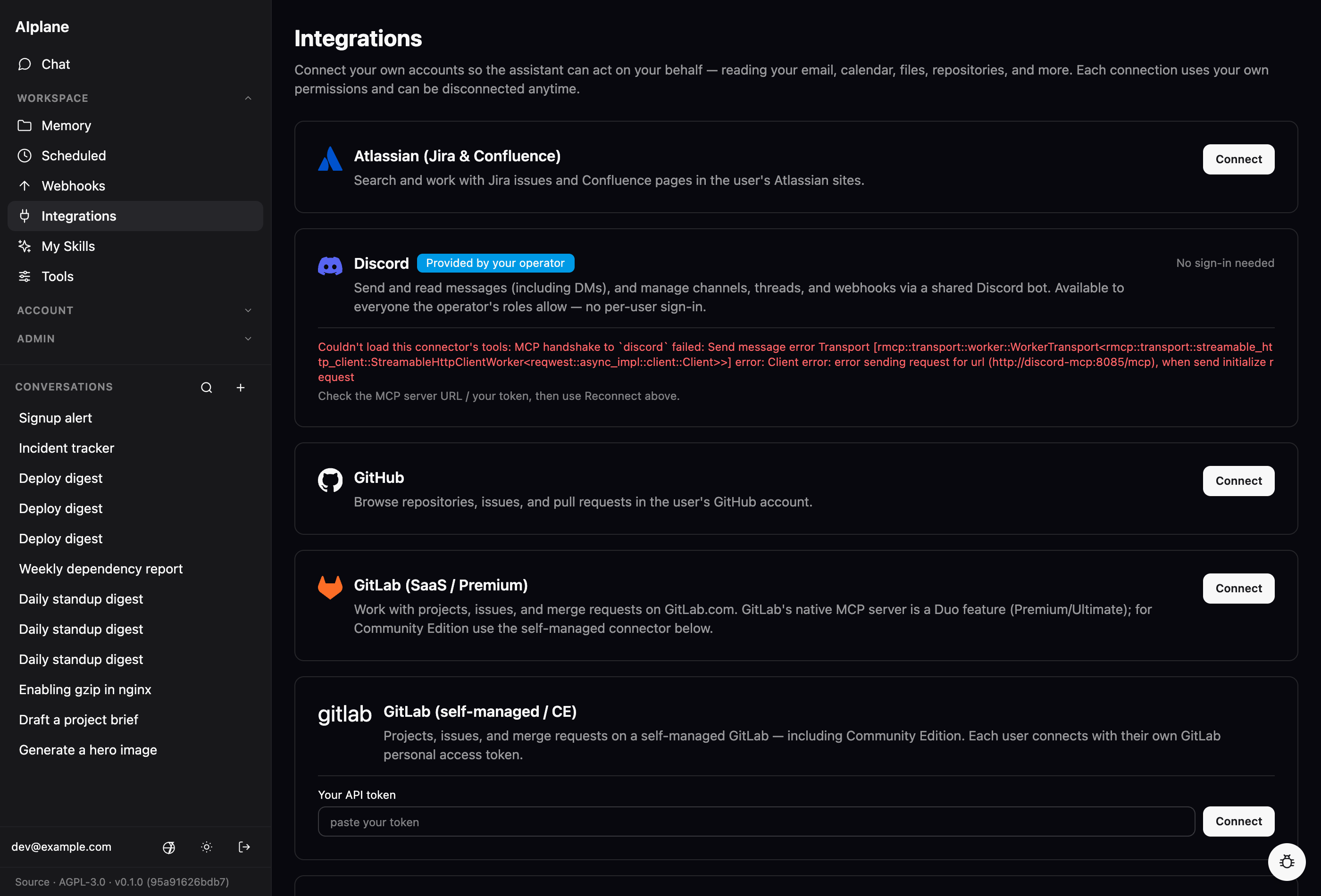
An admin curates which servers the catalog offers at /admin/connectors; users just click Connect. Four auth models are supported, chosen per connector:
- OAuth 2.1 + dynamic client registration — nothing to configure beyond a URL (e.g. Atlassian, GitLab.com, a self-hosted Google Workspace server).
- OAuth 2.1 with a manual client — the admin registers one OAuth app once (e.g. GitHub, Slack).
- User-supplied token — each user pastes their own API token / PAT (e.g. self-managed GitLab CE).
- None — a public, unauthenticated server (e.g. Kiwi.com flight search); users still connect individually to opt its tools into their own chats.
Per-user OAuth tokens are encrypted at rest (AES-256-GCM) and refreshed in the background so connections don't silently expire. Each connected server's tools are namespaced (mcp__<server>__*) and obey the same per-tool always/ask/off controls as the built-in tools. Files a connector hands back — a mail attachment, a Drive export — never reach the model as base64: AIplane decodes them into ordinary conversation attachments and gives the model the id, so the file is readable, sandbox-stageable and downloadable at a few dozen tokens instead of a megabyte of context. Provider and deployment setup — including the self-hosted Google Workspace and GitLab CE bridges — is in deploy/README.md and docs/connectors.md.
Claude Code against your own models
Claude Code speaks the Anthropic Messages API, and AIplane serves it at POST /v1/messages. Point it here and it runs on the models you host — with your auth, your rate limits, your usage tracking and your server-side tools in front of them. Nothing about Claude Code is patched or wrapped; it is configured through the environment variables it already supports:
export ANTHROPIC_BASE_URL=https://aiplane.example.com
export ANTHROPIC_AUTH_TOKEN=gwk_…            # a token from /tokens
export ANTHROPIC_MODEL=default                # an alias you defined on /admin/upstreams
export ANTHROPIC_DEFAULT_HAIKU_MODEL=default  # background tasks go here too
export CLAUDE_CODE_DISABLE_NONESSENTIAL_TRAFFIC=1
export CLAUDE_CODE_MAX_CONTEXT_TOKENS=262144  # match what your model serves

# Recommended when the pool has several replicas and uses `prefix_affinity`:
# one value per shell is one value per session, so every turn of this session
# goes back to the GPU that already holds its KV cache.
export ANTHROPIC_CUSTOM_HEADERS="x-aiplane-affinity: $$-$(date +%s)"

claude
ANTHROPIC_DEFAULT_HAIKU_MODEL matters more than it looks: Claude Code sends
background work (summaries, titles) to its haiku alias, which otherwise
arrives as an Anthropic model id your AIplane has never heard of and only
survives because of the unknown-model fallback. Point it somewhere real — a
small model if you have one.
CLAUDE_CODE_DISABLE_NONESSENTIAL_TRAFFIC=1 stops Claude Code's telemetry and
update checks, which keeps your usage numbers to actual work.CLAUDE_CODE_MAX_CONTEXT_TOKENS should match the window your model actually
serves (max_model_len, shown per backend on /admin/upstreams) — it is absent
from the published variable reference but is read, and changing it moves the
context meter.
Keeping a session on one GPU
x-aiplane-affinity is the exact-affinity hook for a prefix_affinity pool
(see docs/upstreams.md).
Claude Code reads ANTHROPIC_CUSTOM_HEADERS once at launch, so one value
per terminal is precisely one value per session. Any value works — it is hashed,
not interpreted — as long as it differs between concurrent sessions; $$ (the
shell's pid) plus a timestamp is enough.
It is optional: without it AIplane matches the request's prompt prefix
against an index of what each replica was recently sent, which pins a
conversation just as well and additionally lets a new session start warm on a
replica that already holds the shared system prompt. Measured on two replicas,
seven interleaved conversations, four turns each:
| Strategy | Conversations that stayed on one replica | First-turn spread |
|---|---|---|
least_inflight |
0 / 7 — every turn bounced to the cold replica | 4 / 3 |
prefix_affinity, no header |
7 / 7 | 3 / 4 |
prefix_affinity + x-aiplane-affinity |
7 / 7 | 4 / 3 |
Set the header when you want the guarantee rather than the inference — for
example when sessions are launched from a script that always opens with the same
prompt, where the prefix alone cannot tell them apart.
X-Gateway-Backend on every response names the replica that served it, so you
can check any of this from the client:
curl -sD- -o /dev/null https://aiplane.example.com/v1/messages \
  -H "authorization: Bearer $ANTHROPIC_AUTH_TOKEN" \
  -H 'content-type: application/json' -H 'anthropic-version: 2023-06-01' \
  -d '{"model":"default","max_tokens":8,"messages":[{"role":"user","content":"hi"}]}' \
  | grep -i x-gateway
Then alias the model ids Claude Code asks for (claude-sonnet-4-6, claude-haiku-4-5, …) onto the models you actually serve, on /admin/upstreams — the same alias also makes them discoverable in Claude Code's /model picker. Any id you don't alias falls through to the pool's configured unknown-model fallback, so a working setup can be one alias or none.
Everything the normal workflow needs works: streaming, tool calls (including several per turn), multi-turn context, model selection, and errors surfaced with the backend's own wording so Claude Code's built-in retries still fire. Token counting is answered from the serving model's own tokenizer, not an estimate. The gateway's server-side tools are available to it too — web search, RAG, the sandbox, your MCP connectors — when the token has tool use enabled, in which case AIplane runs its own tools invisibly and hands Claude Code's back for it to execute.
Setup, the full translation table, and the known limits are in docs/claude-code.md.
OpenCode against your own models
OpenCode can use AIplane's OpenAI-compatible API. The
configuration below registers an AIplane deployment as a custom provider and
makes the model alias qwen (served as Qwen3.8) available in the model picker:
// ~/.config/opencode/opencode.jsonc
{
  "$schema": "https://opencode.ai/config.json",
  "model": "aiplane/qwen",
  "provider": {
    "aiplane": {
      "npm": "@ai-sdk/openai-compatible",
      "name": "croit AIplane",
      "options": {
        "baseURL": "https://aiplane.example.com/v1"
      },
      "models": {
        "qwen": {
          "name": "Qwen3.8"
        }
      }
    }
  }
}
Store the AIplane API token with OpenCode's provider credentials (or use an
environment substitution in options.apiKey); never commit a token to a
project file. Start OpenCode and choose aiplane/qwen with /models, or pass it
directly:
opencode --model aiplane/qwen
AIplane already exposes GET /v1/models, but OpenCode's custom@ai-sdk/openai-compatible provider requires model entries in its configuration
for the picker and does not populate that map from the endpoint. Add further
model aliases under provider.aiplane.models as needed; each key is the
model id sent to AIplane. AIplane's model list remains available for
inspection with:
curl https://aiplane.example.com/v1/models \
  -H "Authorization: Bearer $AIPLANE_API_KEY"
Quick start (from source)
You need mise, which manages the Rust + Node toolchains.
mise install                      # Rust 1.95 + Node 24
mise run dev                      # Vite HMR + gateway, together on http://localhost:8080
No config file needed: mise run dev generates a persistent dev session key on
first run. Vite serves the hot-reloading UI on :8080 and proxies every dynamic
route to the private Rust gateway on :8081, including authentication and chat
attachments. The app serves a setup wizard at
http://localhost:8080/setup that asks for your OIDC provider, proves it with a
real sign-in, and lets you pick which claim value grants admin. Everything else
an operator configures — OCR, compaction, attachment storage, the code sandbox,
ComfyUI, RAG, skills, Typst, GeoIP, usage, limits, feedback and Web Push — is at/admin/settings. There is no config file.
Open http://localhost:8080. An unconfigured gateway sends you to /setup; once you finish the wizard, sign in and add backends at /admin/upstreams.
UI changes hot-reload through the same http://localhost:8080 origin; no second
terminal or alternate browser URL is needed. To verify the compiled static
artifact instead, run:
mise run dev-served # production-shaped static SPA, no HMR
UI-only shortcut (no OIDC): mise run dev-ui boots a real server with mock backends and a pre-seeded session, and prints a session cookie you can paste into a browser or Playwright. Pass AIPLANE_STATIC_DIR=target/frontend/build if you want it to serve the UI too.
Full developer workflow: docs/dev-workflow.md.
Setup wizard
A fresh deployment needs one environment variable (AIPLANE_SESSION_KEY) and a writable volume. Everything else is configured in the browser.
Until setup finishes, every page redirects to /setup, which asks two questions:
- Your identity provider — AIplane's public URL (pre-filled from the request that reached it) plus issuer, client id and client secret. It also shows the exact redirect URI to whitelist. Submitting starts a real authorization-code login against what you just typed; nothing is saved yet.
- Who administers it — you come back from your provider with a verified ID token, and the wizard shows you every claim it actually carried. Pick the claim value that should grant admin. This is why the wizard insists on a real sign-in first: the name of your groups claim and the shape of its values are not guessable, and getting them wrong is the classic way to end up locked out of your own gateway.
Finishing writes the provider (client secret sealed with the at-rest key), creates an admins group mapped to the value you chose plus a default users group, and swaps the live OIDC client in — /login works on the very next request, with no restart.
Recovering access
Locked out — the IdP moved, or no group maps to admin? Reopen the wizard from the host:
docker compose exec aiplane restore-setup     # compose
podman exec aiplane restore-setup             # quadlet
It prints a one-time link valid for 30 minutes. AIplane keeps serving while that window is open: chats, /v1, and existing sessions are untouched, and only /setup becomes reachable again — so fixing one admin's access never means an outage for everyone else. The link carries a token because, unlike a first run, there is now a live deployment worth protecting; you are already at a terminal reading the output, so copying it costs nothing.
Recovery deletes nothing. Users, chats, pools and the current provider all survive, and the wizard comes up pre-filled with what is configured today.
The one case it cannot fix is a provider that is gone entirely — the wizard proves a provider by signing in through it. Keep at least one group in $AIPLANE_BOOTSTRAP_ADMIN_GROUPS if you want a break-glass admin that does not depend on the group tables.
Configuration
There is no required configuration file. Everything an operator configures lives in the database and is edited in the browser: pools, backends and models at /admin/*, groups at /admin/groups, the OIDC provider at /setup, and the remaining operator settings — OCR, conversation compaction, attachment storage, the code sandbox, ComfyUI, RAG, skills, Typst, GeoIP, usage, limits, the feedback widget, Web Push, and session/token lifetimes — at /admin/settings, grouped into five tabs.
Changes apply immediately. A save re-derives the affected clients, stores and tool registrations and swaps them in, so the new value is in force on the next request — no restart, and no config file. Five fields are the exception, badged restart in the editor: rag.enabled, rag.data_dir, rag.clone_concurrency, comfyui.base_url and comfyui.content_dir. Each of those owns a long-running background worker (the indexer, the ComfyUI job scheduler), and replacing one means stopping work that is in flight — an aborted ComfyUI poll can leave a job row pending whose asset is never fetched. A restart is the clean way to quiesce that. Saving one leaves a banner until the process comes back, so the person who restarts the container sees what is waiting on them. Secrets entered there are sealed at rest.
Is there a config file? No. AIplane reads none, from anywhere. Every
block that used to live in one is a database row now, edited in the admin UI,
and the table below says where each one went.
Two things never moved into the database, because both have to be resolved
before it can be read: where the database is ($AIPLANE_DB_PATH) and the
break-glass admin list ($AIPLANE_BOOTSTRAP_ADMIN_GROUPS). Both are
environment variables, so a deployment still needs no file. The listen socket
was never in the file either — that is $IP / $PORT.
Secrets never live in a file. They are entered at /setup,/admin/upstreams or /admin/settings and go into the database sealed
under the at-rest key. A backend may instead name an environment variable to
read its key from, so a deployment that keeps credentials in its unit file can
go on doing that.
How you configure upstreams and models: in the browser. Pools, backends, and per-model settings live in the database and are managed entirely at /admin/* — there has never been TOML for them. A fresh install boots with no upstreams; the setup path for a new operator is:
- Start AIplane and open it. With nothing configured it sends you to
/setup, where you enter your OIDC provider, prove it with a real sign-in, and pick the claim value that grants admin — no file involved. - Sign in. Your account now reaches the admin UI.
- At
/admin/upstreams, add a pool (chat / transcription / embedding / image / speech / system_one) and its backends — base URL, API key (stored encrypted), weight, max in-flight, aliases, per-pool compliance and rate-limit flags, and unknown-model / all-offline fallbacks. Click Apply changes and it goes live — no restart. - At
/admin/models, set per-model prices, reasoning budgets, context windows, capabilities, sampling defaults, the per-feature default model, and the web-search backend (SearXNG URL or Brave API key) that powerssearch_web.
Routing then needs no static table: the health probe reads each backend's /models endpoint and routes by what it advertises. See docs/upstreams.md for the routing model.
The environment variables a deployment can set:
export AIPLANE_SESSION_KEY=$(openssl rand -hex 32)    # REQUIRED: 32 random bytes, hex-encoded
export AIPLANE_DATA_DIR=/var/lib/gateway              # optional: where the DB + RAG store are written
                                                      # (the container image already sets this)
export IP=0.0.0.0                                     # optional: listen address, default 127.0.0.1
export PORT=8080                                      # optional: listen port, default 8080
                                                      # (the container image already sets both)
export AIPLANE_DB_PATH=/var/lib/gateway/gateway.sqlite # optional: overrides the path derived from
                                                      # AIPLANE_DATA_DIR
export AIPLANE_BOOTSTRAP_ADMIN_GROUPS=platform-admins # optional: break-glass admin claim values,
                                                      # comma-separated
export AIPLANE_OIDC_CLIENT_SECRET=…                   # only for an upgrade: resolves the legacy
                                                      # [oidc] block's client_secret_env on import.
                                                      # A new install enters the secret at /setup
export AIPLANE_ENCRYPTION_KEY=$(openssl rand -hex 32) # optional: 32-byte key encrypting the DB's at-rest secrets
Every one of these is also read under its old GATEWAY_* spelling — the project was called croit LLM Gateway, and a running deployment must not stop at boot because a variable was renamed. The old names log a deprecation warning and go away in a future breaking release; the one case that needs care is a GATEWAY_DATA_DIR override, which the container image's own AIPLANE_DATA_DIR would outrank (AIplane refuses to start rather than pick one). See docs/renaming.md.
AIPLANE_SESSION_KEY is required — AIplane refuses to boot without it — and must be stable across restarts. It is the HMAC key the session cookie is signed with, so a new key means every open cookie fails verification and every user is silently logged out. It also derives the at-rest key (below), so a lost key means lost secrets. Generate it once, keep it for the life of the deployment, and back it up alongside the database.
Earlier releases fell back to an ephemeral per-process key and only logged an error. That produced a deployment that looked healthy while logging everyone out on every restart and losing every sealed secret — invisible until it had already cost data. If you are upgrading and see the new startup error, the variable never made it into the service environment; add it to the unit's EnvironmentFile and restart.
AIPLANE_ENCRYPTION_KEY is optional: it's the AES-256-GCM key under which AIplane's database-stored secrets are encrypted — each user's MCP-connector OAuth tokens, admin-stored connector client secrets, and upstream backend API keys entered through the admin UI. If unset, AIplane derives a stable key from AIPLANE_SESSION_KEY — which is itself mandatory, so the derived key is always stable. Set it explicitly if you want at-rest encryption decoupled from session-cookie signing (that way the session key can be rotated without destroying stored secrets). Rotating this key invalidates already-stored ciphertext — re-enter backend keys at /admin/upstreams after a change. (Formerly GATEWAY_MCP_KEY. If you set it explicitly, rename the env var to the same value and nothing else changes. If you rely on the key derived from AIPLANE_SESSION_KEY (env unset), the derivation label was renamed once, when at-rest sealing grew beyond MCP tokens — and that shipped without a migration, so an earlier release did lose access to secrets sealed before it. That is fixed: AIplane now reads values sealed under the old key and rewrites them under the current one on the first boot, logging how many it moved. Nothing to re-enter.)
Where each block of the old config file went. Kept as a lookup table for
anyone who remembers a TOML key and wants to know which screen owns it now —
AIplane itself no longer reads any of them.
| Former block | Feature | Now configured at |
|---|---|---|
[rbac] + [[roles]] |
OIDC claim → group mapping, and what each group grants | /admin/groups |
[chat.s3] |
Chat attachments in S3 / MinIO / R2 / Backblaze B2 | /admin/settings → Content & data |
[chat.ocr] |
Automatic PDF/image OCR via an internal ocr pool (docs/ocr.md) |
/admin/settings → Chat |
[chat.compaction] |
Summarising long conversations | /admin/settings → Chat |
[typst] |
Document-rendering tools from a templates directory | /admin/settings → Tools |
[sandbox] |
Code-execution + document tools (docs/sandbox.md) |
/admin/settings → Tools |
[comfyui] |
Image + video generation tools | /admin/settings → Tools |
[geoip] |
IP→location for get_user_location |
/admin/settings → Tools |
[skills] |
Skill bundles | /admin/settings → Content & data |
[rag] |
Index sources and search them from chat (RAG) | /admin/settings → Content & data |
[usage] |
Request/token accounting behind /usage |
/admin/settings → Access & usage |
[limits] |
Rate limits and quotas | /admin/limits (master switch under Access & usage) |
[feedback] |
The in-UI feedback widget that files GitHub or GitLab issues | /admin/settings → Notifications |
[push] |
Web Push turn-complete notifications | /admin/settings → Notifications |
[gateway] |
Session + API-token lifetimes, and whether admins may impersonate | /admin/settings → Access & usage |
[gateway].public_url |
AIplane's own base URL | /setup |
[gateway].bootstrap_admin_groups |
Break-glass admin claim values | $AIPLANE_BOOTSTRAP_ADMIN_GROUPS — deliberately not in the DB, so a broken group table cannot lock everyone out |
[db].path |
Where the SQLite database lives | $AIPLANE_DB_PATH — it has to be found before anything can be read out of the database |
[oidc] |
The identity provider | /setup |
[bind] |
The listen socket | Removed — use $IP / $PORT |
Chat attachments (S3)
The chat composer accepts any file via paperclip / drag-drop / clipboard paste. Each file is uploaded to S3 (or any S3-compatible store) and either inlined into the user message as a fenced text block (CSV / JSON / source code / …) or referenced via image_url content parts on the OpenAI request (images).
Configure it at /admin/settings → Content & data: endpoint, region,
bucket, an optional key prefix (default chat-attachments), and the access /
secret key. The two keys are secret fields — they go into the database sealed
under the at-rest key, so there is nothing to export into the environment and
nothing to keep in a file.
Notes:
- The bucket can stay fully private (no public-read ACL, no presign capability needed on the credentials): AIplane fetches every byte server-side and hands it to the upstream LLM inline — images as a
data:URI in the request, other files as text. Soendpointonly needs to be reachable from the gateway, not from the upstream LLM's network. Path-style requests are always used, so DNS-style bucket subdomains aren't required; the same shape works for MinIO, Backblaze B2, and R2. - Capability gating isn't done at AIplane — wire only multi-modal chat models into the pools. A mismatch surfaces as the upstream's own error in the chat bubble.
- Past-turn attachments are stripped from the replayed history (kept as
[attached: name.ext (omitted)]stubs) so the context window stays bounded.
When automatic OCR is enabled, the current turn's image attachments — and any
PDF whose text layer is too thin to trust — are sent to the internal OCR sidecar
before the chat request. The sidecar owns PDF conversion and calls
Unlimited-OCR; recognised text arrives in the user message as clearly delimited
untrusted document data, and the original upload stays available throughfetch_attachment (which also gains mode="ocr" and mode="auto"). Results are
cached by document hash, so the same document is recognised once and reused on
later turns and across restarts, and each run shows up as a document_ocr row
in the turn's activity list with queued/running/completed/failed status. If no
healthy ocr backend is configured, AIplane does not fetch the attachment
for OCR and does not expose an OCR capability to the model. Seedocs/ocr.md.
RAG (codebase search)
Point AIplane at a body of documents; it fetches, chunks, and embeds it, and exposes it to the chat model through the rag_search tool (plus rag_list_collections, so the model can discover what's available). It's for "answer from our code and docs" without stuffing everything into the context window.
Where the documents come from is a per-collection choice:
git— clone a repository and index its working tree. Needsgiton the host PATH (the container image ships it).webdav— index a folder tree on a WebDAV server: Nextcloud, ownCloud, OpenCloud, or a plain RFC 4918 server. Give it a server URL, an account, and an app password (stored encrypted at rest), plus optionally the folder to index. It indexes exactly what that account can see, so scope the account's shares to what you want indexed. On the ownCloud lineage AIplane detects theoc:fileid/ propagating-etag extensions automatically and uses them for move-proof file identity; a plain server works too, just without those.gdrive— index a Google Drive folder tree (including shared drives), authorised per collection. Same walk and the same per-document extraction as the other two; Google's own file ids give move-proof identity.hyperkitty— index a public mailing-list archive (Mailman 3's web archiver). Paste the list's page URL, e.g.https://lists.example.com/hyperkitty/list/[email protected]/; no credentials, since only public archives can be read. One thread is one document, with quoted reply chains, signatures and list footers stripped and every message keeping its author, date and permalink — so the model retrieves the conversation that contains the answer, and can cite the message it came from. The whole export is downloaded once and kept under<data_dir>/source-cache/; later syncs fetch only the days since the last one (?start=…&end=…) and append them, so a daily refresh costs kilobytes rather than tens of megabytes of somebody else's bandwidth. The local copy is refilled from scratch every 30 days, which is also how a message deleted from the archive leaves the index. Turn Keep a local copy off to download the whole export every time instead. Either way only threads that actually changed are re-embedded. One list per collection — add a second collection for the devel list — and set Auto re-sync to daily, since a mailing list has no webhook to ring.
Pick the source on the /rag create form — the credential fields come from the provider itself, so the form matches whichever source you choose — and use Test connection to check the account and folder before starting an index. GET /api/v0/rag/providers returns the same descriptors for scripting.
What gets read. Text files and born-digital PDFs are read in-process. Scans and images go to the OCR backend if one is configured, and .docx/.pptx/.xlsx go through the sandbox — both optional: without them those files are skipped, counted, and reported on the collection's timeline with the reason, rather than silently dropped. Hits are cited by page for documents and by line for source files.
Questions about sets of documents. Passage search answers "what does the contract say about SLAs". It cannot answer "when did we last get an invoice from X, and how much" — that is a superlative over a filtered set, and a handful of similar-looking chunks is a coin flip. Attach an extraction profile to a collection and each document additionally gets a row of normalised fields (vendor, date, amount, project, …) plus a two-sentence summary, written at index time by a cheap model. The chat model then reaches those through rag_query_documents (filter, sort, total), rag_list_documents (folder listing with the stored summaries) and rag_fetch_document.
Two profiles ship seeded — invoice and project_document — and you manage them at /rag/profiles before picking one on the /rag form (GET /api/v0/rag/profiles lists their editable prompts and fields). Extraction costs one model call per document, cached by content hash, so a re-index re-embeds but never re-extracts. Leave the profile as None for code or plain-text collections.
Normalisation happens in the prompt, not in code: 31.12.2025 and 12/31/2025 both come back as one ISO date, 1.234,56 € and $1,234.56 as a decimal plus a currency code. That is what makes one code path serve a German and English corpus.
Requirements: an embedding-kind upstream pool (chunks and queries are embedded through it), and git on the host PATH for git collections (the indexer shells out to it — the container image ships it). Turn RAG on at /admin/settings → Content & data, where its two knobs also live: data_dir (default ./data/rag) and clone_concurrency. Both own the indexer process, so they are badged restart.
Each collection gets a self-contained folder <data_dir>/<uuid>/ holding its SQLite store (chunk text + lexical index), its index.usearch (vectors), and the git clone/. This is the heavy, fully regenerable state — put data_dir on a big/cheap disk, separate from the small database you actually back up. Deleting a collection in the UI removes its folder.
Adding a collection. As an admin, open /rag (or POST /api/v0/rag/collections) and provide: a name, git URL + branch/tag, an optional PAT for private repos, the embedding model id, include/exclude globs, and chunk size/overlap (characters; default 800/100). A background worker clones and embeds it; status moves pending → cloning → indexing → ready (or error, with the message and index log shown). A collection can aggregate several git sources (multiple repos or branches), each managed and re-indexed independently. Re-index re-pulls the sources and rebuilds the collection.
Keeping it fresh. Three things re-sync a collection: Re-index on /rag, a POST /hooks/rag/{token} from whatever noticed the change, and the collection's own Auto re-sync interval (refresh_interval_mins; hourly / daily / weekly on the form, 0 = never, which is what an existing collection keeps). Set an interval for anything that cannot ring the doorbell — a mailing-list archive has no webhook — and leave it off where the file host does. A due collection joins the indexer's queue on its next poll; a build already running is never restarted by it.
Globs match the repo-relative path, in three forms (there is no full glob engine):
| Pattern | Matches |
|---|---|
*.rs, *.md |
file extension |
src/, target/ |
path prefix (note the trailing slash) |
vendor, node_modules |
substring anywhere in the path |
* or ** |
everything |
An empty include list means "everything not excluded." Binaries, files larger than 1 MB, and .git/ are always skipped; excludes win over includes.
Retrieval is hybrid. A query runs against both a dense vector index (usearch, cosine) and a lexical BM25 index (SQLite FTS5), and the two rankings are fused with reciprocal rank fusion. Dense recall catches paraphrases; lexical recall catches exact identifiers (e.g. osd_op_timeout) that embeddings tend to blur. Queries are embedded with an instruction prefix (asymmetric retrieval); documents are embedded bare.
Sizing. The vector index dominates disk, at roughly chunks × embedding_dims × 4 bytes. With a 4096-dim model (e.g. Qwen3-Embedding-8B) that's ~16 KB per chunk, so a codebase that splits into ~100k chunks needs ~1.5 GB. Embedding is the slow part of indexing — budget time accordingly for large repos, and prefer narrow globs (source + docs) over * on a huge tree.
Agent Skills
Skills are operator-installed instruction bundles the chat model loads on demand — house style, brand guidelines, domain playbooks — without fine-tuning or stuffing everything into the system prompt. A skill is a SKILL.md (YAML frontmatter name + description, then a markdown body) plus optional references/ and assets/. The model only sees each permitted skill's name + description up front (cheap); when a request matches, it calls read_skill to pull the full body, then read_skill(name, path) for a referenced file (e.g. an SVG logo to inline into HTML). Once loaded in a conversation the guidance stays applied for the rest of it.
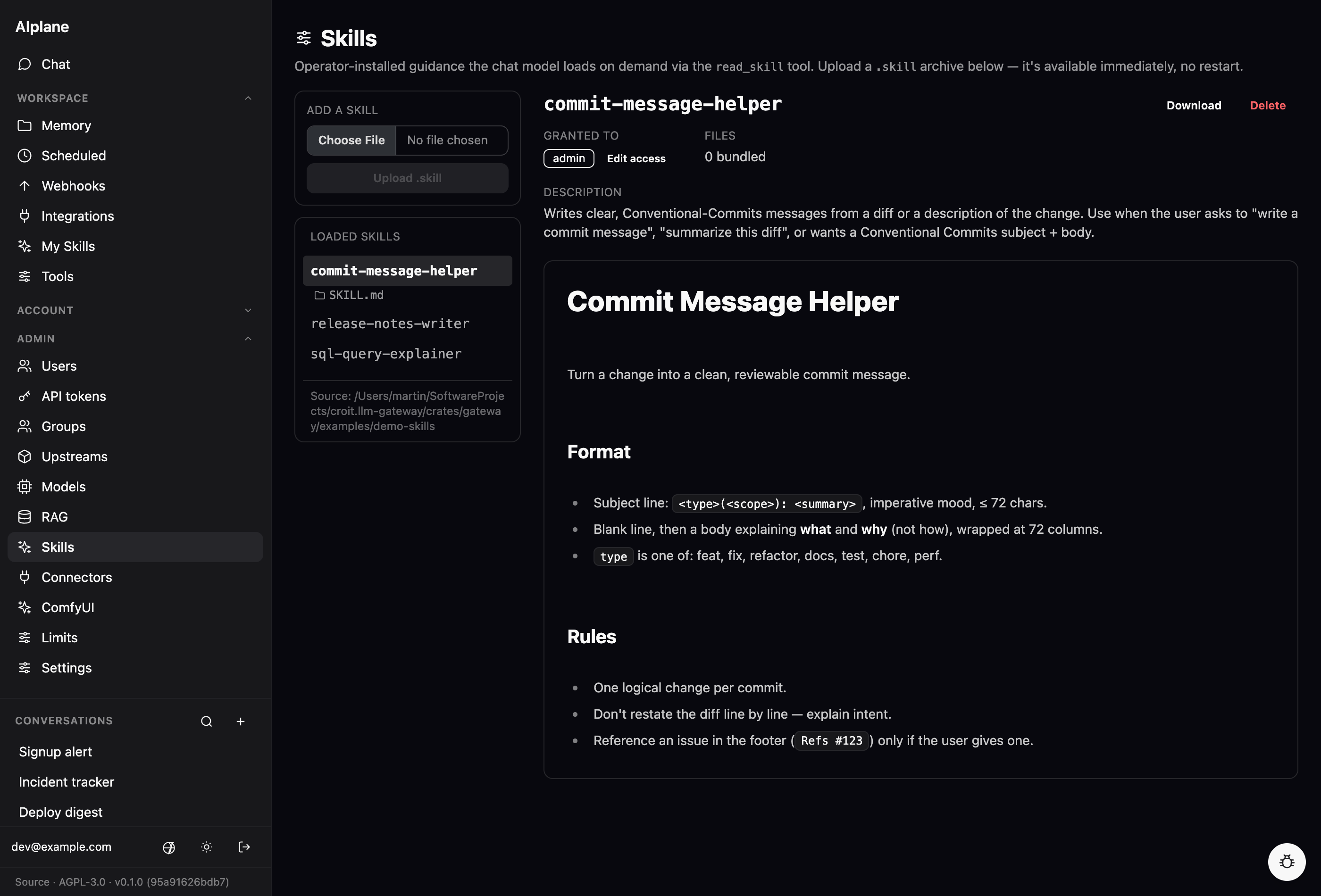
Managing skills. Point the skills directory at wherever you keep bundles — /admin/settings → Content & data, dir (default ./data/skills) — and drop bundles in.
As an admin, open /admin/skills to upload a .skill archive (a zip of a SKILL.md bundle), view a skill's rendered SKILL.md + file tree, and delete one — all live, with no restart: the store re-scans the directory and hot-swaps the loaded set. RBAC gates which roles may use which skill; read_skill rides along automatically for any role that's been granted a skill. Grants come from two sources, unioned: each role's static skills list in the config (["*"] for all, exactly like tools), plus a per-skill grant editor in the UI — click Granted to on a skill to pick the roles allowed to load it. UI grants are stored in the DB and take effect immediately; config grants stay authoritative and show read-only in the dialog.
Private user skills. Every signed-in user gets their own private skills at /skills — upload a .skill archive or write SKILL.md inline in the editor. Ownership is the grant: a private skill needs no RBAC role and is usable only in that user's own chats, invisible to everyone else. Private skills overlay the global operator set — a private skill with the same name shadows the global one for that user. They live under <skills.dir>/.users/<user>/ (so [skills] must be configured), are capped per user, and are loaded through the same read_skill progressive-disclosure path as global skills.
Notifications (Web Push)
Because the UI is an installable PWA, it can push a notification when an assistant turn a user started finishes while the app isn't focused — useful on a phone where you fire off a long turn and lock the screen. Turns run server-side in a background worker regardless of whether a tab is attached, so the "done" ping fires even after you've closed the app.
This is on by default and needs no setup or third-party account — AIplane generates its own VAPID keypair on first boot (persisted in the DB, private half sealed under the at-rest key) and encrypts each payload end-to-end for the subscription (RFC 8291). The only hard requirement is that AIplane is served over HTTPS (localhost is exempt for dev): service workers and the Push API only run on secure origins. A user opts in per device from the Notifications card on /tokens; whether a notification is actually shown is decided in the service worker (suppressed when a focused tab already has that conversation open).
[push]
enabled = true                       # optional; default true. false turns the feature + its /api/v0/push/* endpoints off
contact = "mailto:[email protected]"   # VAPID `sub`: a contact the push service may use to reach you (set a real one for prod)
Platform support: Android/Chrome works directly; on iOS Web Push requires the PWA to be installed to the home screen (iOS 16.4+), not just open in Safari.
Using AIplane
1 — Get an API token. Sign in at /login, then create a gwk_… token on the /tokens page.
2 — Call it like the OpenAI API:
export OPENAI_API_KEY=gwk_…
export OPENAI_BASE_URL=https://aiplane.example.com/v1
openai api chat_completions.create -m <model-id> -g user "Hello"
GET /v1/models lists every model AIplane has discovered across all pools — pick a model id from there.
2b — Or point Claude Code at it by setting ANTHROPIC_BASE_URL and ANTHROPIC_AUTH_TOKEN — see Claude Code against your own models.
3 — Or just use the chat UI at /chat: pick a model, attach files, and chat with streaming replies. Conversations persist server-side and resume on reconnect.
HTTP endpoints
| Endpoint | Auth | Purpose |
|---|---|---|
POST /v1/chat/completions |
Bearer token | Chat completions (streaming + non-streaming). |
POST /v1/systemone |
Bearer token | TypeSafe System One-compatible typed decisions; routes to a system_one-kind pool. |
POST /v1/messages |
Bearer token or x-api-key |
Anthropic Messages API (streaming + non-streaming) — the compatibility layer Claude Code talks to. Same routing, limits, tool loop and usage accounting as /v1/chat/completions; only the wire format differs. See docs/claude-code.md. |
POST /v1/messages/count_tokens |
Bearer token or x-api-key |
Exact token count for an Anthropic-shaped request, from the serving model's own tokenizer (vLLM's /tokenize). 404 when the backend exposes none, which is the client's signal to count from response usage instead. |
POST /v1/embeddings |
Bearer token | Embeddings. |
POST /v1/images/generations |
Bearer token | Image generation (routes to an image-kind pool). |
POST /v1/images/edits |
Bearer token | Image editing (multipart: image + prompt); routes to an image-kind pool. |
POST /v1/audio/transcriptions |
Bearer token | Whisper-style transcription (multipart upload). |
POST /v1/audio/speech |
Bearer token | Text-to-speech (OpenAI-shaped). Only served when a speech upstream pool is configured. |
GET /v1/models |
Bearer token | All discovered models across pools (deduplicated by id). |
GET /v1/sandbox/files/{run}/{filename} |
Bearer token | Download a file a sandbox run produced for the caller (scoped to your user). |
HEAD /api/hello |
none | Connection-warming probe an Anthropic-format client sends at startup. |
GET /healthz, GET /readyz |
none | Liveness / readiness probes. |
/, /{*name} |
public (shell) / session cookie (its API calls) | The web UI: a SvelteKit SPA served as static files from AIPLANE_STATIC_DIR. Any path that is not a real file falls back to index.html, so /login, /chat, /tokens, /usage, /skills, /memory, /scheduled, /webhooks, /integrations, /tools, /setup and the /admin/* screens are client routes — the server has no handler for them and every action behind them is an /api/v0/* call. 503 (not 404) when no SPA build was deployed. |
/hooks/{secret} |
secret in URL | Fire a webhook: runs the owner's saved prompt with the request body appended as an untrusted block. Accepts GET and POST; sync webhooks return the model output as a JSON envelope, async ones return 202. |
/hooks/rag/{token} |
token in URL | Re-sync one RAG collection. Point a file host's webhook (Nextcloud's webhook_listeners, ownCloud's equivalent, or a cron line) at it so a changed folder is searchable in minutes rather than at the next poll. The body is ignored — this is a doorbell, not a change feed; the walk that follows establishes what actually changed. Returns 202 with the number of refs queued. |
GET /rag/{id}/connect, GET /rag/oauth/callback |
admin session cookie | OAuth round trip for a RAG source that needs one (Google Drive, …). Outside /api/v0 because the callback URI is registered with the external provider, so the path is not ours to move. |
POST /integrations/{key}/connect, POST /integrations/{key}/retry, GET /integrations/callback |
session cookie | Same shape for a per-user MCP connector — see docs/connectors.md. |
GET /api/v0/setup/state, POST /api/v0/setup/test, POST /api/v0/setup/restart, POST /api/v0/setup/finish |
none on a first run; one-time token afterwards | Deployment setup wizard behind the /setup screen: enter your OIDC provider, prove it with a real sign-in, and pick the claim value that grants admin. Open (and everything else redirects to it) until setup completes; gone afterwards, unless restore-setup on the host reopens it for 30 minutes — see Recovering access. |
/api/v0/push/config, /api/v0/push/subscribe, /api/v0/push/unsubscribe |
session cookie | Web Push (turn-complete notifications): fetch the VAPID public key + enabled flag, register a browser subscription, and forget one. Governed by the Web Push settings at /admin/settings → Notifications. |
POST /api/v0/me/browser/feedback/{turn_id} |
session cookie | Result of a browser_control batch, posted by the chat page after the paired browser extension ran it (or refused it, or reported that it isn't installed). The turn must belong to the caller: this reply becomes the model's picture of a page in someone's browser, so answering a stranger's turn would be prompt injection with a return address. See docs/browser-control.md. |
/api/v0/admin/* |
admin role | Everything behind the admin screens: users (list + start impersonation, and POST /api/v0/admin/impersonate/stop to end it), the deployment-wide API-token register (every token with its owner, month-to-date spend, model allowlist and quota; the secret itself is unrecoverable — only a SHA-256 is stored — and the one thing editable is an operator model restriction, which intersects with the owner's own so neither side can widen the other), groups (maps OIDC claims onto gateway groups and sets per-group tool/skill grants; pools, RAG collections and MCP connectors then restrict access by group), upstreams (edits the pool/backend topology in the DB and hot-reloads it), connectors (docs/connectors.md), ComfyUI's workflow catalog (docs/comfyui.md), skills, limits, and the operator settings — OCR, compaction, attachment storage, sandbox, ComfyUI, RAG, skills, Typst, GeoIP, usage, limits, feedback, push and session/token lifetimes, with secrets sealed at rest. Almost everything takes effect on the next request; fields that own a background worker are badged restart. |
GET /openapi.json |
none | OpenAPI 3.1 for the session API, generated by AIplane from its compiled /api/v0/* route declarations. No separate spec file is shipped or maintained. |
GET /api/v0/build |
none | Runtime source URL and exact version/git label used by the public login card and persistent AGPL source offer. |
/api/v0/* |
session cookie unless documented above | The JSON API backing the UI — identity, tokens, chat (including GET /api/v0/chat/sessions/{id}/events), memories, scheduled actions, webhooks, skills, integrations, usage, RAG, transcription and speech. |
The /v1/* endpoints require Authorization: Bearer gwk_… (/v1/messages also accepts the same token in x-api-key, which is where an Anthropic-format client puts it). Client Authorization headers are dropped at the proxy and the configured upstream key (if any) is injected; hop-by-hop headers are filtered both ways; upstream 4xx/5xx are relayed verbatim. The UI uses the signed session cookie minted at OIDC login.
The UI is an installable PWA. Its manifest, service worker and icons ship with the SPA (web/static/) and are served from the root without auth: /manifest.webmanifest, /sw.js, /favicon.svg, /icons/*. Because the SPA's bundles are content-hashed and served immutable under /_app/immutable/*, the service worker carries no fetch cache at all — installability and Web Push are its whole job, and every request goes straight to the network. Installability requires HTTPS (localhost exempt for dev).
When Web Push is enabled (the default), the PWA can also deliver Web Push notifications: after a user opts in from the /tokens screen, the service worker shows a notification when an assistant turn they started finishes while the app isn't focused. This uses a self-generated VAPID keypair (persisted, private half sealed under the at-rest key) and RFC 8291 payload encryption — no third-party push provider or account is involved beyond the browser's own push service.
Production deployment (container + systemd)
CI builds target/release/aiplane and publishes a runtime container image (debian:trixie-slim plus git + ca-certificates, which the RAG indexer needs). The binary is built outside the Dockerfile and COPYed in. To build locally:
mise run build                    # produces target/release/aiplane (and fetches the typst CLI)
mise run build-web                # produces target/frontend/build (the SvelteKit SPA)
docker build -t gateway:dev .     # Dockerfile COPYs the release binary + SPA into the image
deploy/quadlet/ ships a hardened systemd-podman Quadlet (read-only rootfs, all capabilities dropped, runs as an unprivileged uid). Its README is the full walkthrough; in short:
sudo install -d -m 0750 /etc/aiplane
sudo install -m 0644 deploy/quadlet/gateway.container   /etc/containers/systemd/
sudo install -m 0644 deploy/quadlet/gateway.volume      /etc/containers/systemd/
sudo install -m 0600 deploy/quadlet/gateway.example.env /etc/aiplane/gateway.env
sudo $EDITOR /etc/aiplane/gateway.env     # AIPLANE_SESSION_KEY — the only required variable
# No config.toml: open AIplane's URL and the setup wizard takes it from there.
sudo systemctl daemon-reload
sudo systemctl enable --now gateway.service
Operational notes:
- TLS: the unit binds
127.0.0.1:8080— terminate HTTPS with a reverse proxy (Caddy / Traefik / nginx) in front. Set AIplane's public URL to the external HTTPS URL at/setupso the OIDC callback is correct, and register<public_url>/auth/callbackas a redirect URI on your OIDC client. - State: the SQLite DB + session store live in a Podman-managed named volume and survive image swaps. Point
$AIPLANE_DB_PATH(and, if you use RAG, itsdata_dirat/admin/settings) at that volume. - Updates: Quadlet treats
Image=as the source of truth and won't re-pull:lateston restart — pin a digest or a:<git-sha>tag in production.
Docker Compose
For hosts running Docker rather than podman, deploy/compose.example.yml is the equivalent stack (gateway + self-hosted Google Workspace MCP server, plus the sandbox runner and egress proxy under the sandbox profile). The optional PDF OCR sidecar starts under the ocr profile; it requires OCR_VLLM_BASE_URL pointing at an Unlimited-OCR vLLM service.
Kubernetes
deploy/helm/aiplane/ is a Helm chart with the same hardening. A default install is four objects — StatefulSet (one replica), PVC, Service, ServiceAccount — and needs no values at all:
kubectl create namespace aiplane
helm install aiplane oci://ghcr.io/croit/charts/aiplane -n aiplane \
  --version 2609.1.0 \
  --set ingress.enabled=true --set ingress.host=aiplane.example.com
The chart is published as an OCI artifact next to the images and carries the same version, so --version 2609.1.0 pins chart and images to one build (docs/releases.md). The MCP bridges (Google Workspace, GitLab CE, Discord) and the OCR adapter run as extra containers in the same pod, each behind an enabled flag; the code sandbox stays outside the chart, because it needs a gVisor/Kata host and AIplane reaches it through a URL in its settings. docs/kubernetes.md is the step-by-step guide, including backups, the sandbox options and why the deployment is deliberately single-replica.
All deployment-relevant docs — every method, every component, the full Google Workspace connector setup — live in deploy/README.md.
Documentation
Everything is in docs/ — start at that index. The ones most people want first:
docs/architecture.md |
What runs inside the one binary, and how a request flows through it |
docs/upstreams.md |
Pools, backends, model aliases, backend profiles, prefix-affinity routing |
docs/gateway-api.md |
The OpenAI-compatible surface in detail |
docs/claude-code.md |
Pointing Claude Code at your own models |
docs/auth.md |
OIDC, sessions, tokens, the setup wizard and recovery |
docs/tools-rbac.md + docs/tools-inventory.md |
How server-side tools are gated, and every tool that exists (drift-guarded) |
docs/connectors.md |
Per-user MCP connectors, end to end |
deploy/README.md |
Deployment: Docker Compose, systemd/Podman, Helm |
docs/kubernetes.md |
Running on Kubernetes, step by step |
docs/releases.md |
The YYMM.RELEASE.BUILD version scheme and what each published tag means |
docs/renaming.md |
Upgrading from croit LLM Gateway — what the rename changed, what kept its old name, and the one place it wants a decision |
AGENTS.md doubles as human onboarding.
Artifacts. Container images and the Helm chart are published to GHCR on every build:
| Artifact | Reference |
|---|---|
| AIplane | ghcr.io/croit/aiplane |
| Helm chart | oci://ghcr.io/croit/charts/aiplane |
| Sandbox runner + workload image | ghcr.io/croit/aiplane-sandbox-runner, ghcr.io/croit/aiplane-sandbox |
| OCR sidecar | ghcr.io/croit/aiplane-ocr-sidecar |
Deploy :production (the newest release) or pin a :vYYMM.RELEASE.BUILD tag; :latest follows main. Releases · packages.
Contributing
Contributions are welcome — see CONTRIBUTING.md for the workflow, the sign-off requirement, and the Contributor License Agreement (CLA.md).
License
Licensed under the GNU Affero General Public License v3.0 (AGPL-3.0-only) — see LICENSE.
You are free to use, study, modify, and redistribute this software, including in a commercial setting. Because it is AGPL, one obligation stands out: if you run a modified version to provide a network service, you must offer the complete corresponding source — including your modifications — to the users of that service (AGPL §13). The UI carries a persistent "Source" link for this; operators of a modified deployment should point it at their own source via the AIPLANE_SOURCE_URL environment variable.
Commercial licensing. If the AGPL's terms don't fit your use case, a separate commercial license is available — contact croit GmbH ([email protected]).
Third-party components bundled with or linked into the binary retain their own licenses; see NOTICE.
Yorumlar (0)
Yorum birakmak icin giris yap.
Yorum birakSonuc bulunamadi