tmux-claude-hatch
Health Pass
- License — License: MIT
- Description — Repository has a description
- Active repo — Last push 0 days ago
- Community trust — 380 GitHub stars
Code Pass
- Code scan — Scanned 11 files during light audit, no dangerous patterns found
Permissions Pass
- Permissions — No dangerous permissions requested
No AI report is available for this listing yet.
tmux plugin that runs Claude Code sessions in popups per project directory, with an fzf picker showing each session's status and a bell that highlights the window that needs you.
tmux-claude-hatch
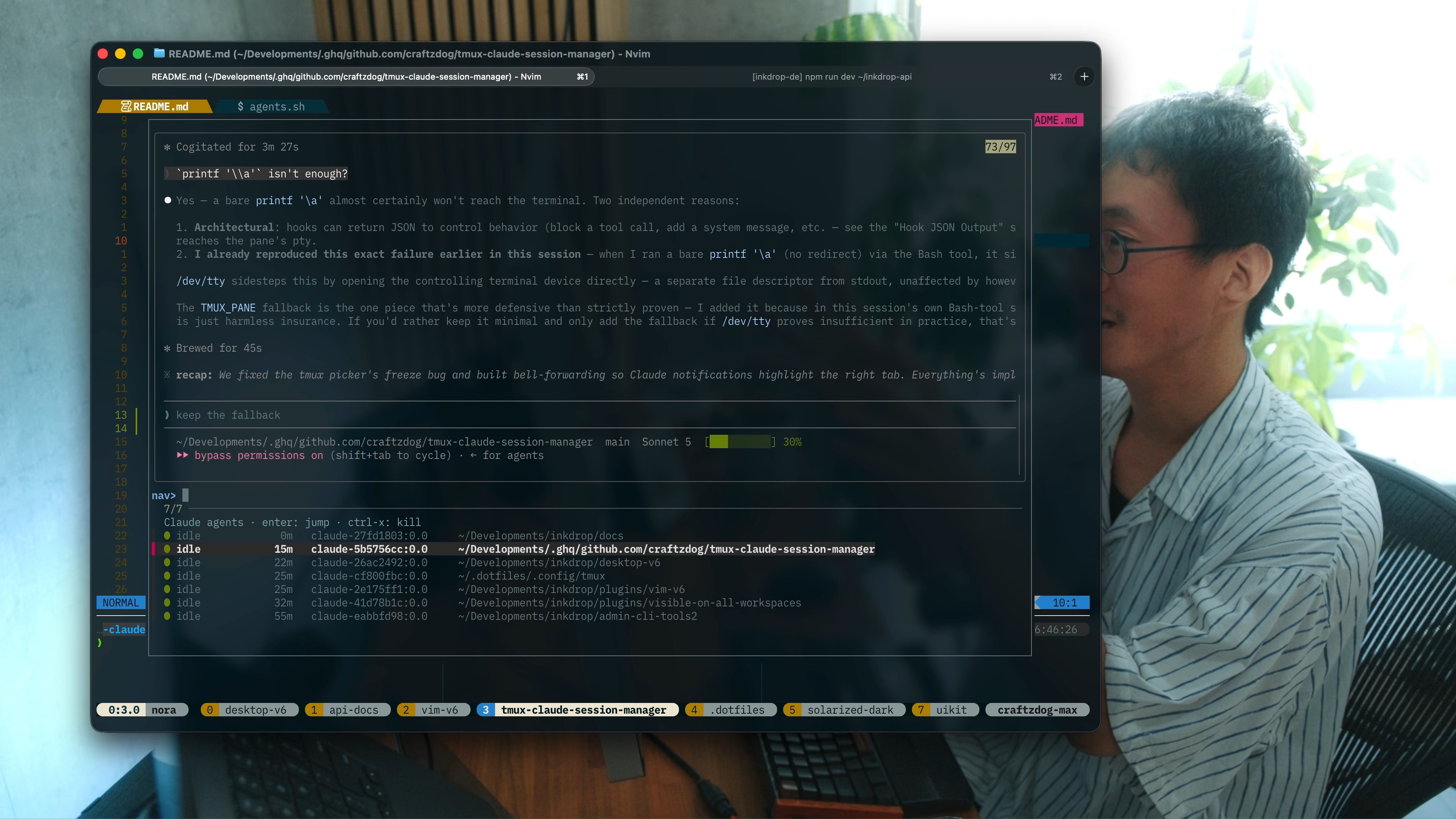
A tmux plugin (plus an optional Claude Code plugin) that runs a Claude Code
session in a popup for each project directory. Open the hatch, hand Claude the
work, close it and get back to your editor. Each session lives in its own nested
tmux session, so closing the hatch never interrupts it. When you want to check
in, an fzf picker lists every running session, shows what each one is doing,
and jumps you straight to it. And when a session finishes or needs your
attention, it rings a bell that highlights the window you launched it from — so
you know where to go without even opening the picker.
Simple by design: it's just a few shell scripts.
Why / philosophy
- Who it's for
- People who want to stay in their editor — (Neo)vim, Emacs — in the main tmux
session - People who still read, write, and review the code themselves
- People who'd rather have a small tool than a full-blown one just to manage
agent sessions
- People who want to stay in their editor — (Neo)vim, Emacs — in the main tmux
- Who it's not for
- People whose focus is the agent's chat interface rather than the code
- People who want one tool for sessions across several AI providers — this one
is Claude Code only - People who run a swarm of agents and don't read or write code themselves
Features
- A central picker (
prefix+u) listing every running Claude agent —
several in one project, and any running loose in an ordinary pane. - Live status per agent —
working/waiting/idle— read straight
fromclaude agents --json, so you instantly see which need you. No setup. - A live preview of each agent's screen right in the picker.
- Smart jump — selecting an agent switches your client to the window it
was launched from, then resumes it in a popup over it. - A launcher (
prefix+y) that opens/attaches a Claude session for the
current directory. - Quick kill (
ctrl-x) of a finished agent from the picker. - Bell forwarding — a bell in a dedicated session highlights the window
you launched it from, so you notice even without opening the picker
(one-time Claude Code setup).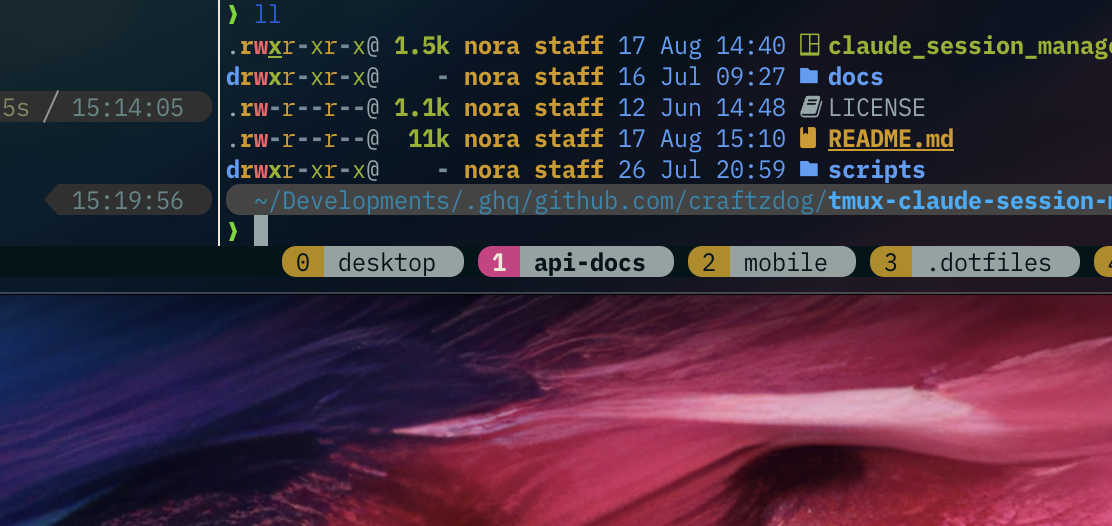
Prerequisites
- tmux ≥ 3.2 (for
display-popup) - fzf — the picker UI
- jq — parses
claude agents --json - Claude Code ≥ 2.1.139 — for the
claude agentscommand (claude --versionto check) - bash; macOS or Linux
Installation
tpm
Add to ~/.tmux.conf (or ~/.config/tmux/tmux.conf):
set -g @plugin 'craftzdog/tmux-claude-hatch'
Then hit prefix + I to install.
Keybinding note: by default the plugin binds
prefix+y(launch) andprefix+u(list). If your config binds those elsewhere, either change the
options, or make sure the plugin loads after your own bindings
(putrun '~/.tmux/plugins/tpm/tpm'after them) so the one you want wins.
(Optional) Claude Code plugin
Independent of the tmux plugin above. It ships the Claude Code hook
configuration this plugin wants, so you don't have to hand-edit~/.claude/settings.json:
- Rings the terminal bell when an agent ends a turn, asks for permission, or
asks you a question — the moments the picker callsidleandwaiting. That
is what bell forwarding needs in order to
highlight the window you launched the agent from. - Refreshes the picker's agent cache on those same events, plus session
start/end and prompt submit. The picker paints from cache for a fast startup,
so without this the first frame can be stale — showingworkingfor an agent
that has been waiting on you.
/plugin marketplace add craftzdog/tmux-claude-hatch
/plugin install tmux-claude-hatch@tmux-claude-hatch
See plugins/tmux-claude-hatch for exactly what
it registers.
Usage
| Key | Action |
|---|---|
prefix + y |
Launch (or re-attach to) a Claude session for the current directory, in a popup |
prefix + d |
Close the popup and go back to your window; the Claude session keeps running |
prefix + u |
Open the agent picker |
Inside the picker:
| Key | Action |
|---|---|
enter |
Jump to the agent |
ctrl-x |
Kill the highlighted agent |
↑ / ↓, type to filter |
fzf navigation |
Agents needing your attention (waiting, idle) sort to the top.
Every running Claude gets its own row — the picker identifies each by its
process, not by its tmux session. So several agents in one project all show up
separately, as does a Claude you started by hand in an ordinary pane.
Options
Set any of these before the plugin loads (defaults shown):
set -g @claude_launch_key     'y'        # prefix key: launch/open for current dir
set -g @claude_list_key       'u'        # prefix key: open the picker
set -g @claude_command        'claude'   # command run in new sessions
set -g @claude_args           ''         # extra args appended to the command
set -g @claude_session_prefix 'claude-'  # tmux session name prefix
set -g @claude_popup_width     '90%'     # popup width
set -g @claude_popup_height    '90%'     # popup height
set -g @claude_fzf_options    ''         # extra options passed to the fzf picker
set -g @claude_forward_bell   'on'       # highlight the origin window on a bell
For example, to skip permission prompts in launched sessions:
set -g @claude_args '--dangerously-skip-permissions'
Manual installation
If you don't use tpm:
git clone https://github.com/craftzdog/tmux-claude-hatch ~/clone/path
Add to ~/.tmux.conf, then reload (prefix + r ortmux source ~/.tmux.conf):
run-shell ~/clone/path/claude_hatch.tmux
Customizations
Making Claude ring the bell
Forwarding relays a bell; it cannot create one. Claude Code has to emit it. The
Claude Code plugin takes care of that; the
alternatives below do the same job by hand.
Via Claude's own notification settings
Two settings decide this — and they live in different files.
How it notifies — ~/.claude/settings.json:
{
  "preferredNotifChannel": "terminal_bell"
}
Only terminal_bell and iterm2_with_bell write a real \a. iterm2, kitty
and ghostty send escape sequences that tmux does not count as a bell,notifications_disabled sends nothing, and the default auto picks by terminal —
so pin it.
When it notifies — ~/.claude.json, the global config (settings.json
ignores this key and drops it silently):
{
  "messageIdleNotifThresholdMs": 0
}
Claude rings once it has sat idle this long. The default is 60000, long enough
that you'd normally have gone back to look before it fires; 0 rings the moment a
turn ends.
Via a hook
A hook is the way to keep the bell while pointing preferredNotifChannel at an
OS-notification channel instead. This is what the Claude Code plugin registers;
to wire it by hand, in ~/.claude/settings.json:
{
  "hooks": {
    "Stop": [
      {
        "matcher": "",
        "hooks": [
          {
            "type": "command",
            "command": "printf '\\a' 2>/dev/null > /dev/tty || { [ -n \"$TMUX_PANE\" ] && printf '\\a' 2>/dev/null > \"$(tmux display-message -p -t \"$TMUX_PANE\" '#{pane_tty}' 2>/dev/null)\"; } || true"
          }
        ]
      }
    ]
  }
}
Stop fires the moment a turn ends, with no idle timer involved. The bell goes to/dev/tty — the hook's controlling terminal, which inside tmux is the pane's own
pty, exactly where Claude's built-in bell would land. The $TMUX_PANE branch
covers a hook running without a controlling terminal, resolving the pane's tty
through tmux instead; the trailing || true keeps a failed bell from failing the
hook.
Note that 2>/dev/null comes before the /dev/tty redirection. A failed
redirection is reported by the shell itself, so a trailing 2>/dev/null is
applied too late to suppress it — with the operands the other way round, a hook
running without a controlling terminal printsbash: /dev/tty: Device not configured on every turn.
Use the same command under Notification with the permission_prompt matcher to
ring when Claude asks for permission, or under PreToolUse matchingAskUserQuestion to ring when it asks you a question.
Set @claude_forward_bell 'off' to disable forwarding altogether.
Customizing the fzf picker
@claude_fzf_options is passed straight to fzf, so you can add your own
bindings. Here is a vim-style example:
set -g @claude_fzf_options "\
  --prompt 'nav> ' \
  --bind 'j:down' \
  --bind 'k:up' \
  --bind 'q:abort' \
  --bind 'x:execute-silent(kill {3})+reload(sleep 0.3; \$CLAUDE_PICKER --list)' \
  --bind 'i:unbind(j,k,q,i,a,x)+change-prompt(filter> )' \
  --bind 'a:unbind(j,k,q,i,a,x)+change-prompt(filter> )' \
  --bind 'esc:rebind(j,k,q,i,a,x)+change-prompt(nav> )'"
The picker opens in nav mode:
| Key | Action |
|---|---|
j / k |
move down / up |
i / a |
switch to filter mode — type to fuzzy-match |
x |
kill the highlighted agent (like the built-in ctrl-x) |
q |
close the picker |
enter |
jump to the agent (both modes) |
esc |
filter mode → back to nav |
Only the bound keys are special in nav mode; any other key still filters as you
type. x reloads the list through $CLAUDE_PICKER, a path the picker exports
for exactly this — write it as \$CLAUDE_PICKER inside the double-quoted value
above so tmux stores a literal $ (in a single-quoted value, use a bare$CLAUDE_PICKER).
License
MIT © Takuya Matsuyama
Reviews (0)
Sign in to leave a review.
Leave a reviewNo results found