ai-hedge-fund
Health Pass
- License — License: MIT
- Description — Repository has a description
- Active repo — Last push 0 days ago
- Community trust — 98 GitHub stars
Code Pass
- Code scan — Scanned 12 files during light audit, no dangerous patterns found
Permissions Pass
- Permissions — No dangerous permissions requested
No AI report is available for this listing yet.
Public trading experiment on 11 Hyperliquid markets. Claude proposes, code disposes.
AI Hedge Fund
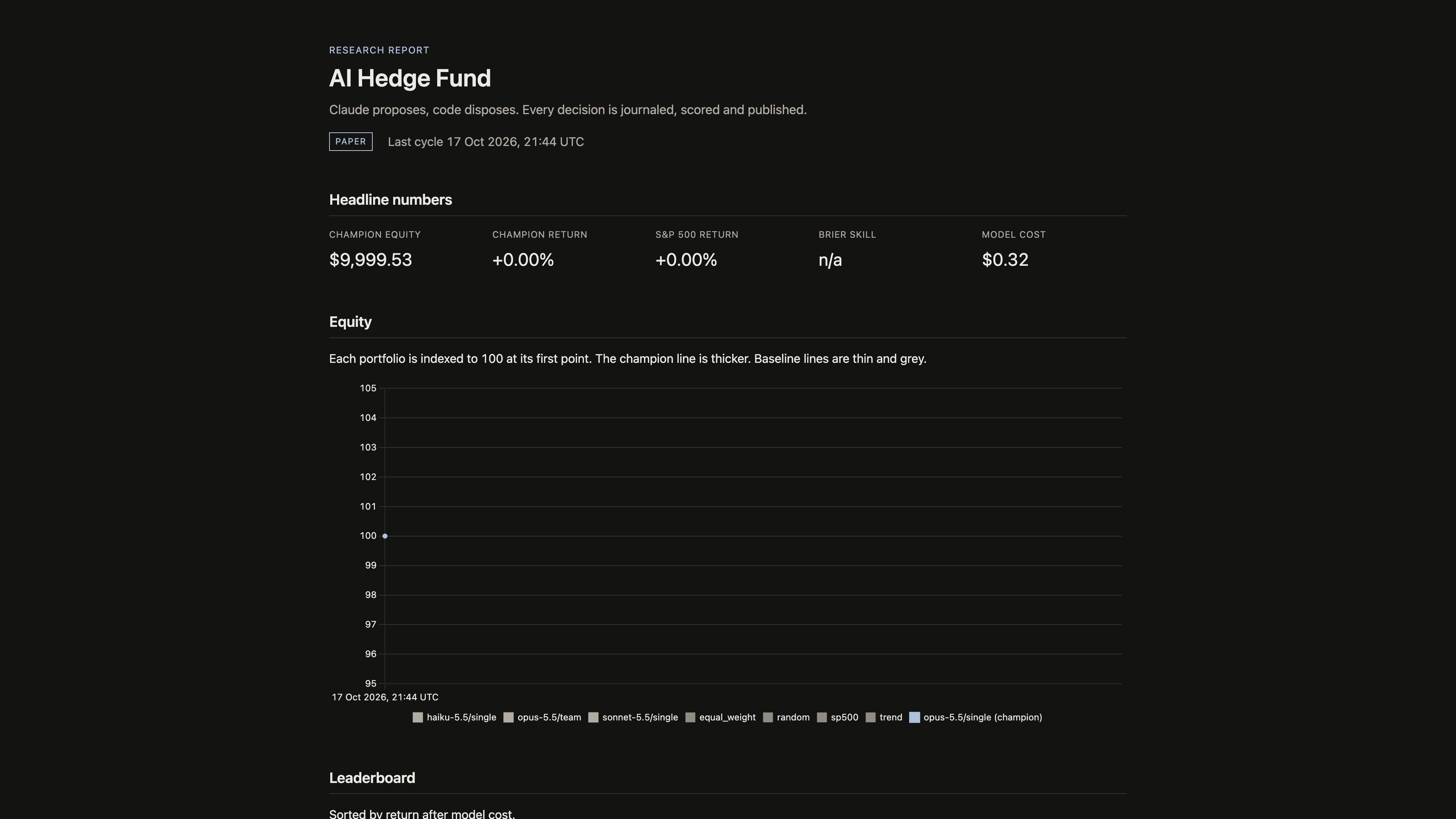
An open-source Python experiment that runs a trading fund in public across 11 perpetual futures markets. Claude proposes, code disposes. Every decision is journalled, scored and published.

What it does
Cycles are 4-hour slots, currently started by hand. In one run, fund:
- Takes a snapshot of 11 perpetual futures markets on Hyperliquid: 2 US stock indices, 4 US stocks, gold, WTI crude oil, USD/JPY, bitcoin and ether.
- Asks Claude for a target weight, the probability the price is higher in 24 hours, a stop and a short thesis for each market.
- Passes that proposal through a deterministic risk gate. The model never sends an order.
- Executes the gated book on Hyperliquid only when a live mode is on, and always keeps paper books for all model configurations and 4 rule-based baselines.
- Journals the inputs, decisions, reasoning summaries, gate decisions, orders and costs, then publishes them.
How it is built
- A workflow, not an agent loop. Each cycle runs a fixed sequence of steps in order and calls Claude only for the optional news digest and trade proposals. It is easier to inspect when something looks wrong.
- Claude proposes, code disposes. Claude outputs target weights, probabilities, stops and a short thesis. Deterministic code enforces the risk limits and sends orders.
- Small blast radius. A dedicated wallet, an agent key that cannot withdraw, a $1,000 live equity ceiling, stops placed on the exchange and a 20% drawdown halt keep a bad cycle from growing.
- Glass box. Every input, output, reasoning summary, gate decision, order and cost is journalled and published to a git branch.
- Forward only evaluation. Language models have memorised prices up to their training cutoff, so a backtest over that period is contaminated. Hiding tickers or dates does not fix it. Results are scored forward from the first published cycle, with fees, funding and model costs included.
- Fail closed. A failure in data, a decision or execution adds no new risk for that cycle.
- Pure core, thin shell. Features, the risk gate, sizing, accounting and scoring are pure functions. Network calls live in a few modules, so the core can be tested without keys.
Architecture
flowchart LR
    S[Scheduler<br/>every 4 hours] --> D[Market data<br/>and news]
    D --> C[Claude<br/>targets, forecasts, theses]
    D --> X[Shadow configs<br/>and baselines on paper]
    C --> G[Risk gate<br/>deterministic limits]
    G --> E[Executor<br/>orders and stops]
    E --> J[(Journal)]
    X --> J
    J --> R[Scoring<br/>returns, costs, calibration]
    R --> P[Public dashboard]
| Module | Role |
|---|---|
cycle.py |
Runs one cycle in a fixed order. |
data/ |
Public market data, features and the snapshot. |
brain/ |
Prompts, Claude calls, the news digest and the offline fake model. |
risk/ |
The deterministic gate. |
execution/ |
Turns gated weights into orders and stops. |
venues/ |
Paper accounting and the execution venue. |
journal/ |
Cycle records, forecasts, equity and transcripts. |
scoring/ |
Returns, costs, Brier score and calibration. |
dashboard/ |
The static research site. |
cli.py |
fund run, status, score, dashboard, halt, resume, doctor, replay. |
Safety
Real orders, when enabled, pass through every layer below.
- The trading wallet is dedicated to this project. Its private key is never stored here.
- The agent key can trade and cannot withdraw.
- Live orders are refused when live equity is above
max_live_equity_usd($1,000) infund.toml. - The risk gate caps weight per market, gross exposure, net exposure and new risk per cycle. In closed markets (US market hours for stocks, indices, commodities and FX), it blocks new positions, flips and increases, but reductions and holds still pass. Positions cannot flip again within 12 hours.
- Stops are placed on the exchange after fills.
- A 20% drawdown from the high water mark halts and flattens the book.
fund haltstops the next cycle.fund halt --flattenalso closes the live book.- Autonomy defaults to approve, which prints the gated plan and waits for a person.
- Mainnet trading stays off unless
FUND_ALLOW_MAINNETisyes.
Results
The public dashboard is the record: chase-mew.github.io/ai-hedge-fund.
Figures start at the first published cycle. There is no backtest, because language models have memorised price history up to their training cutoff. Fees, funding and model costs are included. Until there are hundreds of cycles, treat any result as an anecdote about this experiment, not evidence of an edge.
Quickstart
Install uv and Python 3.13, then:
uv sync
uv run fund run --mode paper --fake-llm
uv run fund status
uv run fund score
uv run fund dashboard --out site
That path needs no API keys. The --fake-llm flag uses an offline model whose weights follow the gap to the 20 day average.
With ANTHROPIC_API_KEY in .env:
uv run fund doctor
uv run fund run --mode paper
uv run fund dashboard --out site
open site/index.html
Copy .env.example to .env and fill in only the keys you are using.
Configuration
fund.toml holds the fund name, cycle length, paper starting equity, daily model budget, journal directory and autonomy mode. It sets the champion, shadows, model IDs, token prices, news digest switch and search limit. The risk section is the gate: per market weight, gross and net exposure, new risk, minimum trade weight, daily loss, drawdown, flip cooldown, pre-weekend cap, stop range and class caps. The execution section is leverage, minimum order size, mainnet and testnet slippage, price gap limit and live equity ceiling. The paper section holds fill slippage and fees. The universe lists the 11 markets.
Running with real orders
Start on testnet with a new, dedicated wallet. Fund it with a small mainnet deposit so you can claim the testnet faucet, then run scripts/setup_agent.py to create an agent key that can trade but cannot withdraw. Put the address and testnet agent key in .env. Never put the wallet private key in .env.
The autonomy setting in fund.toml applies only to the real venue:
papernever sends a real order.approve(the default) prints the gated plan and waits for a person to confirm it.autosends the gated plan directly. Use this for unattended runs only after you have watchedapprovemode.
fund run --mode testnet uses test funds. fund run --mode live is refused unless FUND_ALLOW_MAINNET=yes is set. fund halt --flatten --mode testnet stops the next cycle and closes the book. fund resume clears the halt after you confirm.
Hyperliquid's testnet faucet pays 1,000 mock USDC only to an address that has already made a mainnet deposit. The minimum mainnet deposit is 5 USDC. There is no way around that step.
Automation
.github/workflows/cycle.yml runs one cycle, scores it, builds the static dashboard and publishes the journal branch and GitHub Pages. Start it by hand from the GitHub Actions tab, or run gh workflow run cycle.yml -f mode=paper.
The 4 hour schedule in the workflow is commented out, so cycles do not run automatically. Pushing code does not spend the model budget on its own. To turn unattended runs on, uncomment the schedule, add ANTHROPIC_API_KEY as an Actions secret and set the repository variable FUND_MODE to paper. GitHub disables scheduled workflows on a public repository after 60 days without activity.
Development
make check
That runs ruff, pyright and pytest with coverage. Live network tests are marked live and stay off unless you pass -m live.
Offline tests use recorded market responses in tests/fixtures/ and FakeClaude. Golden prompt files live in tests/golden/. Update them with uv run pytest tests/test_render.py --update-golden only when a prompt change is intentional.
To add a model configuration, create a catalogue entry and list its model/style ID under shadows in fund.toml. style is single or team. Only the champion can trade the real account.
fund replay tests/fixtures/snapshot_real.json --times 3 reruns the champion on a saved snapshot and sends no orders. It needs ANTHROPIC_API_KEY.
History
The first version was built in a day on 26 January 2025. It was a TypeScript chain of gpt-4-turbo agents arranged as an org chart, with employee agents reporting to a CEO agent. Each employee agent wrapped one financial data endpoint. That setup was slow and made sequential recursive calls. It had no portfolio state, risk limits or evaluation, and its fake exchange only printed. This version keeps the idea of a model proposing trades and replaces everything else. The original is preserved at the v0-legacy tag.
Disclaimer
This is an experiment, not investment advice. Trading leveraged derivatives can lose money. There is no warranty.
License
MIT. See LICENSE.
Reviews (0)
Sign in to leave a review.
Leave a reviewNo results found