Hatchdoor
Health Pass
- License — License: AGPL-3.0
- Description — Repository has a description
- Active repo — Last push 0 days ago
- Community trust — 13 GitHub stars
Code Pass
- Code scan — Scanned 12 files during light audit, no dangerous patterns found
Permissions Pass
- Permissions — No dangerous permissions requested
No AI report is available for this listing yet.
Self-hosted, agent-native web app and MCP server for your Obsidian-style Markdown vault. Browse, search, and edit notes from a fast UI or from AI agents.





Hatchdoor
Hatchdoor is a self-hosted, agent-native web app for your Obsidian-style
Markdown vault. Browse, search, and edit your notes in a fast web UI, and give
AI agents first-class access to the very same vault over the Model Context
Protocol (MCP).
Point an MCP client like Claude, Claude Code, Codex, Cursor, or Hermes at
Hatchdoor and your agent can read, search (keyword and semantic), create, edit,
move, and link notes. Every action goes through the same safe, atomic vault
operations the UI uses, with optional automatic git commit-and-push. The web UI
and your agents are two front doors to one vault.
Your Markdown files stay the source of truth. Hatchdoor builds a disposable
SQLite read model for fast browsing, links, backlinks, keyword search, semantic
search, graph data, and metadata. If the cache is deleted, Hatchdoor rebuilds it
from the vault.
Hatchdoor was built with AI coding agents, primarily Claude Code and Codex,
under close human review, with tests and a documented safety model.
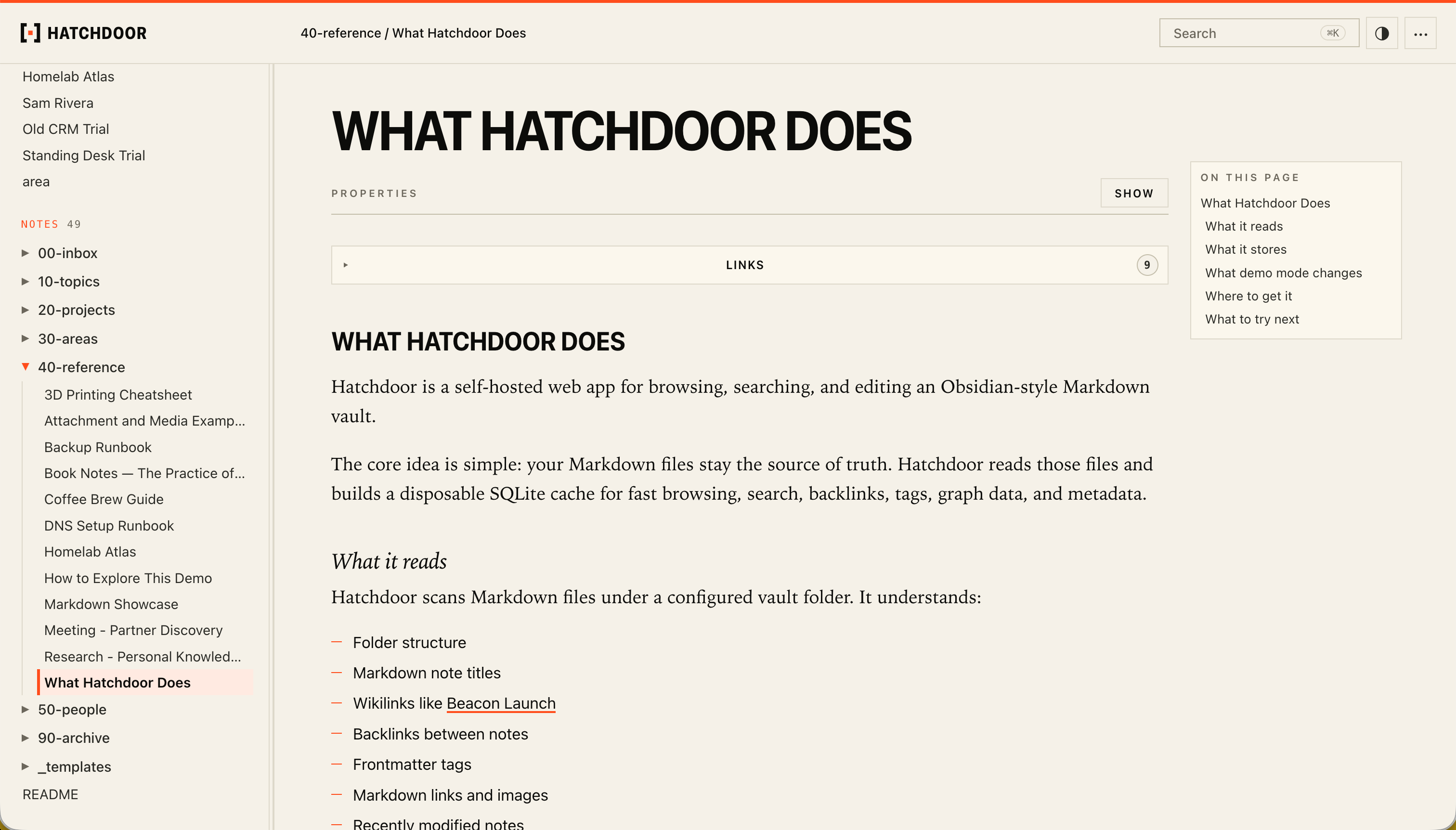
▶ Try the live demo, a read-only public vault.
Contents- What You Get
- Screenshots
- Who It Is For
- Quick Start With Docker
- Data And Safety Model
- Permissions
- Configuration
- Using Hatchdoor
- MCP Agent Access
- Git Sync
- Running Without Docker
- Troubleshooting
- API Reference
- Security Notes
- Development
- Project Docs
- License
What You Get
- A web UI for browsing folders and Markdown notes.
- Clean note URLs at
/n/:slug. - Obsidian-style wikilinks for
[[Note]],[[Folder/Note]], and[[Note|Alias]]. - Markdown rendering with GitHub-flavored Markdown, math, Mermaid diagrams,
frontmatter, images, attachments, and broken-link styling. - Keyword search and semantic search.
- Recent notes, backlinks, outbound links, stats, and graph views.
- Browser write support when the vault mount is writable.
- Attachment uploads, local asset serving, and inline previews for linked PDF
vault assets. - A first-class MCP server so AI agents can read, search, create, edit, and link
notes with the same safety as the UI. - Optional automatic git commits and pushes for Hatchdoor writes.
- PWA assets and service worker caching for common read paths.
- Distroless, rootless container image (no shell, runs as
nonroot) that
deploys with either Docker or Podman.
Screenshots
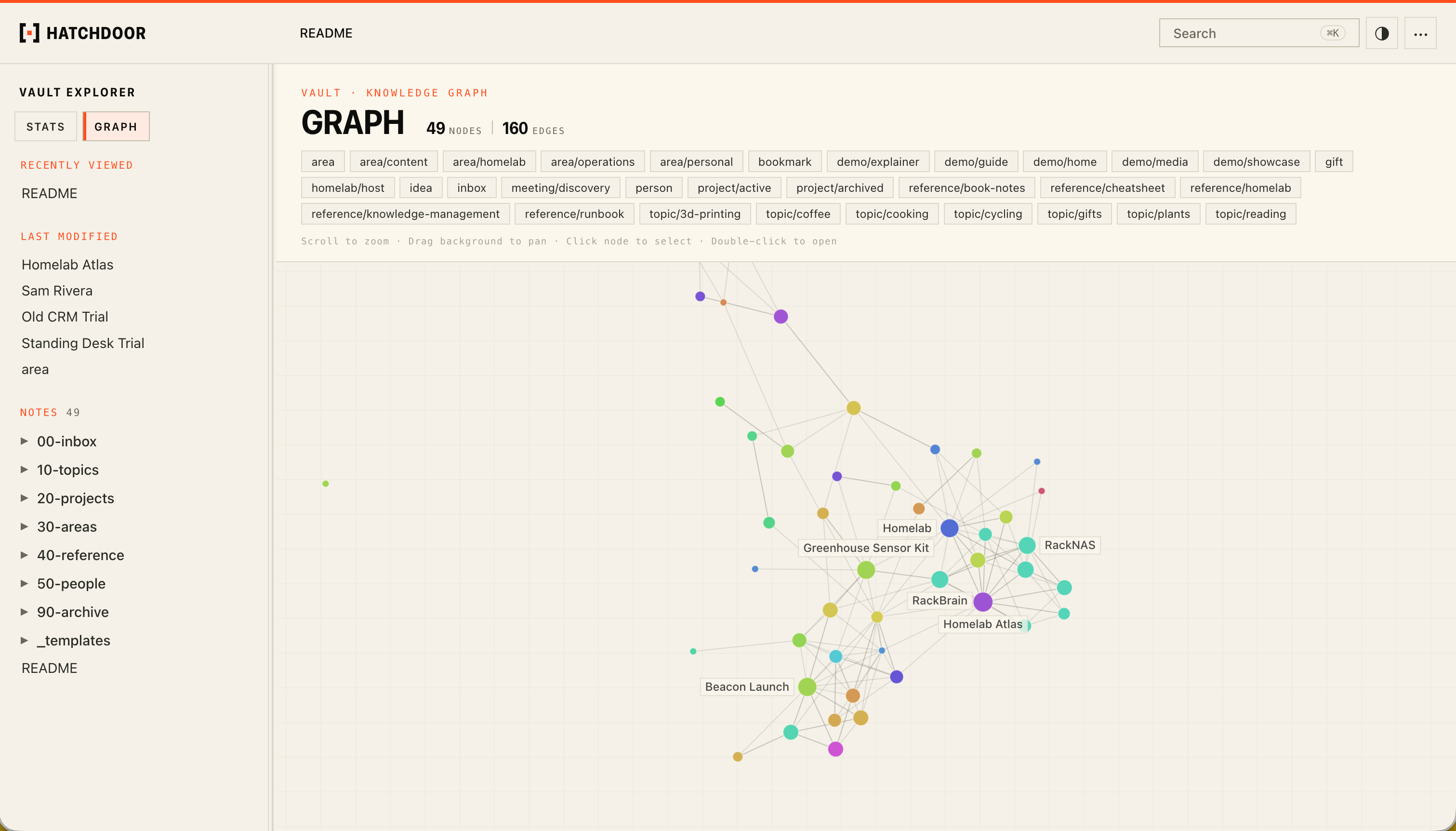
Knowledge graph: notes, links, and tags |
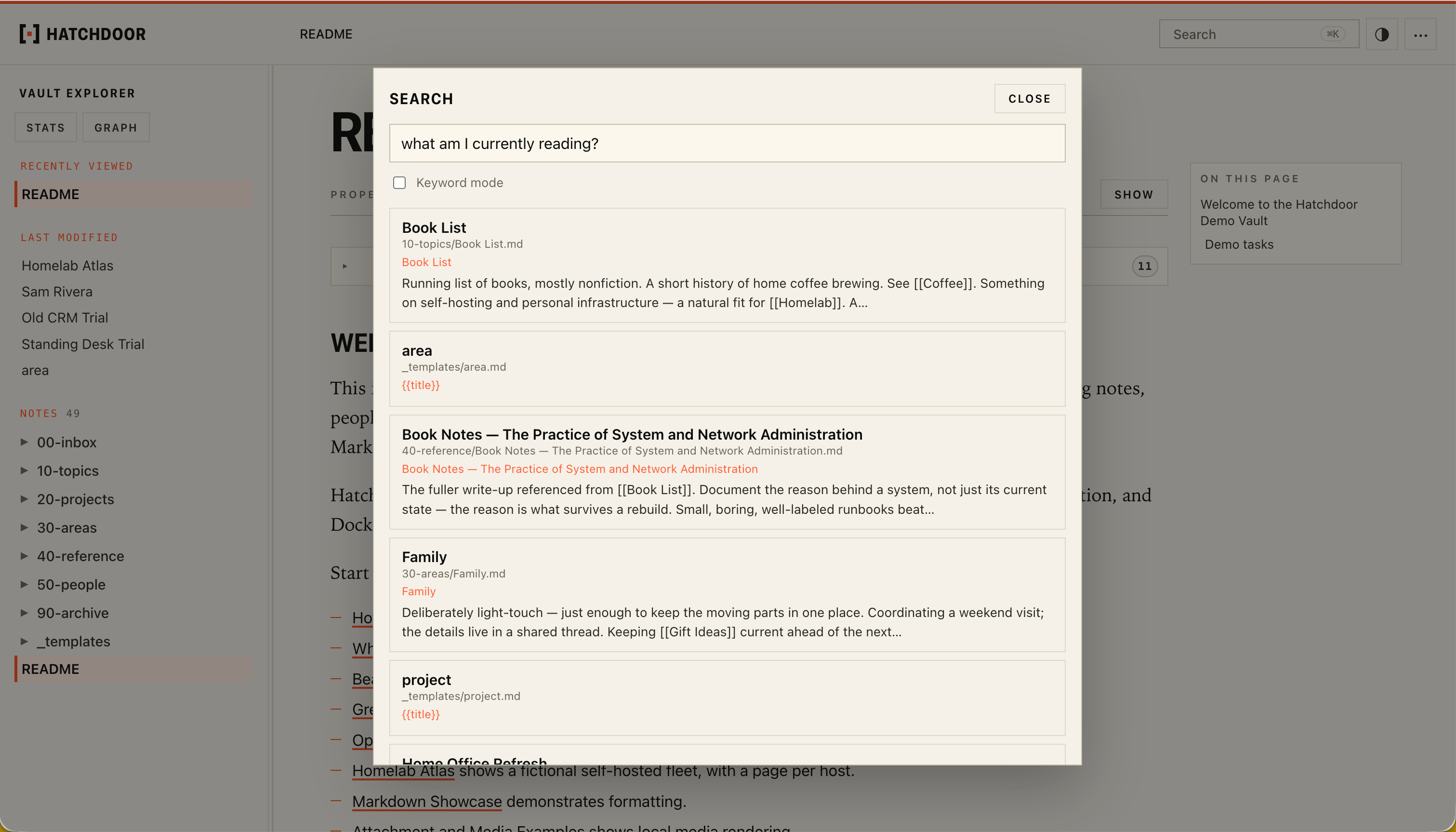
Semantic + keyword search |
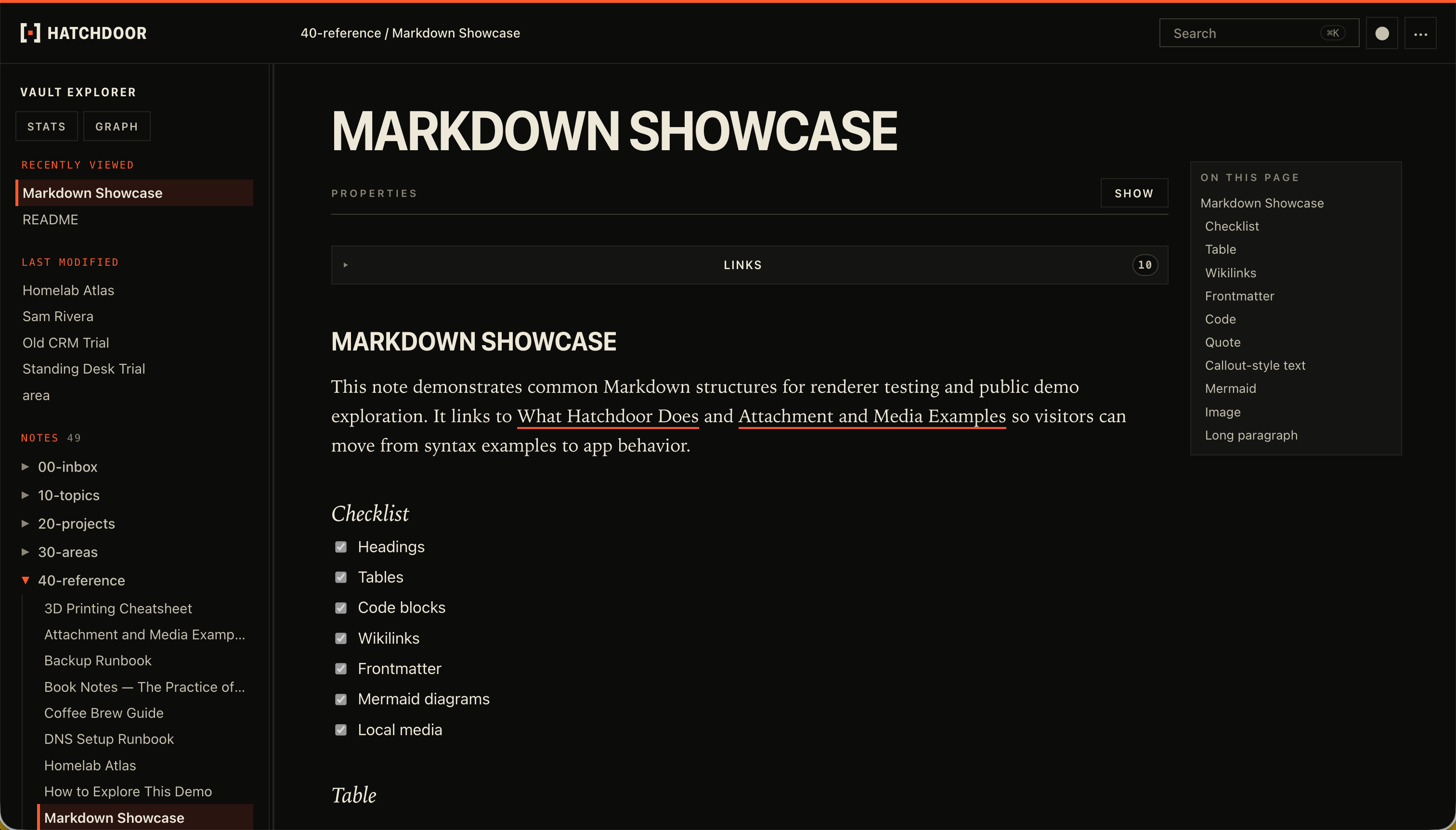
Dark mode |
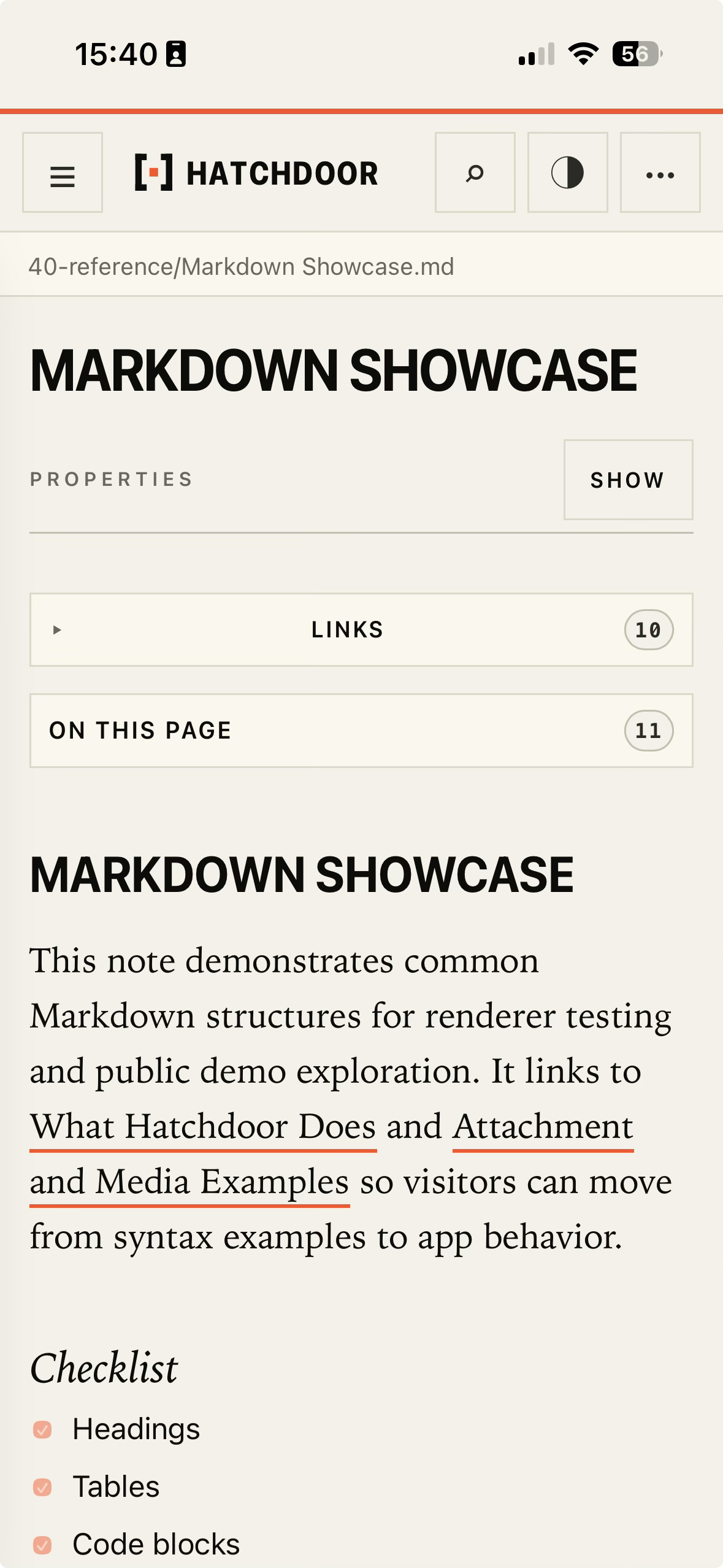
Responsive & installable (PWA) |
Who It Is For
Hatchdoor is useful if you have a folder of Markdown notes and want a private
web interface for them.
It is beginner-friendly enough to run with Docker Compose, but it also includes
advanced features for people who want agent access, git-backed vault sync,
semantic search, and local development.
Hatchdoor is not a hosted sync service, not a multi-user collaboration platform,
and not a replacement for Obsidian. It is a self-hosted companion for a Markdown
vault you control.
Quick Start With Docker
1. Requirements
You need:
- Docker and Docker Compose (Podman and
podman composealso work) - A Markdown vault folder, or an empty folder if you want Hatchdoor to create a
starter vault
2. Create Your Config
Copy the example environment file:
cp .env.example .env
Edit .env and set at least these values:
HOST_VAULT_PATH=/absolute/path/to/your/markdown-vault
HOST_CACHE_PATH=./data/cache
HOST_MODELS_PATH=./models
HATCHDOOR_WEB_BEARER_TOKEN=choose-a-long-random-token
What these mean:
HOST_VAULT_PATHis your Markdown vault on the host machine.HOST_CACHE_PATHstores Hatchdoor's generated SQLite cache.HOST_MODELS_PATHstores downloaded search models and the local Gemma terms receipt.HATCHDOOR_WEB_BEARER_TOKENprotects your notes in the browser.
Docker Compose binds Hatchdoor to 0.0.0.0 inside the container so the
published port works. Hatchdoor refuses to start on a non-loopback bind unlessHATCHDOOR_WEB_BEARER_TOKEN is set, except in explicit read-only demo mode.
3. Start Hatchdoor
docker compose up -d
Open:
http://localhost:42824
Enter the web bearer token when prompted.
4. Choose Your Search Model
Hatchdoor images include no model weights. On the first launch, Hatchdoor asks
you to choose how semantic search is set up before it downloads anything.
- Set up Gemma is the default. EmbeddingGemma is multilingual and provides
the best search quality. Read and accept the Gemma terms in the web UI (or
through the first-run MCP setup tools); Hatchdoor then downloads the model,
scans the vault, and builds the index automatically. - Use Nomic instead declines Gemma and starts the same setup with Nomic
Embed Text v1.5. It needs no Gemma acceptance, but it is English-only and is
less suitable for multilingual vaults.
Accepting the Gemma terms only permits Hatchdoor to download and use that model.
It does not change ownership of your vault or its content, and Hatchdoor does
not send vault content anywhere. The downloaded model and the local acceptance
receipt stay in HOST_MODELS_PATH, so they persist across container restarts.
The UI and logs show download and indexing progress. Vault features remain
unavailable until setup is ready; if a model download fails, Hatchdoor presents
a retry action instead of silently changing models.
5. Container Image And Paths
The image is published on Docker Hub:
battermanz/hatchdoor:latest          # also version tags, e.g. 2.4.0
battermanz/hatchdoor:podman-latest   # for Podman users (podman-<version> too)
The runtime image is distroless and rootless. It is built ongcr.io/distroless/cc-debian13:nonroot, ships no shell or package manager, and
runs as an unprivileged nonroot user. Hatchdoor also runs unchanged under
Podman (rootless included); swap docker / docker compose for podman /podman compose.
Docker Compose mounts:
| Container path | Purpose |
|---|---|
/data/vault |
Markdown vault, source of truth |
/data/cache |
Generated SQLite cache |
/models |
Downloaded search model and local Gemma terms receipt |
Data And Safety Model
Hatchdoor is designed around a simple rule: your Markdown vault is the source of
truth.
- Markdown files live in
VAULT_PATH. - SQLite is a generated cache and can be rebuilt.
- The SQLite cache should live outside the vault.
- Hatchdoor scans
.mdfiles under the vault while excluding built-in and
configured noise paths (including.hatchdoor-trash). - Delete actions move notes and referenced assets into
.hatchdoor-trash. - Archive actions move notes under
HATCHDOOR_ARCHIVE_PREFIX. - Browser write actions are available only when the vault is writable.
- MCP is disabled by default.
- MCP requires its own bearer token whenever it is enabled.
- Git sync is disabled by default.
If VAULT_PATH contains no Markdown files, Hatchdoor creates a small starter
vault before the first index build. Existing vaults are not seeded or modified
by this startup step (the .hatchdoor-trash folder is ignored when deciding
whether a vault is empty).
The starter vault lays out a lightweight PARA-style structure with index notes
and onboarding references:
README.md
10-topics/Topics Index.md
20-projects/Projects Index.md
30-areas/Areas Index.md
40-reference/Hatchdoor — Getting Started.md
40-reference/Hatchdoor — Agent Guide.md
40-reference/Hatchdoor — Agent Skill.md
40-reference/Hatchdoor — Markdown Feature Showcase.md
40-reference/Hatchdoor — Starter Vault Organisation.md
These are ordinary notes you can edit, move, or delete like any other. The
reference notes double as onboarding docs, including a ready-to-use agent
skill template (see MCP Agent Access) for wiring an AI
agent to the vault through MCP.
Permissions
The Docker image runs as a non-root user.
For read-only browsing:
- Mount the vault read-only if you want.
- Keep the cache directory writable.
For browser writes, MCP writes, attachment uploads, or git sync:
- The vault mount must be writable by the container runtime user.
- The cache directory must be writable.
If Hatchdoor starts but write features are disabled, check the permissions on
your vault mount and call /api/write-capabilities from an authenticated
browser session.
Configuration
Copy .env.example to .env and adjust values.
Basic Server And Storage
| Variable | Default | Purpose |
|---|---|---|
HOST_VAULT_PATH |
./vault |
Host-side vault path for Docker Compose |
HOST_CACHE_PATH |
./data/cache |
Host-side cache directory for Docker Compose |
HOST_MODELS_PATH |
./models |
Persistent downloaded-model directory for Docker Compose |
VAULT_PATH |
/data/vault |
Runtime vault path read by Hatchdoor |
HATCHDOOR_CACHE_DB |
/data/cache/hatchdoor-cache.sqlite3 |
Runtime SQLite cache file |
HOST |
127.0.0.1 |
Bind host for local cargo run |
PORT |
42824 |
HTTP port |
RUST_LOG |
hatchdoor=info,tower_http=info,axum::rejection=warn |
Backend logging filter |
Web Authentication
| Variable | Default | Purpose |
|---|---|---|
HATCHDOOR_WEB_BEARER_TOKEN |
empty | Protects /api/*, /vault-assets/*, and note downloads |
HATCHDOOR_DEMO_MODE |
false |
Allows unauthenticated public browsing while disabling Hatchdoor write features |
When this token is set, protected requests must send:
Authorization: Bearer <token>
The bundled PWA stores the token locally after a 401 response and attaches it
to API calls. For image, download, and server-sent-event URLs where headers
cannot be set, the frontend appends an access_token query parameter.
Hatchdoor refuses to start with HOST=0.0.0.0 or another non-loopback bind
unless HATCHDOOR_WEB_BEARER_TOKEN is set.
For a public test instance that people can browse without credentials, use demo
mode:
HOST=0.0.0.0
HATCHDOOR_DEMO_MODE=true
HATCHDOOR_WEB_BEARER_TOKEN=
HATCHDOOR_MCP_ENABLED=false
HATCHDOOR_GIT_SYNC_ENABLED=false
Demo mode is intentionally read-only. It disables browser write operations and
the manual /api/refresh reindex, reports writes as unavailable through/api/write-capabilities, and refuses to start if MCP or automatic git sync are
enabled.
Demo mode does not rate-limit requests. Search computes an embedding per query
and note downloads bundle attachments in memory, so an anonymous visitor can
generate real CPU and memory load. Put a public demo behind a rate-limiting
reverse proxy (e.g. nginx limit_req, Caddy rate_limit, or TraefikrateLimit middleware) before exposing it to the internet.
Vault Behavior
| Variable | Default | Purpose |
|---|---|---|
HATCHDOOR_ARCHIVE_PREFIX |
90-archive/ |
Vault-relative folder prefix used by archive actions and archived-link styling |
HATCHDOOR_EXCLUDE |
empty | Comma-separated gitignore-style paths to omit from indexing, appended after the built-in noise rules |
HATCHDOOR_EMBED_LAYERS |
true |
Set to false to keep demoted layers keyword-searchable but skip their vector embeddings |
Using Hatchdoor
Browsing
Hatchdoor builds a folder explorer from your vault folders and Markdown files.
The UI root is named Vault. Folder names come directly from your filesystem;
Hatchdoor does not require a PARA, Zettelkasten, or numbered folder scheme.
Vault Layers And Exclusions
A folder can place its notes on a named, demoted layer by adding a.hatchdoor-layer file. The smallest useful marker is a YAML scalar:
# sources/.hatchdoor-layer
sources
Every Markdown note below sources/ is then assigned to the sources layer.
It is absent from the browser tree, browser search, and other default-surface
results, while remaining available to trusted MCP clients that explicitly select
that layer. A mapping marker can add an operator-facing description:
name: sources
description: Ground-truth clips and reference material.
Nested markers override their parent. Use name: default in a nested folder to
bring that subtree back to the default surface. Named markers cannot live at the
vault root, and default, all, noise, and none cannot be layer names.
MCP read and search tools default to the default surface. Passlayers: ["sources"] to select one named layer, layers: ["default", "sources"] to include both, or layers: ["all"] for every layer. get_note
can fetch a known note by slug or vault-relative path regardless of its layer.
The browser intentionally has no layer selector.
Noise patterns prevent files from entering the index. Hatchdoor always excludes.obsidian/, .trash/, .hatchdoor-trash/, .DS_Store, *.tmp, and*.sync-conflict-*; .hatchdoor-layer files are always read even if a broad
pattern would otherwise match them. Add deployment-specific patterns with a
comma-separated environment value:
HATCHDOOR_EXCLUDE=imports/,*.bak
Patterns use gitignore syntax and are applied after the built-ins, so a leading! can reinstate a default pattern when needed:
HATCHDOOR_EXCLUDE=!*.sync-conflict-*
Writes to an excluded target are refused rather than creating a file that the
index would hide. Marker changes trigger a full reindex; if a malformed marker
causes startup indexing to fail, correcting it lets the vault watcher recover
without restarting the server.
To inspect the active rules, markers, layer counts, and conflicts, callGET /api/diagnostics (optionally ?path=sources/Clip.md) or the MCPlayer_diagnostics tool. Diagnostics are disabled in demo mode because they can
reveal demoted paths.
Note URLs And Links
Note slugs are generated from Markdown filenames. Duplicate filenames receive
unique suffixes so routes remain stable.
Supported wikilinks include:
[[Note]]
[[Folder/Note]]
[[Note|Alias]]
Hatchdoor resolves links, backlinks, headings, tags, graph data, and broken-link
state into the SQLite cache.
Search
Hatchdoor stores:
- Full Markdown content
- File metadata
- Tags and headings
- Wikilinks and backlinks
- FTS5 keyword search data
- sqlite-vec semantic vectors
A recursive vault watcher refreshes the cache after Markdown or asset changes.
Browser clients subscribe to /api/vault-events and reload visible data after a
refreshed revision is broadcast.
Manual Cache Rebuild
If you want to rebuild the cache from scratch:
rm ./data/cache/hatchdoor-cache.sqlite3
docker compose restart hatchdoor
Adjust the path if you changed HOST_CACHE_PATH.
MCP Agent Access
The embedded MCP endpoint is disabled by default. Enable it only for trusted
clients.
MCP requires a bearer token even in read-only mode because /mcp bypasses the
web auth layer and can expose the full vault.
HATCHDOOR_MCP_ENABLED=true
HATCHDOOR_MCP_BEARER_TOKEN=change-me
Enable write tools separately:
HATCHDOOR_MCP_WRITE_ENABLED=true
Register the endpoint with a Streamable HTTP MCP client:
http://127.0.0.1:42824/mcp
Send:
Authorization: Bearer <token>
MCP Metadata Queries
search_notes accepts optional exact metadata filters alongside semantic or
keyword retrieval. Filters support all-of exact tag matching, hierarchical tag
prefixes (a topic/selfhosting prefix also matches topic/selfhosting/immich),
a vault-relative path prefix, required property names, and typed property equality. Search results
always include normalized tags and aliases; use include_properties to return
only the frontmatter fields the agent needs.
Use query_notes when metadata completely defines the request and there is no
meaningful content query—for example, listing every note tagged type/device
with status: active. It requires at least one filter and returns note summaries
rather than repeated chunks. get_note returns the complete normalized metadata
object for a single note.
Date values are currently exposed as frontmatter values and support exact
matching. Date ranges and a broader Dataview-style query language are not part
of the 2.3.0 metadata filter contract.
Agent Skill
Hatchdoor ships with a ready-to-use agent skill for driving the vault
through MCP. When Hatchdoor seeds a starter vault it writes the template to40-reference/Hatchdoor — Agent Skill.md; the source also lives atdocs/starter-vault/40-reference/Hatchdoor — Agent Skill.md.
Copy its hatchdoor-vault skill block into your agent's skills directory to
teach the agent Hatchdoor's conventions: search before editing, pass the
returned content hash on writes, prefer small edits, and let Hatchdoor manage
backlinks, moves, and git sync.
Attachment Upload
Agents and the web UI upload attachments directly — no shared staging folder to
mount. Two paths cover the size/compatibility trade-off:
POST /api/attachment(multipart) — the default. Used by the web UI and
by any agent that can make an HTTP request (e.g. shell out tocurl).
Accepts either the web bearer token or the MCP bearer token, so an MCP agent
can reuse its existing credential. Capped byHATCHDOOR_MAX_ATTACHMENT_BYTES
(default 10 MiB).import_attachmentMCP tool — the fallback, for MCP clients that cannot
make an out-of-band HTTP request. Sends the file bytes base64-encoded inline;
works with any MCP client, but base64 rides inside the JSON-RPC message and
gets unreliable as files grow. Capped byHATCHDOOR_MCP_MAX_BASE64_BYTES
(default 5 MiB), measured on the decoded file.
HATCHDOOR_MCP_MAX_BASE64_BYTES=5242880
HATCHDOOR_MAX_ATTACHMENT_BYTES=10485760
Agents can call get_attachment_import_config to discover both methods, their
size limits, and which to use.
Git Sync
Git sync is optional and disabled by default. When enabled, successful Hatchdoor
write tools commit and push vault changes to the configured remote.
HATCHDOOR_GIT_SYNC_ENABLED=true
HATCHDOOR_GIT_REMOTE=origin
HATCHDOOR_GIT_BRANCH=main
HATCHDOOR_GIT_HTTPS_USERNAME=hatchdoor
HATCHDOOR_GIT_HTTPS_TOKEN=your-token
HATCHDOOR_GIT_DEBOUNCE_SECONDS=30
HATCHDOOR_GIT_AUTHOR_NAME=Hatchdoor
HATCHDOOR_GIT_AUTHOR_EMAIL=hatchdoor@localhost
Requirements:
- The vault directory must be a git repository root.
- The checked-out branch must match
HATCHDOOR_GIT_BRANCH. - The remote URL comes from the repository's existing remote config.
- Authentication uses HTTPS username/token credentials.
- Merge conflicts are kept for human resolution on the server.
Use the get_git_sync_status MCP tool to check whether recent writes were
committed and pushed.
Running Without Docker
Build the frontend once:
cd frontend
npm ci
npm run build
cd ..
Run the backend:
cargo run
By default, local source runs bind to 127.0.0.1:42824 and read ./vault.
Point Hatchdoor at a real vault with:
VAULT_PATH=/path/to/notes cargo run
For frontend dev mode:
# terminal 1
cargo run

# terminal 2
cd frontend
npm run dev
The first-run model choice also applies to local development. Hatchdoor stores
models in ./models by default, so no model-prefetch command is required.
Troubleshooting
Hatchdoor refuses to start on 0.0.0.0
Set HATCHDOOR_WEB_BEARER_TOKEN, bind to 127.0.0.1, or enableHATCHDOOR_DEMO_MODE=true for a read-only public demo.
This is intentional. A non-loopback bind can expose your vault to the network,
so Hatchdoor requires web authentication unless demo mode has disabled the app's
write surfaces.
Docker starts, but the UI cannot write
Check that the mounted vault directory is writable by the container runtime
user. Browser write support depends on filesystem permissions.
Cache errors or stale data
Delete the generated SQLite cache and restart:
rm ./data/cache/hatchdoor-cache.sqlite3
docker compose restart hatchdoor
The app starts with a starter vault
Hatchdoor seeds starter notes only when VAULT_PATH contains no Markdown files.
If you expected an existing vault, this almost always means the container
mounted an empty directory, so double-check that HOST_VAULT_PATH in .env
resolves to your actual vault and isn't a typo or a stale Docker volume
shadowing the mount.
For the full list of notes Hatchdoor creates, see
Data And Safety Model.
MCP returns 401 or 403
Check:
HATCHDOOR_MCP_ENABLED=trueHATCHDOOR_MCP_BEARER_TOKENis set- The client sends
Authorization: Bearer <token> - Browser-originated MCP requests come from an allowed origin in
HATCHDOOR_MCP_ALLOWED_ORIGINS
Git sync does not push
Check:
- The vault is a git repository root.
- The current branch matches
HATCHDOOR_GIT_BRANCH. - The remote exists in the repo config.
- The HTTPS token can push.
- There are no merge conflicts waiting for manual resolution.
API Reference
Common routes:
| Method | Path | Purpose |
|---|---|---|
GET |
/health |
Health check |
GET |
/api/tree |
Folder and note tree |
GET |
/api/recently-modified |
Recently modified notes |
GET |
/api/note/:slug |
Read a note |
GET |
/api/note/:slug/links |
Outbound links and backlinks |
GET |
/api/note/:slug/download |
Download a Markdown export |
GET |
/api/resolve?target=... |
Resolve one wikilink target |
POST |
/api/resolve-batch |
Resolve multiple wikilink targets |
GET |
/api/search?q=... |
Search notes |
GET |
/api/stats |
Vault stats |
GET |
/api/graph |
Graph data |
GET |
/api/diagnostics |
Inspect layer and noise-exclusion diagnostics |
POST |
/api/refresh |
Trigger cache refresh |
GET |
/api/vault-events |
Server-sent vault revision events |
GET |
/api/write-capabilities |
Check write availability |
POST |
/api/note |
Create a note |
PUT |
/api/note/:slug |
Update a note |
PATCH |
/api/note/:slug/rename |
Rename a note |
PATCH |
/api/note/:slug/move |
Move a note |
PATCH |
/api/note/:slug/archive |
Archive a note |
PATCH |
/api/note/:slug/move-rename |
Move and rename a note |
DELETE |
/api/note/:slug |
Move a note to trash |
POST |
/api/attachment |
Upload an attachment |
GET |
/vault-assets/*path |
Serve vault assets |
POST |
/mcp |
Streamable HTTP MCP endpoint |
Security Notes
- Use a long random
HATCHDOOR_WEB_BEARER_TOKEN. - Do not expose Hatchdoor publicly without HTTPS in front of it.
- Use
HATCHDOOR_DEMO_MODE=trueonly for browse-only public test instances. - Keep MCP disabled unless you need it.
- Treat MCP write mode as powerful: it can create, edit, move, delete, and
import content. - Keep the SQLite cache outside the vault.
- Keep
.envout of git. - Review Docker volume paths before starting the container.
Development
Backend checks:
cargo fmt --check
CARGO_BUILD_JOBS=1 cargo clippy --all-targets -- -D warnings
CARGO_BUILD_JOBS=1 cargo test
Frontend checks:
cd frontend
npm run format:check
npm run typecheck
npm run lint
npm test
npm run build
Build and publish the Docker image:
docker build -t battermanz/hatchdoor:latest .
docker tag battermanz/hatchdoor:latest battermanz/hatchdoor:2.4.0
docker push battermanz/hatchdoor:2.4.0
docker push battermanz/hatchdoor:latest
Project Docs
- Documentation index: architecture, collaboration, roadmap,
research, maintenance, and historical records. - Product roadmap: draft overall product direction
and the workstreams it breaks into. - Design system: visual tokens, component patterns,
layout rules, and interaction states used by the frontend. - Semantic search strategy: decision
record for shipping pure semantic search instead of hybrid retrieval or a
cross-encoder reranker in the runtime path.
License
Hatchdoor is licensed under the GNU Affero General Public License v3.0 only.
See LICENSE.
Reviews (0)
Sign in to leave a review.
Leave a reviewNo results found