archeus
Health Uyari
- License — License: MIT
- Description — Repository has a description
- Active repo — Last push 0 days ago
- Low visibility — Only 9 GitHub stars
Code Gecti
- Code scan — Scanned 12 files during light audit, no dangerous patterns found
Permissions Gecti
- Permissions — No dangerous permissions requested
Bu listing icin henuz AI raporu yok.
The workspace layer for Claude Code — browse every session, persistent project memory, MCP awareness, and per-project launch control. Terminal UI and desktop GUI. Zero runtime dependencies.
archeus
Formerly claudectl. Everything migrates on first run —
settings, memory graphs and per-project state. Nothing is deleted.
The workspace layer for Claude Code.
Your projects stop being a stream of chats and start being workspaces —
with memory, history, and per-project launch control.


-brightgreen)



🌐 claudectl.space
·
📖 Full documentation → docs.claudectl.space
Everything below is the short version. Every feature, key binding and file is
documented in detail on the docs site.
PyPI ·
Blog ·
FAQ ·
LinkedIn ·
dev.to
Not the Rust archeus. Two independent projects share this name;
this one is the Python workspace layer for Claude Code.
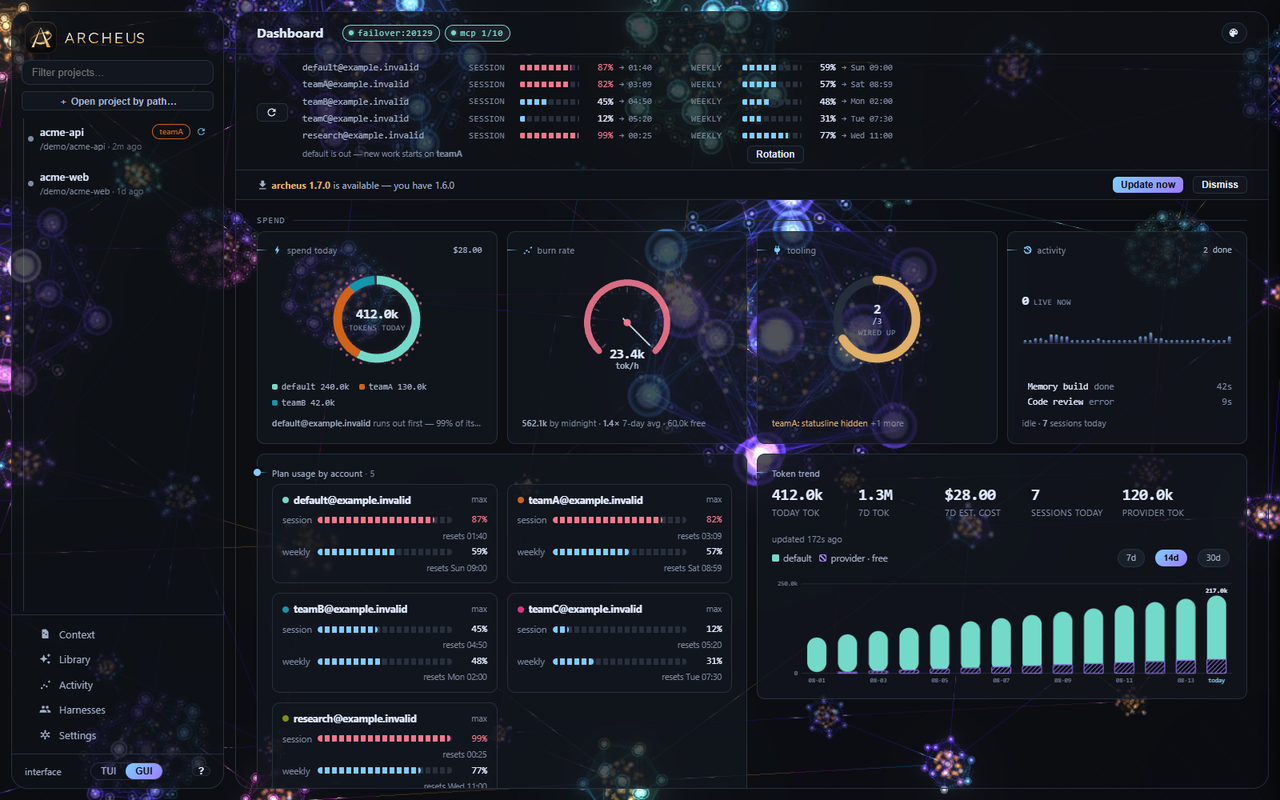
What problem does this solve?
Claude Code is excellent inside a session and forgetful between them. Every new
session starts from nothing, your old sessions are hard to find, and the only
way to give the agent context is a CLAUDE.md that grows until it costs more
than it's worth.
archeus sits in front of Claude Code and fixes that. Pick a project, see
every session you've ever had in it, and launch with the model, effort,
permissions and context you meant. Underneath, it maintains a semantic memory
of the codebase and injects only the part relevant to what you just asked.
It is a terminal UI and a desktop GUI over the same engine — use whichever you
prefer, they do the same things.
Quickstart
pipx install archeus     # or: pip install archeus
archeus
There is nothing to build and no dependencies to install. To run it from a
checkout instead:
git clone https://github.com/babarmuhammad/archeus.git
cd archeus
python claude-sessions.py          # terminal UI
python claude-sessions.py --gui    # desktop GUI
Requires Python 3.10+ and the
Claude Code CLI (auto-detected on
PATH or at ~/.local/bin/). No API key — it uses the Claude Code auth you
already have. No third-party packages.
It also ships as a Claude Code plugin, if you'd rather stay inside the session:
/plugin marketplace add babarmuhammad/archeus
/plugin install archeus@archeus
What it looks like
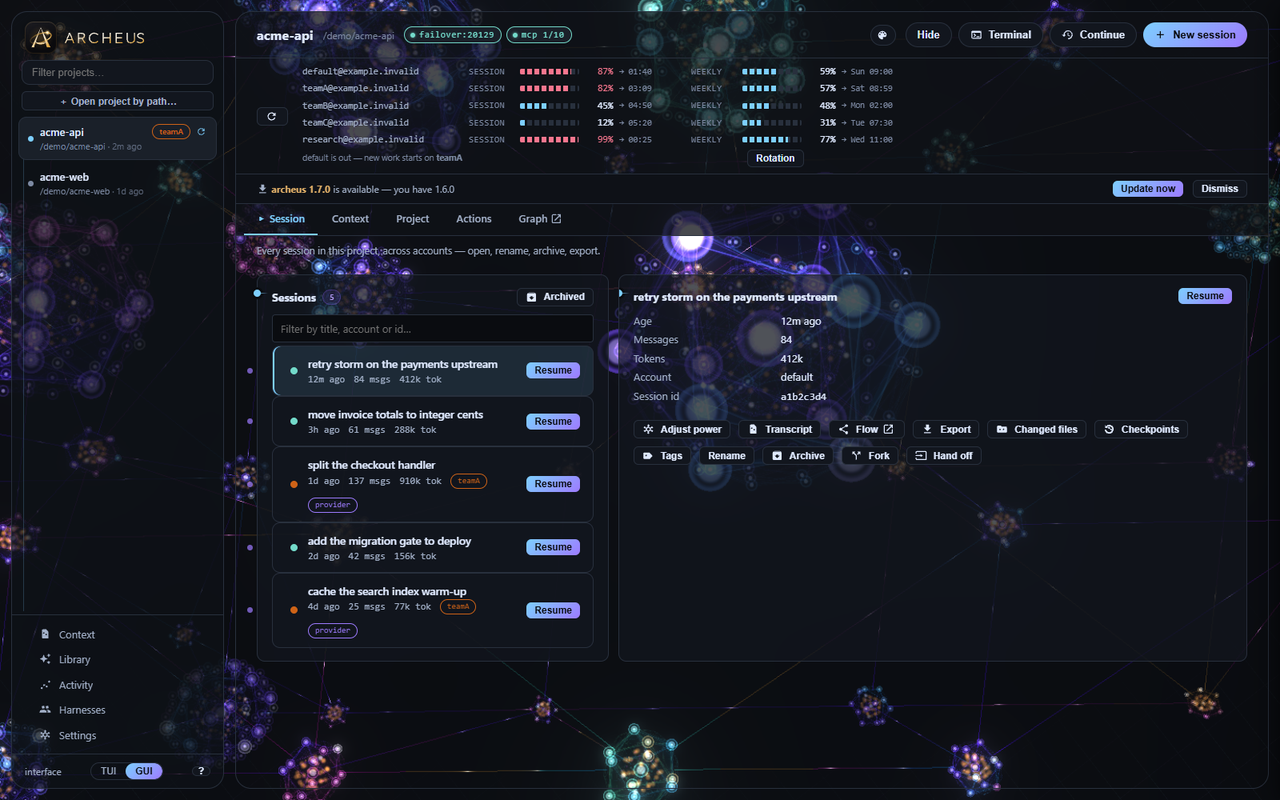 Every session, every project. Search, tag, fork, resume, archive, export — across multiple Claude accounts at once. |
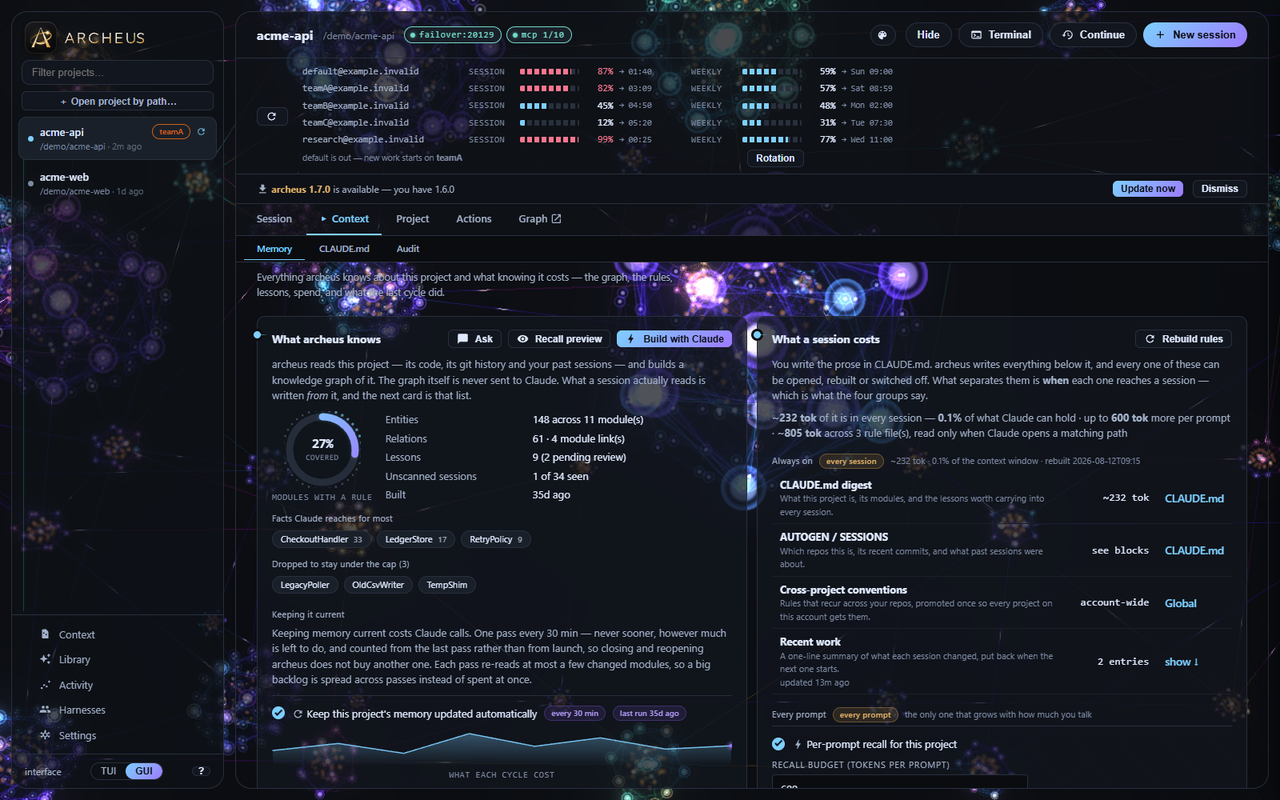 Memory Claude built about your code. Entities, relations and lessons, with the token cost of every block shown before you spend it. |
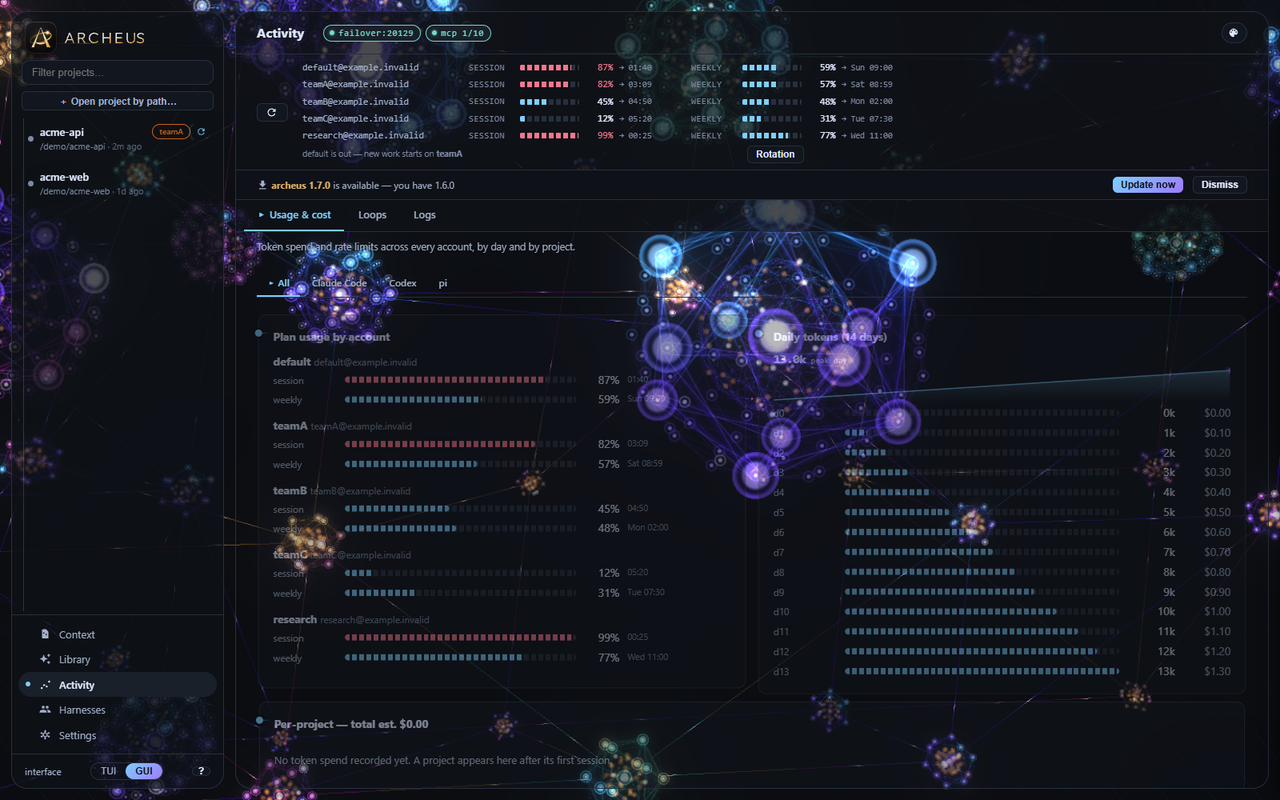 Where the tokens went. Per day, per project, per account, per model — read from your own transcripts, not an API. |
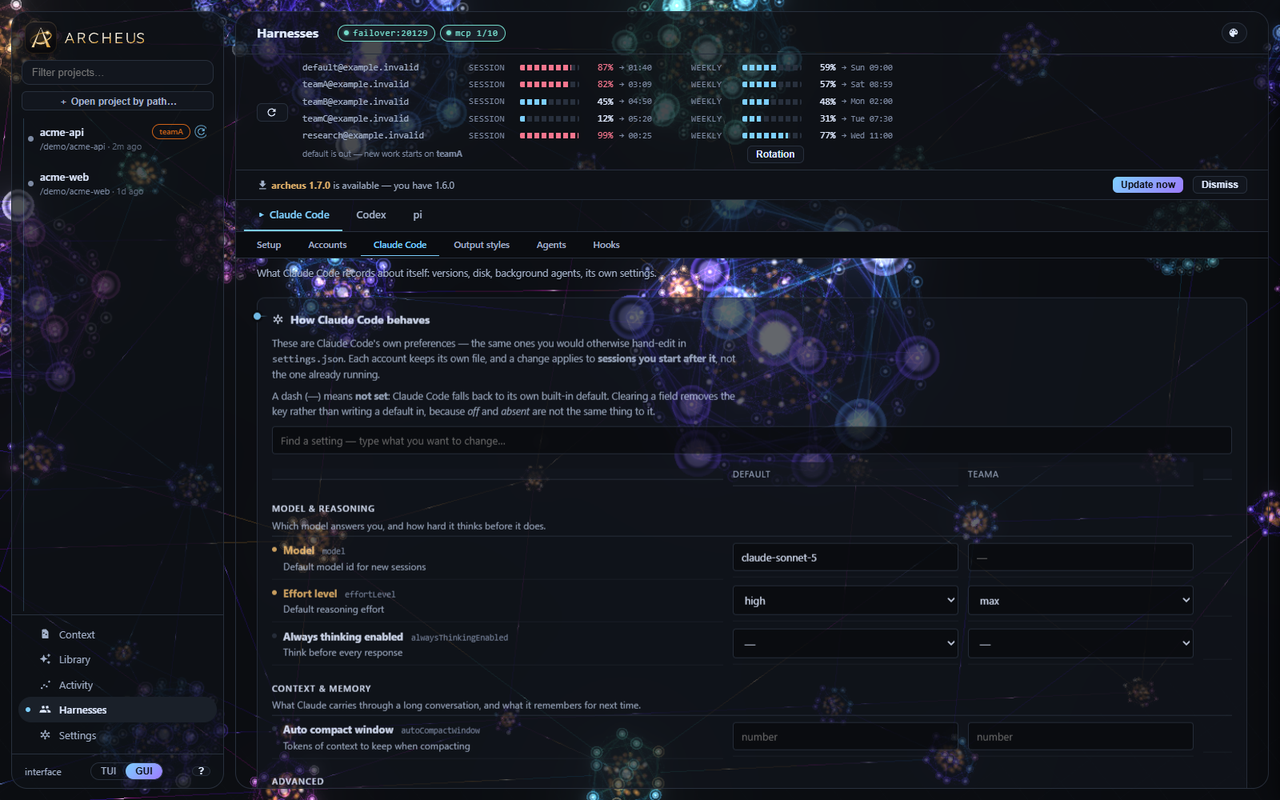 Claude Code itself, made visible. Which skills and plugins you actually use, what is on disk, and a typed editor for every account's settings. |
The terminal UI is the same tool, keyboard-first:
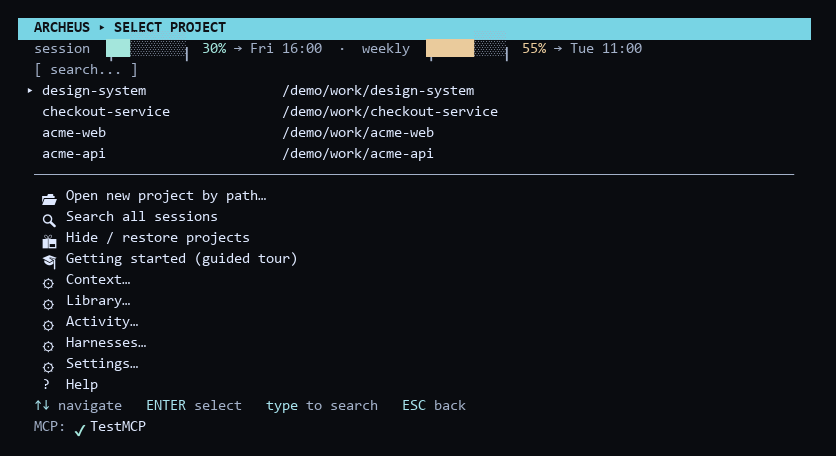
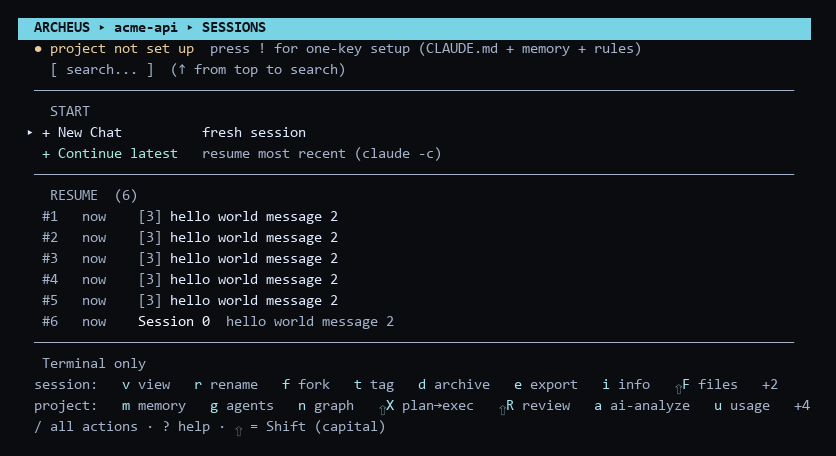

The architecture graph — every module and its dependencies,
expandable down to single files (Python · C/C++ · C# · JS/TS).
Also: 32 palettes, 8 skins and 4 themed worlds — a skin changes the shape of the app,
not just its colours.
See them →
Why archeus
- 🧠 Intelligent memory, not a memory dump — task-scoped, token-budgeted injection at the launcher: a micro-index always on (≤250 tok), per-module detail loaded only when Claude touches those files, and an optional per-prompt hook that injects just the subgraph relevant to what you asked.
- 📚 It learns from every session — durable lessons (fixes, decisions, preferences) distilled from transcripts, human-reviewed, injected when relevant, decayed when stale.
- 🕸️ See your architecture — an animated, expandable dependency graph that opens at the project level and drills down to single files.
- 🩺 Auto-solves common Claude Code pain — pre-launch health checks, context-loss insurance after
/compact, permission-fatigue killer, token-burn advisor, daily usage tracking. - 🤖 Adaptive agents — the right subagents suggested (or auto-applied) per project from local signals.
- 📦 Workspace, not chats — browse, search, tag, fork, resume and archive every Claude Code session across every project and account.
- ⚡ Zero runtime dependencies — pure Python standard library; uses your existing Claude Code auth.
How archeus saves tokens
Without archeus, a big project either starves the agent (no context) or floods it (a huge CLAUDE.md loaded every message). archeus spends the minimum tokens for the maximum relevant context:
- Flat always-on cost — the CLAUDE.md block is a ≤250-token index, not a full dump; it does not grow as the codebase grows.
- On-demand detail — per-module knowledge lives in path-scoped
.claude/rules/, so nothing is paid for until it's relevant. - Task-scoped injection — the optional prompt hook injects only the subgraph your prompt actually needs (budgeted, default ≤600 tok).
- No stale weight — superseded facts are invalidated, dead entities evicted.
- Cheaper model for the grunt work — Plan→Execute runs the expensive model once for the plan and a cheap (or free) one for execution.
Documentation
The full manual lives at docs.claudectl.space.
| Getting started | what it is, the three surfaces, where to go next |
| Installation | pipx, pip, checkout, plugin, GUI window, Windows shortcuts |
| Quickstart | install to first session in five minutes |
| Command line | every command, for scripts and hooks |
| Terminal UI | every screen and every key binding |
| Desktop app | the same workspace as a local app, plus the theme system |
| Configuration | every file archeus reads and writes, and where |
| Project memory | the three injection surfaces, lessons, recall |
| Architecture graph | the interactive dependency view |
| Usage & cost | measuring and cutting the per-turn cost |
| API reference | the local HTTP API the GUI is built on |
| Troubleshooting | when something does not work |
Product pages — Features ·
Compare · FAQ ·
Download ·
Changelog — are on
claudectl.space.
Credits
archeus is built on ideas from the wider Claude Code ecosystem — cognee and Aider's
repo-map behind the memory graph, Anthropic's code-review plugin behind archeus review,
claude-mem behind recent-work memory, OmniRoute behind free execution, and VoltAgent's
subagent catalog behind the agent library. Every one is credited, with links, on the
Credits page.
License
MIT — see LICENSE.
Yorumlar (0)
Yorum birakmak icin giris yap.
Yorum birakSonuc bulunamadi