castor
Health Gecti
- License — License: AGPL-3.0
- Description — Repository has a description
- Active repo — Last push 0 days ago
- Community trust — 14 GitHub stars
Code Gecti
- Code scan — Scanned 12 files during light audit, no dangerous patterns found
Permissions Gecti
- Permissions — No dangerous permissions requested
Bu listing icin henuz AI raporu yok.
The local LLM solution to cutting cloud API bills, smartly.
Castor
Keep your frontier model. Stop paying it to read files.
Castor lets Claude Code, Antigravity, and Cursor hand the grunt work (reading, grepping, editing, running tests) to a model on your own GPU.
The cloud model still does the thinking. Your cloud bill drops to almost nothing.




npx -y mcp-castor install --client all
One command. Registers with every MCP client it finds. No config file needed.
Where your tokens actually go
Watch a cloud coding agent work and you'll see that most of what you pay for isn't thinking. It's the agent reading 20 files, grepping, running cargo test, and reading the logs. Then every one of those outputs gets sent again and billed again on every later turn.
Castor splits the job in two:
| Cloud-only agent | With Castor | |
|---|---|---|
| Planning & architecture | Frontier model | Frontier model (unchanged) |
| Reading, grepping, editing, testing | Frontier model, billed per token, every turn | Your local GPU, $0 in tokens |
| What reaches the cloud | Every raw log and file dump | Only the short, verified result |
| Cloud context window | Fills up with terminal noise | Stays clean |
You keep frontier-quality planning. You stop paying frontier prices for
catandgrep.
The receipts
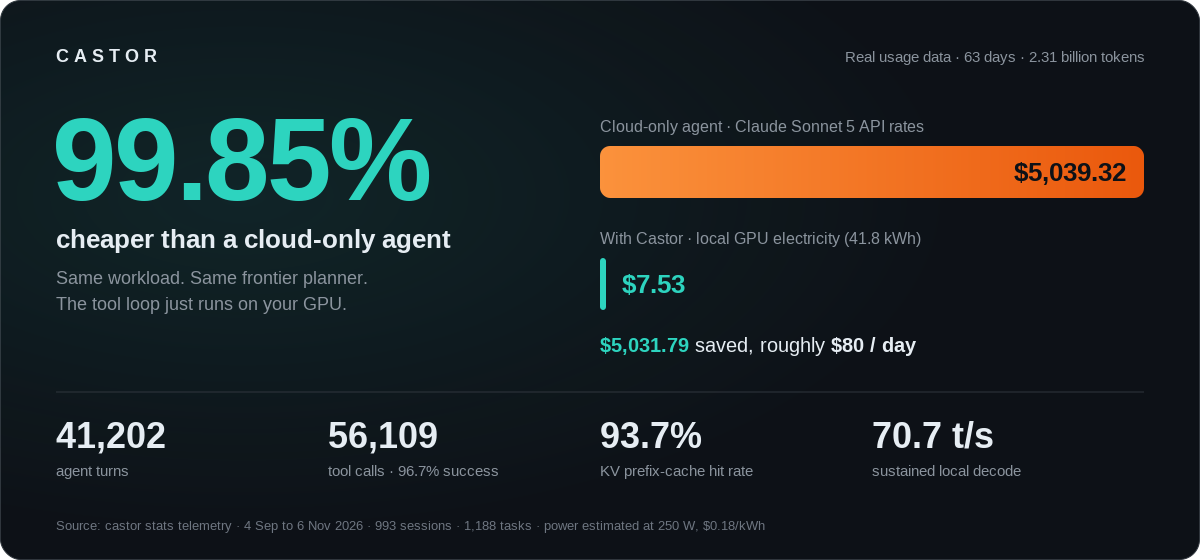
These numbers come straight from castor stats on a real workstation, from 4 Sep to 6 Nov 2026. They are not projections.
| $5,039.32 | what the same workload would have cost at Claude Sonnet 5 API rates |
| $7.53 | what it actually cost: 41.8 kWh of GPU electricity |
| $5,031.79 | saved in 63 days, a 99.85% margin |
| 2.31 B | tokens processed locally instead of billed |
| 41,202 | agent turns across 993 sessions |
| 96.7% | tool-call success rate across 56,109 calls |
| 93.7% | KV prefix-cache hit rate, so repeated context stays warm |
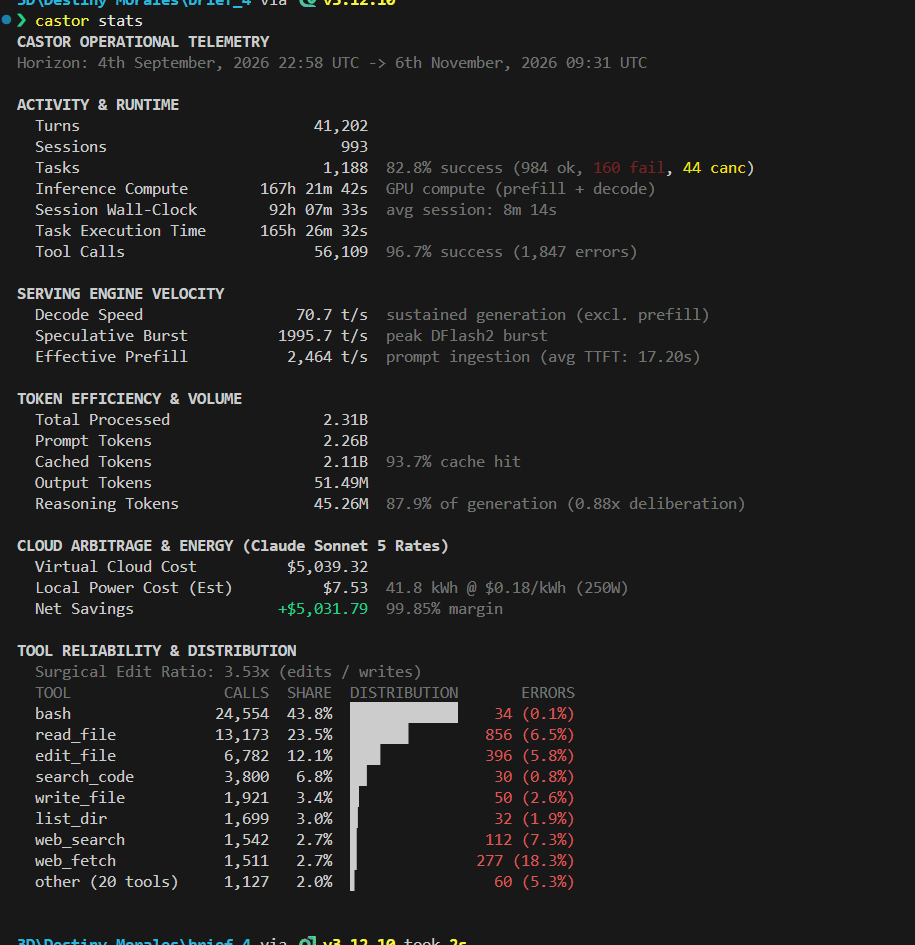
Run castor stats yourself and you'll get the same breakdown for your own usage.
See it work
 The cloud model plans → Castor runs the edit-and-test loop locally → a short, verified result goes back. Watch in 1080p60.
Why engineers trust it
- Built in Rust and fast. Tool calls run in-process in under 0.1 ms, with no network round trip per
grep. - Sandboxed by default. A zero-trust containment pipeline blocks path escapes, symlink tricks, and destructive shell commands before anything runs.
- Hard to wedge. A pre-flight check rejects oversized "mega-prompts". A token-budgeted scheduler keeps concurrent tasks from overloading your VRAM. A stream guard kills runaway output loops.
- No polling bill. Long tasks hand back a wait hook, so your cloud agent sleeps for $0 and wakes up the moment the work is done.
- Works with what you already run. Any OpenAI-compatible engine works, and it's auto-detected.
| Cloud clients | Local engines |
|---|---|
| Claude Code · Google Antigravity · Cursor · Claude Desktop · any MCP client | vLLM · llama.cpp · LM Studio · SGLang · Ollama · any OpenAI-compatible /v1 |
Get started in 60 seconds
1. Install
npx -y mcp-castor install --client all
2. Point it at your engine. If your engine is on the default 127.0.0.1:18020, Castor finds it automatically. If not:
export CASTOR_BASE_URL="http://127.0.0.1:1234/v1" # e.g. LM Studio
3. Ask your cloud agent as usual
"Refactor the auth middleware to use JWT and verify with
cargo testusing castor."
That's it. For engine profiles, manual MCP config, and per-engine notes, see Getting Started.
Documentation
| 🚀 Getting Started | Install, manual MCP config, engine setup, supported clients and engines |
| 🧠 Architecture | DGI firewall, zero-turn lifecycle, token-budget semaphore, stream proxy, Evo, MCP tool surface |
| 🛡️ Security | The zero-trust workspace containment pipeline |
| ⌨️ CLI & Development | Command reference, building from source, test gate |
| ⚙️ Engine Profiles · llama.cpp | Serving-engine tuning and managed llama-server |
License
AGPL-3.0 open source. Network-deployed modifications must publish their source.
Commercial dual-licensing is available for proprietary embedding without copyleft obligations. Contact [email protected].
Yorumlar (0)
Yorum birakmak icin giris yap.
Yorum birakSonuc bulunamadi